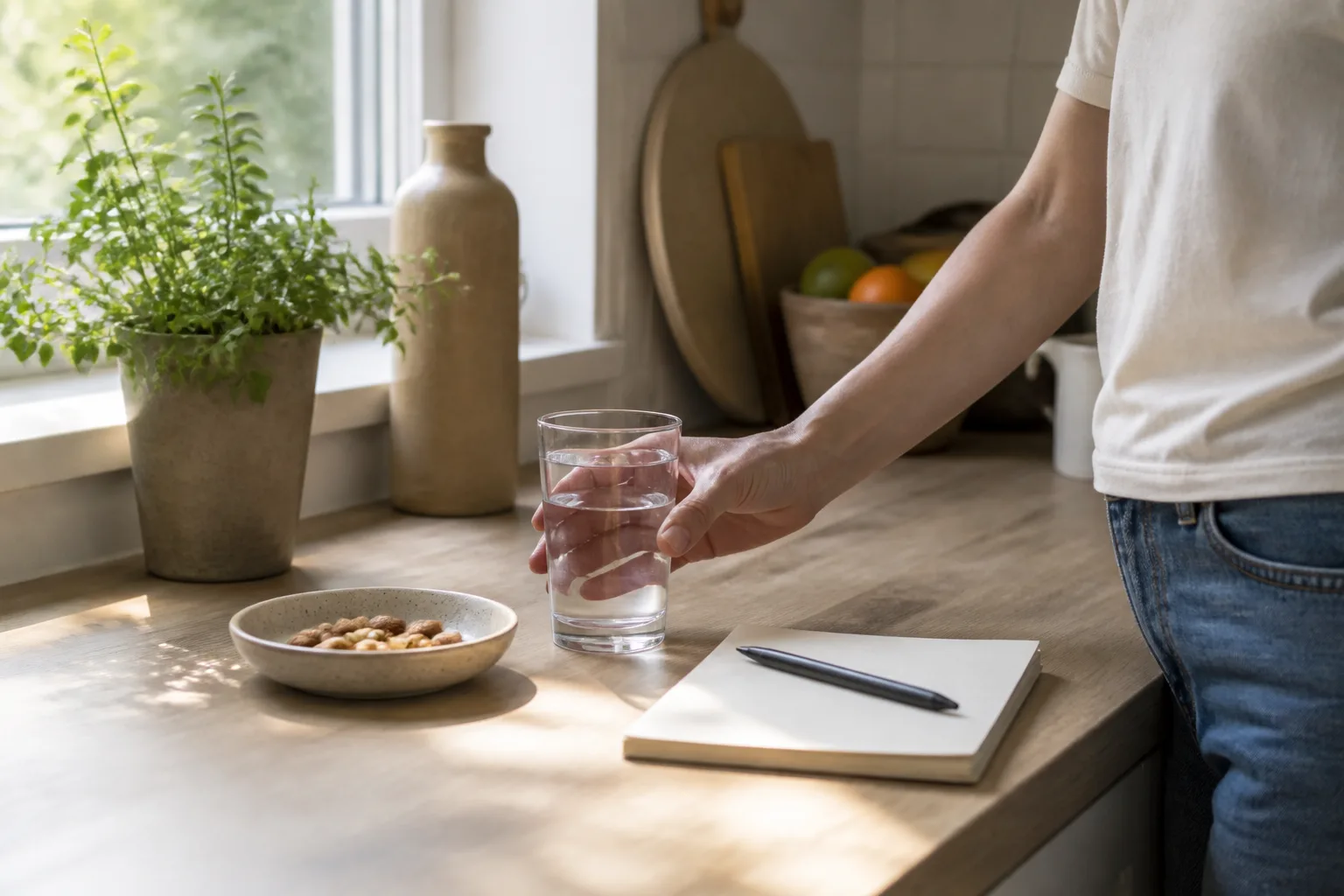
Hydration on GLP-1 can start with small drink cues that fit your actual day, not a universal number that ignores your health, routine, or food comfort.
GLP-1 medications are prescription medicines that can affect appetite, fullness, or food comfort for some people; they are not a single prescribed diet.
Here is a familiar scene. You filled the water bottle at eight in the morning with good intentions. By three in the afternoon it is still sitting on the corner of your desk, nearly full, slightly warm. You did not refuse to drink. Drinking simply never crossed your mind, because appetite cues and thirst cues both feel quieter than they used to. On a GLP-1, this happens to a lot of people, and it is not a character flaw. It is a signal problem, and signal problems respond well to small, repeatable routines.
The approach here is a rhythm of small sips tied to moments that already exist in your day. No fixed ounce target, no contest with yourself, no guilt about the full bottle. Just a structure you can actually keep.
Hydration on GLP-1 Starts With a Rhythm
Keep thirst and a target separate
Most hydration advice begins with a number. Drink this much, every day, no exceptions. That framing quietly assumes two things: that your thirst signals are reliable enough to tell you when you are behind, and that your body needs roughly the same thing every day.
On a GLP-1, the first assumption is shaky. When appetite is muted, thirst often gets muted alongside it, because in daily life the two are tangled together. You drink with meals, you drink when you snack, you drink when food makes you thirsty. Take away the eating cues, and the drinking cues quietly go with them. The bottle stays full not because you are careless, but because the ordinary triggers that used to remind you are gone.
The second assumption is shaky for everyone, GLP-1 or not. The CDC explains that water needs vary with age, sex, pregnancy, activity, and climate. A wellness graphic cannot account for your medication, health conditions, or individual guidance.
A rhythm sidesteps both problems. Instead of asking "have I hit my number yet," you ask "did I drink at my usual moments." Moments are concrete. You know when you wake up, when you eat, when you leave work, when you sit down in the evening. Attaching a small drink to moments you already have removes the need for a thirst signal you may not be getting.
The idea is deliberately modest: give yourself a handful of automatic cues so drinking happens on days when your body forgets to ask.
Why a Fixed Number Does Not Fit Everyone
A range is not a rule
It is worth slowing down on why the fixed-target approach fails, because understanding it makes the rhythm easier to trust.
First, needs genuinely differ. Activity, climate, body size, and life stage all shift how much fluid a person uses. A single number treats different days identically.
Second, food carries water. Soups, yogurt, fruit, vegetables, and other moisture-rich foods contribute to daily fluid intake, so a drinking target cannot capture the whole picture.
Third, some people have medical reasons to limit fluid, not chase more of it. Certain heart, kidney, and other conditions come with fluid restrictions set by a clinician. For those readers, "drink more" is not neutral advice — it can be actively wrong. Fluid restrictions are individual medical instructions, and they always outrank anything a general article can say. If you have been given one, that is your target, full stop.
Fourth, comfort matters. A large glass quickly, especially on an empty or queasy stomach, can feel unpleasant and make a routine harder to repeat.
Water still matters. The useful question is not only "how much" but also "how does drinking fit into my day?" Our broader GLP-1 nutrition guide takes the same position on food: the pattern matters more than any single target.
Build a Sipping Routine That Fits Your Day
Use existing moments as cues
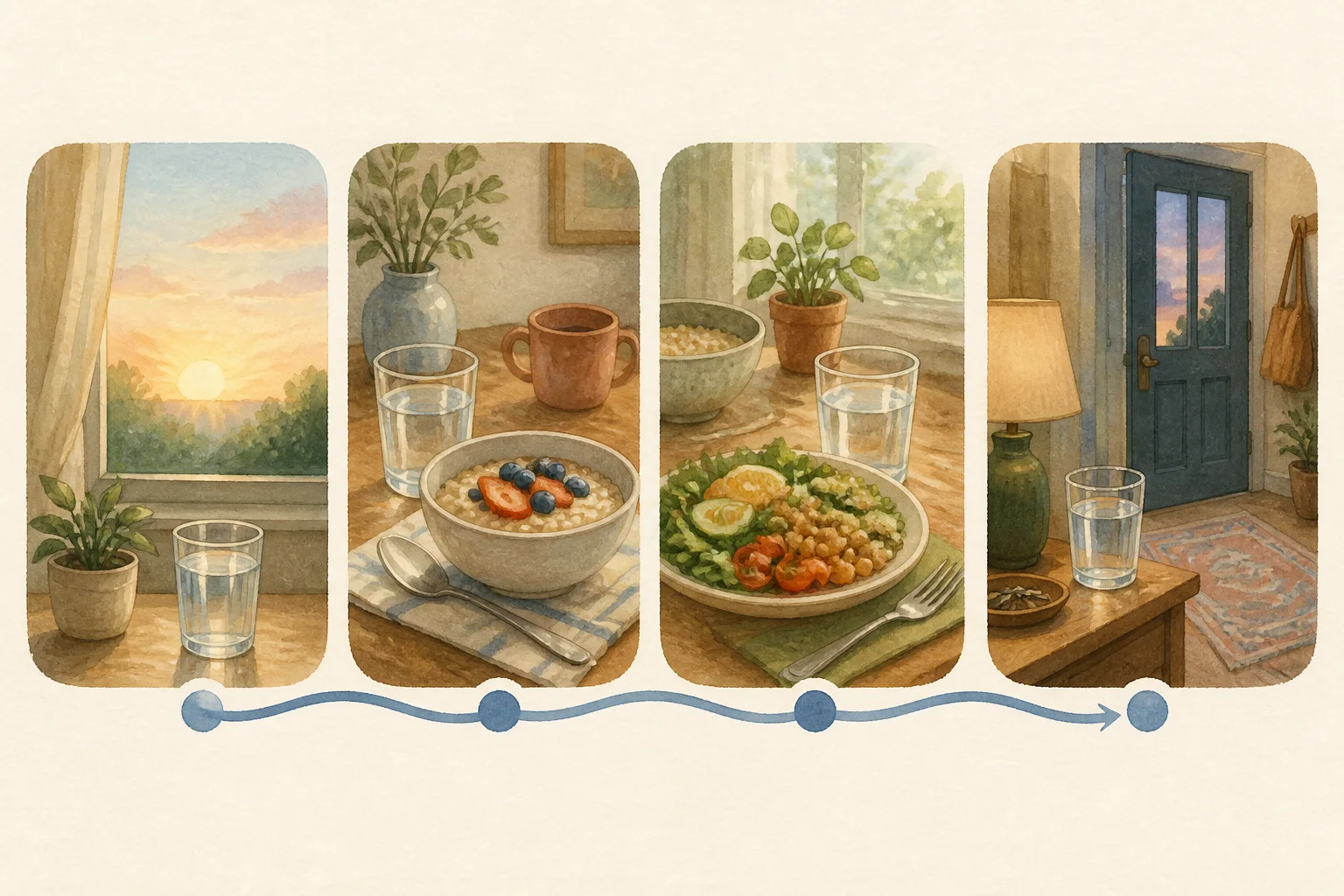
Here is the practical core. Instead of one big goal, you set a few small cues, each attached to something that already happens.
Start by picking three to five anchor moments. Good candidates for most people:
- Right after waking, before coffee or tea
- With each meal or snack, however small
- When you sit down at your desk or start a work block
- When you get home or finish the workday
- With any medication or supplement you already take at a set time
At each anchor, the action is small: a few sips or half a small glass. Sips are easy to repeat and can feel gentler on a queasy stomach.
A few adjustments that make the rhythm stick:
- Keep water visible. The full bottle on the desk failed partly because it blended into the background. A glass in your line of sight, refilled at anchors, works better than a capped bottle in a bag.
- Let temperature do some work. Many people on GLP-1s find cold water easier, others prefer room temperature or warm. There is no correct answer — use whichever you will actually drink.
- Count other drinks honestly. Coffee, tea, and milk all contribute fluid. If plain water is unappealing on a low-appetite day, an herbal tea or a broth still moves the day in the right direction.
- Pair sips with food moments. If you are working on eating enough when appetite is low, you already have small food moments in your day. Each one is a natural drinking cue.
If you like having a reference point, our water intake calculator can give you a general estimate to discuss with your clinician. Treat it as orientation, not instruction — the anchors above are the actual routine.
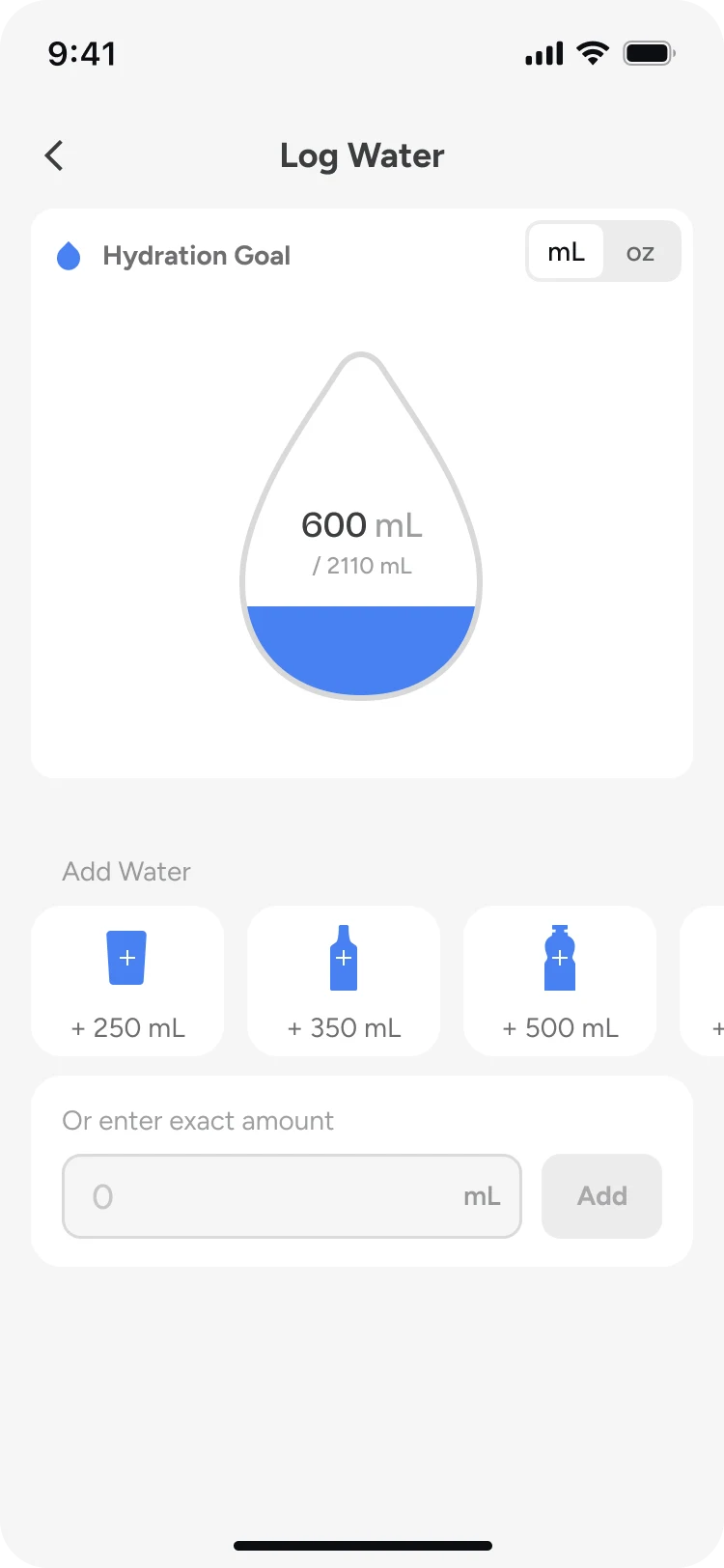
This is also where the Food and Protein Tracker fits. It keeps water in the same daily record as food, with optional appetite, fullness, and personal notes; weekly views make patterns easier to review.
A gentler water routine
Keep a simple hydration pattern in view
Bring water, food context, and the notes that help you notice a pattern into one calm daily record.
Glowise does not set a water target or medically interpret symptoms. It is an organizational companion: it keeps the record so you can notice your own pattern and bring it to a professional when needed.
When a Different Day Needs a Different Boundary
Persistent symptoms are not a tracking task
A rhythm is a default, not a rule. Some days legitimately call for more attention to fluids, and it helps to know which ones in advance so you are not improvising.
Hot weather and exercise are the obvious ones. When you sweat more, your fluid needs rise, and a GLP-1 does not exempt you from that. On those days, add anchors rather than forcing bigger glasses: a few sips before you go out, a few when you come back in, water within reach during activity.
Illness days are different in kind, not just degree. This matters specifically for GLP-1 users. The labeling for Wegovy and Zepbound warns that nausea, vomiting, or diarrhea can contribute to dehydration, and advises contacting a healthcare provider when these symptoms are persistent or severe. That does not mean everyone taking a GLP-1 will become dehydrated — most people will not. It means that on days when your stomach is actively working against you, the gentle-rhythm approach has limits, and small frequent sips become a stopgap rather than a solution.
Separate two categories of day. Routine days — including low-appetite days, busy days, and mildly queasy days — belong to the rhythm. Days with repeated vomiting, ongoing diarrhea, or symptoms that are not letting up belong to a conversation with a healthcare provider. Simple notes on what happened and when make that conversation more useful.

Notice the Pattern Without Medicalizing It
Keep only the context that helps
Once a rhythm exists, you will start to see your own pattern. This is valuable, and it comes with one caution: notice, do not diagnose.
Noticing might mean seeing that meeting-heavy days need a noon cue, or that cold sparkling water is easier than still water. These are observations about habits and comfort.
Medicalizing looks different: deciding on your own that a symptom means something specific, or treating your log as a diagnostic instrument. A hydration note cannot tell you why you feel nauseated, whether a dose is right for you, or whether a symptom is serious. Those questions need a clinician, especially when symptoms are persistent or severe — the GLP-1 side effects guide covers that territory in more detail.
The record turns "I think I've been drinking less" into something concrete to discuss with a doctor, dietitian, or pharmacist.
Keep the notes light: water moments, rough appetite, and how you felt. No scoring yourself or turning the log into another obligation.
When to Get Personal Support
Most hydration work is routine-building, but there is a clear line where personal support is the better next step.
Contact your healthcare provider when nausea, vomiting, or diarrhea is persistent or severe. These symptoms can lead to dehydration faster than sips can correct, so do not wait if the problem is not resolving.
Also reach out when you cannot keep fluids down, feel dizzy or faint, or have consistently dark and infrequent urine. These are not problems to troubleshoot alone with a water bottle and willpower.
If you have a heart, kidney, or other condition with fluid guidance, follow that individual plan. The same is true if you are unsure whether what you are experiencing is normal.
Frequently Asked Questions
The practical takeaway
Hydration on GLP-1: key points
- Skip the universal number: water needs vary by person, day, climate, activity, and food, and fixed targets fit almost no one.
- Build a sipping rhythm instead: three to five anchor moments you already have, each with a few easy sips.
- Small and frequent beats large and rare, especially when your stomach is sensitive on a GLP-1.
- Coffee, tea, milk, and broth count; use whatever you will actually drink.
- Hot weather, exercise, travel, and illness days call for adjusted attention — and persistent vomiting or diarrhea calls for your provider, not willpower.
- A simple daily record of water, food, and notes helps you notice your pattern and describe it clearly to a professional.
- Glowise keeps water, food context, and notes in one calm record — it organizes your days without setting a medical target.
Do I need the same water amount as everyone else?
No. Water needs vary with age, sex, pregnancy, activity, and climate, among other factors — plus your food choices, your medications, and any medical conditions you have. A universal number cannot account for any of that. A rhythm of small drinks tied to your own anchor moments, adjusted with your clinician's input, fits better than any fixed target.
Can coffee or tea count toward hydration?
Yes. Coffee, tea, milk, and broths all contribute fluid to your day. Caffeinated drinks have a mild diuretic reputation, but in typical amounts they still provide net fluid. If plain water is unappealing on a low-appetite day, an herbal tea or warm broth is a reasonable and gentle alternative — variety in drinks is fine.
Do I need electrolyte drinks?
On ordinary days, regular fluids and food cover electrolytes for typical activity for many people. They can come up in specific situations like heavy sweating or illness, but no electrolyte recipe or supplement belongs in a general routine. If vomiting or diarrhea is ongoing, or you think you might need electrolyte support, ask a healthcare provider rather than relying on a product shelf.
What if nausea, vomiting, or diarrhea keeps getting in the way?
Small, frequent sips can help you get through a mildly queasy day, but they are a stopgap, not a fix. The labeling for Wegovy and Zepbound advises contacting a healthcare provider when these symptoms are persistent or severe, because they can contribute to dehydration. If symptoms keep interfering with drinking or eating, do not wait it out — bring it to your care team, ideally with notes on what the recent days have looked like.
Sources

About the author
Maya Lee
Glowise Senior GLP-1 Content Editor
Maya Lee is a Glowise Health Content Editor. Her guides turn product records, authoritative sources, and everyday organization questions into clear, practical GLP-1 information.
She helps readers ask better questions and keep the details relevant to a care conversation together.
See more Glowise on Google
Add Glowise as a preferred source to find our GLP-1 guides more easily in Google Search.