
GLP-1 side effects most often involve the digestive system, but the full picture is broader. Current labels for GLP-1 receptor agonists and the dual GIP/GLP-1 medicine tirzepatide also list effects such as headache, fatigue, dizziness, injection-site reactions, and low blood sugar in particular circumstances. The exact list depends on the medicine, whether it is a pill or injection, its approved use, and whether it is used with insulin or a sulfonylurea.
This guide explains the main effects people search for, then shows when a symptom is a question to discuss and when it needs faster medical attention. A category list is not a diagnosis: it cannot establish what caused a symptom for one person or tell you which treatment decision follows. For that, use the current information for the exact product on your prescription.
11 common GLP-1 side effects and safety concerns to know about
Digestive symptoms lead most official lists, but “common” is not a promise that you will have them. It means a particular product label reported the effect in a defined study population or lists it in product safety information. The Wegovy, Ozempic, Rybelsus, Mounjaro, and Zepbound labels illustrate why the product name matters.
| Side effect | How people may describe it | Official label examples | Why the list is not a personal prediction |
|---|---|---|---|
| 1. Nausea | Feeling sick to the stomach, queasy, or put off by food | Listed for Wegovy, Ozempic, Rybelsus, Mounjaro, and Zepbound | Rates and timing differ across products, doses, studies, and approved uses. |
| 2. Vomiting | Throwing up or being unable to keep food down | Listed for Wegovy, Ozempic, Rybelsus, Mounjaro, and Zepbound | It is a label-listed effect for some people, not a result everyone should expect. |
| 3. Diarrhea | Loose or more frequent stools | Listed for Wegovy, Ozempic, Rybelsus, Mounjaro, and Zepbound | The same word can describe many conditions; the label alone does not identify the cause in one person. |
| 4. Constipation | Harder, less frequent, or difficult bowel movements | Listed for Wegovy, Ozempic, Rybelsus, Mounjaro, and Zepbound | It may appear in some product studies, but not in every label's common-effect list or every routine. |
| 5. Abdominal or stomach pain | Pain, discomfort, tenderness, or cramping in the stomach area | Listed for Wegovy, Ozempic, Rybelsus, Mounjaro, and Zepbound | Location, severity, duration, and other symptoms matter more than a broad category label. |
| 6. Indigestion or heartburn | Upset stomach, burning, reflux, or indigestion | Dyspepsia and reflux are listed for Wegovy and Zepbound; dyspepsia is listed for Mounjaro | These terms are product-specific label language, not evidence that one form will affect everyone the same way. |
| 7. Bloating, gas, or belching | Feeling full, gassy, bloated, or burping more than usual | Abdominal distension, flatulence, or eructation are listed for Wegovy and Zepbound | Related symptoms may be grouped differently in different labels and trials. |
| 8. Headache or dizziness | Head pain, light-headedness, or feeling unsteady | Headache and dizziness are listed for Wegovy; dizziness is also listed for Zepbound | These symptoms have many possible explanations and need context rather than an assumption. |
| 9. Fatigue | Feeling unusually tired, low-energy, or worn down | Listed for Wegovy and Zepbound | A listed fatigue term does not explain why someone feels tired or whether the medicine is responsible. |
| 10. Injection-site reactions | Redness, itching, soreness, rash, or bruising where an injection was given | Listed for injectable products including Wegovy, Mounjaro, and Zepbound | This applies to injection products, not oral tablets, and individual reactions vary. |
| 11. Low blood sugar risk | Shakiness, sweating, hunger, dizziness, confusion, or a fast heartbeat | Labels warn that risk can increase when GLP-1 medicines are used with insulin or a sulfonylurea | It is not a form-wide assumption; the other diabetes medicines in use change the risk. |
The practical interpretation is simple: start with the exact medicine and form, then note the symptom in ordinary words. Do not use a broad “GLP-1 side effects” list to decide that a medicine caused an individual symptom or to make a medication change.
Why diabetes and weight-management labels are not interchangeable
The umbrella term “GLP-1” can hide important product differences. Some medicines are GLP-1 receptor agonists; tirzepatide is a dual GIP/GLP-1 receptor agonist. They may be used in type 2 diabetes care, weight-management care, or related clinical situations, but the brand name, active ingredient, form, and approved use are not interchangeable.
Same ingredient, different brand and use
Semaglutide is a useful example. Ozempic is an injectable semaglutide product labeled for type 2 diabetes, while Wegovy is semaglutide used in specific weight-management and cardiovascular-risk-reduction contexts. Rybelsus is an oral semaglutide product for type 2 diabetes. Current U.S. Wegovy information also covers a tablet and an injection, each with its own administration details and labeling context.
Tirzepatide makes the same point from another direction: Mounjaro is labeled for type 2 diabetes and Zepbound for chronic weight management in adults with obesity or overweight plus a weight-related condition. A similarity in active ingredient does not make the products, labels, doses, or coverage decisions interchangeable. For product-specific reading, use the Mounjaro side effects guide or the Zepbound side effects guide rather than borrowing a general list.
This is also why the word “common” needs a label attached to it. A reaction can appear in one product's clinical-trial table, be grouped under a different term in another label, or matter differently when a person uses other diabetes medicines. The exact product information is where those distinctions are spelled out.
Why a pill is not just an injection without a needle
The form can change the daily routine and the instructions that apply. Oral semaglutide products have product-specific absorption directions, while injection products have their own administration instructions and may include injection-site reactions in their safety information. The GLP-1 pill versus injection guide explains the routine comparison; it does not provide a dose conversion or a reason to switch forms without a prescriber.
A note on “Ozempic face”
“Ozempic face” is a popular term, not the name of a labeled adverse reaction. Harvard Health uses it to describe facial appearance changes that may be noticed with rapid weight loss and notes that similar changes can occur with rapid weight loss from other causes. It should not be presented as something every person using Ozempic, Wegovy, or another GLP-1 medicine will experience, or as proof that a medicine caused an individual's facial change.
Product differences and serious-risk boundaries
The labels distinguish between a listed effect that may be discussed at a routine contact, symptoms that deserve a prompt call, and situations where waiting on a symptom log is not appropriate. This is not a personal triage tool; it is a way to recognize the official warning patterns worth acting on.
| What is happening | Practical next step | Why it matters |
|---|---|---|
| A symptom is bothersome, persistent, or changing, but does not match an urgent warning | Contact the prescriber or pharmacist who can review the exact product and your other medicines | Product labels tell readers to discuss effects that bother them or do not go away. |
| Nausea, vomiting, or diarrhea does not go away, especially if fluids are hard to keep down | Contact a healthcare professional promptly | Several labels warn that fluid loss can contribute to dehydration and kidney problems. |
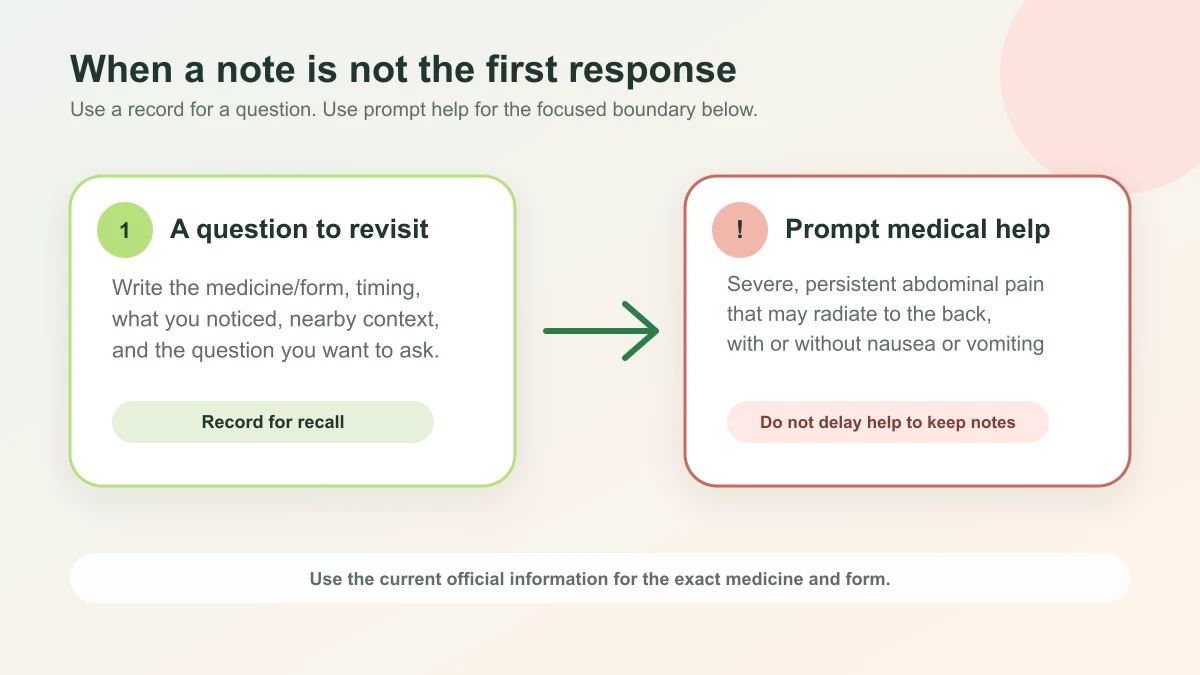
| Severe stomach-area pain that will not go away, with or without nausea or vomiting; pain may sometimes be felt toward the back | Seek prompt medical help instead of continuing to record symptoms | Wegovy, Mounjaro, and Zepbound safety information use this pattern for pancreatitis warnings. |
| Upper-stomach pain with fever, yellowing of the skin or eyes, or clay-colored stools | Contact a healthcare professional promptly | These are product-label symptoms associated with possible gallbladder problems. |
| Swelling of the face, lips, tongue, or throat; trouble breathing or swallowing; fainting; or a severe rash | Get medical help right away | These are official warning signs of a serious allergic reaction. |
The severe-pain boundary is worth keeping visible because it changes the order of action. A note can travel with you after you reach out; it should not delay contact. For the exact Wegovy warning and a stomach-pain-specific path, use the Wegovy stomach-pain guide.
Start with the exact medicine and form
The exact name and form on your prescription are useful anchors for every question. Write them down before adding a symptom description, even if you think you will remember them. A broad category page can help you recognize the words to look up; it cannot replace the current information that applies to the medicine actually dispensed.
This matters when a search result blends products or uses similar everyday words. First ask, “Which product information applies to me?” Then ask, “What did I notice?” The first is a question about the medicine and form; the second is a factual description of your experience. Keeping them separate makes a follow-up clearer.
Record the details that change the question
A note is not a conclusion
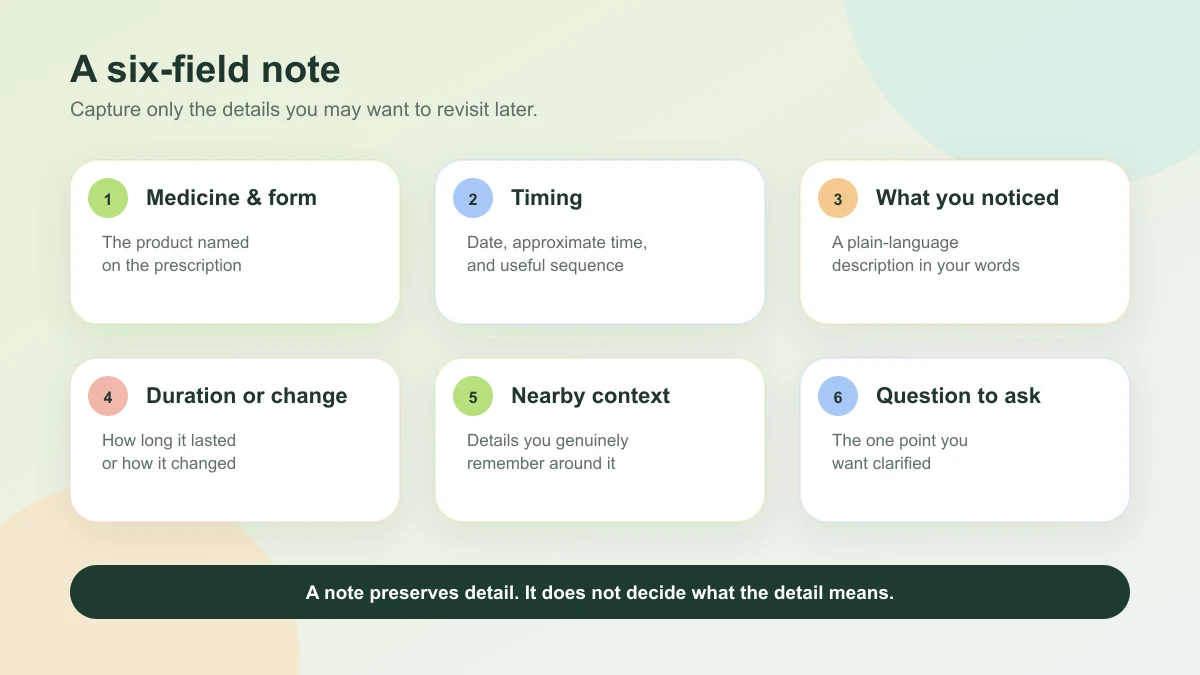
For a non-urgent question, a neutral record preserves the details that otherwise blur together. You do not need a medical diary. Use a smaller, plain-language version of the factual event details that appear in FDA adverse-event reporting guidance:
| Record field | What to write |
|---|---|
| Medicine and form | The named medicine and whether it was a pill, injection, or another form |
| Timing | When you first noticed the event and whether it continued or changed |
| Plain-language description | What it felt like, in your own words |
| Duration or change | How long it lasted and whether it eased, stayed the same, or changed |
| Nearby context | Other medicines, food, hydration, routine changes, illness, or other details you want to remember |
| Question to ask | The one point you want a clinician or pharmacist to address |
This kind of note does not prove a cause and does not choose a treatment. It simply keeps the observation, its context, and the question together.
Keep the record short enough to use
Use ordinary words rather than trying to assign a medical label. If a detail is uncertain, mark it as uncertain instead of filling the gap with a conclusion. “I noticed this after taking the medicine” describes sequence; “the medicine caused this” goes beyond what a record can show.
If you are establishing a routine, the first-month GLP-1 record can help you keep early observations and practical questions together without turning a tracker into an answer key.
Use a tracker for recall, not interpretation
What Glowise keeps organized
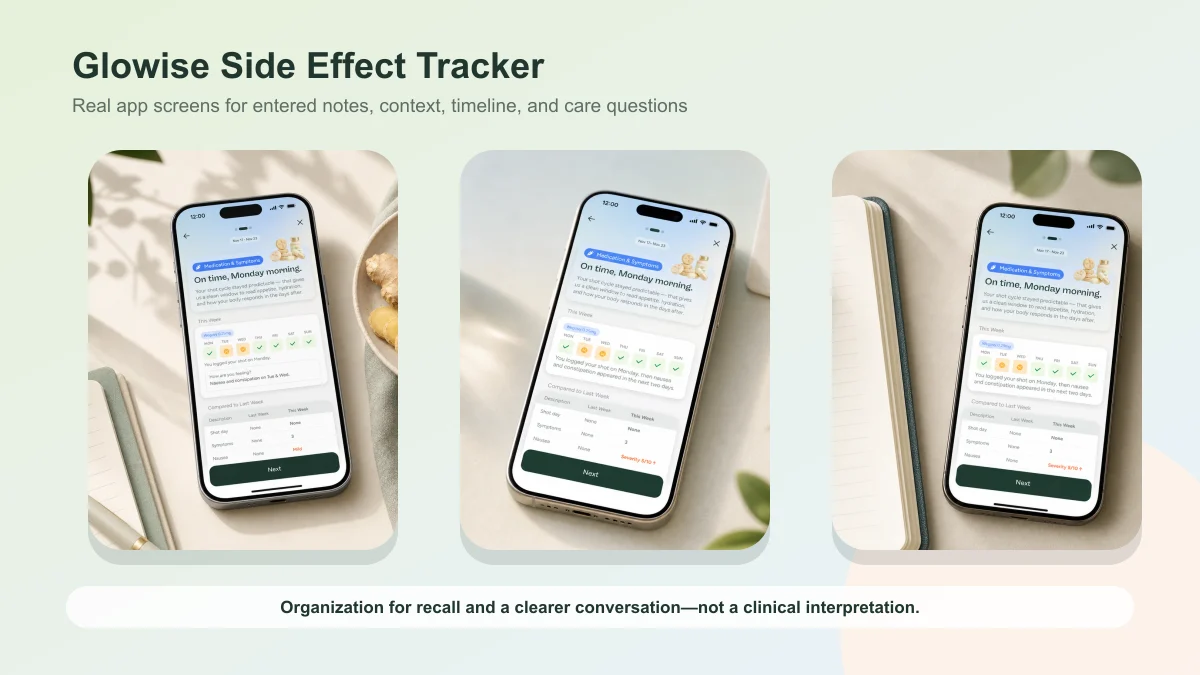
The Glowise Side Effect Tracker is for keeping entered context together when you want to remember several days of observations. Its workflow is simple:
- Record what you noticed in your own words.
- Add timing and the surrounding context you choose to enter, such as medicine, food, hydration, or routine details.
- Review the timeline and save the question you want to ask.
Glowise organizes the details you enter so they are easier to revisit. It does not diagnose the cause of a symptom, judge urgency, or replace a clinician or pharmacist. The value is recall: a conversation can begin with the dates and details you chose to keep rather than a reconstruction from memory.
Keep the useful context together
Turn entered details into a clearer question
Glowise keeps the details you choose to record in one place for your own recall and a future conversation.
Find the right next guide
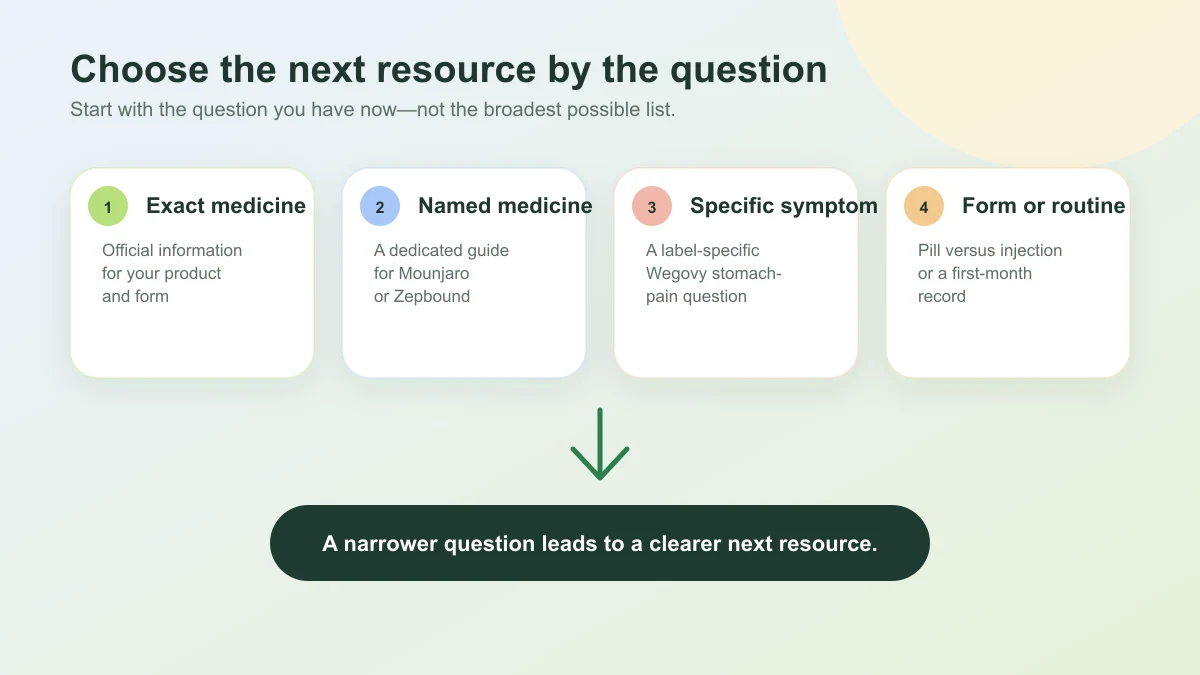
Once you have named the question, a narrower page can prevent different medicines, symptoms, and routines from being mixed together.
| If your question is… | Read next |
|---|---|
| What side effects and warnings apply to Mounjaro? | Mounjaro side effects guide |
| What side effects and warnings apply to Zepbound? | Zepbound side effects guide |
| What is the official route for Wegovy stomach pain? | Wegovy stomach-pain guide |
| Is dry mouth the specific question I need to describe? | Zepbound dry-mouth guide |
| Does a pill or injection change the routine and instructions? | GLP-1 pill versus injection guide |
The practical next step
Start with the medicine and form on your prescription, then use the 11-item list to put a symptom into words. If your question is non-urgent, keep one short factual note and bring it to a prescriber or pharmacist. If an official warning pattern is present, seek the help described in that product's current safety information rather than waiting for a record to become clearer.
The practical takeaway
What to carry forward
- Common GLP-1 side effects are often digestive, but labels also include effects such as headache, fatigue, dizziness, injection-site reactions, and low blood sugar risk in particular situations.
- “Common” varies by exact medicine, form, use, dose, study, and other medicines taken alongside it.
- Use the current product information for your exact prescription; do not treat a broad list as a personal diagnosis.
- Keep medicine/form, timing, description, duration or change, nearby context, and one question together.
- Contact a clinician or pharmacist for symptoms that are bothersome, persistent, changing, or worrying, and seek prompt help for official red-flag patterns.
- Glowise can organize entered context for recall, but it does not diagnose or assess urgency.
Frequently asked questions
What are the most common GLP-1 side effects?
Nausea, vomiting, diarrhea, constipation, and abdominal pain appear across several current GLP-1 and tirzepatide labels. Other listed effects can include indigestion, reflux, bloating, headache, fatigue, dizziness, and injection-site reactions. The exact list and its frequency vary by product and use.
Do side effects differ between diabetes and weight-management products?
They can. Ozempic and Wegovy both use semaglutide but have different labels and approved uses; Mounjaro and Zepbound both use tirzepatide but are labeled for different clinical contexts. Check the current information for the named product and form rather than carrying a list from one brand to another.
Does a symptom mean the medicine caused it?
No. A label or a personal note can describe what happened, but neither establishes why one person has a symptom. Keep the observation factual and use the exact product information when you discuss it with a clinician or pharmacist.
Is “Ozempic face” an official side effect?
No. It is a popular term, not the name of a labeled adverse reaction. It is often used to describe facial appearance changes noticed with rapid weight loss, which can also occur with rapid weight loss from other causes. It should not be treated as an expected effect for everyone taking a GLP-1 medicine.
What should I write down before I contact a clinician or pharmacist?
Write down the medicine and form, timing, a plain-language description, duration or change, nearby context, and the one question you want answered. A short factual record is easier to use than a long list of guesses.
Can a GLP-1 side-effect tracker tell me what a symptom means?
No. Glowise can keep the details you enter—such as notes, timing, duration, medicine, food, hydration, timeline entries, and care questions—together for recall. It does not diagnose the meaning of a symptom or decide how urgent it is.
When should I move from tracking to prompt medical help?
Do not wait on a tracker for official warning patterns such as severe stomach-area pain that will not go away, particularly if it occurs with nausea or vomiting or is felt toward the back. Use the safety information for your exact product and seek prompt medical help.
Sources

About the author
Maya Lee
Glowise Senior GLP-1 Content Editor
Maya Lee is a Glowise Health Content Editor. Her guides turn product records, authoritative sources, and everyday organization questions into clear, practical GLP-1 information.
She helps readers ask better questions and keep the details relevant to a care conversation together.
See more Glowise on Google
Add Glowise as a preferred source to find our GLP-1 guides more easily in Google Search.