A GLP-1 pill vs injection comparison starts with three practical differences: which condition the product treats, how it has to be taken, and what evidence supports it. Both forms can be effective medicines. A tablet may remove the injection step while adding a daily routine; some tablets require an empty stomach, while others do not. A weekly injection has a different schedule and storage requirements.
The details below use U.S. product information checked on September 23, 2026. They include current oral options, rather than treating every GLP-1 pill as the same medicine. Availability, approved uses, and packaging can differ in other countries.
GLP-1 pills and injections at a glance
The most useful comparison is between medicines intended for the same treatment goal. A tablet approved for type 2 diabetes is not automatically a weight-management alternative to an injection just because both affect GLP-1 receptors.
| Product and form | U.S. use relevant to this comparison | Routine in the current label |
|---|---|---|
| Wegovy tablets: semaglutide | Long-term weight reduction in eligible adults; cardiovascular risk reduction in adults with established cardiovascular disease and overweight or obesity | Once daily; morning empty-stomach and water instructions |
| Wegovy injection: semaglutide | Long-term weight reduction in eligible adults and adolescents aged 12 and older; cardiovascular risk reduction in eligible adults; accelerated approval for specific noncirrhotic MASH with F2–F3 fibrosis in adults | Once weekly; with or without meals; adult weight-management dosing may include 7.2 mg only under label conditions |
| Rybelsus or Ozempic tablets: semaglutide | Type 2 diabetes blood-glucose control and cardiovascular risk reduction in high-risk adults with type 2 diabetes | Once daily; morning empty-stomach and water instructions; the two tablet products are not substitutable mg for mg |
| Foundayo tablets: orforglipron | Long-term weight reduction in adults with obesity, or overweight with a weight-related condition | Once daily, with or without food |
| Zepbound injection: tirzepatide | Long-term weight reduction in eligible adults; also a separate obstructive sleep apnea indication | Once weekly; with or without meals |
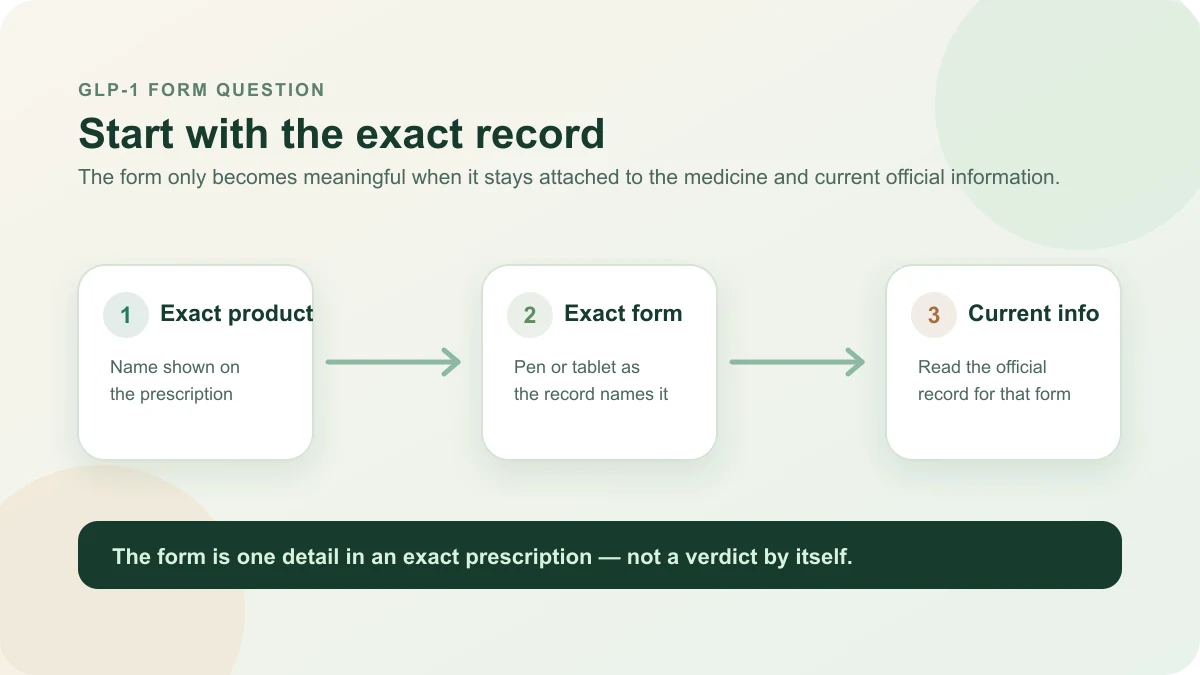
These are examples with different ingredients and indications, not interchangeable choices. Even within Wegovy, the form changes the labeled population and use: the tablets are for adults, while the injection also has labeled uses for adolescents with obesity and for adults with noncirrhotic MASH and F2–F3 fibrosis. The MASH indication has accelerated approval based on improvement of MASH and fibrosis, and continued approval may depend on confirmatory clinical benefit. The 7.2 mg weekly injection is not a routine substitute for a tablet; the label limits it to adult weight reduction after at least four weeks of tolerating 2.4 mg and when additional weight reduction is clinically indicated.
The relevant sources are the current Wegovy label, Rybelsus/Ozempic tablet label, Foundayo label, and Zepbound label. Each has eligibility conditions and warnings beyond this table.
What changes in everyday use?
Food, water, and other morning medicines
Wegovy, Rybelsus, and Ozempic tablets have specific absorption instructions: take the prescribed tablet on an empty stomach in the morning with water, up to 4 ounces, then wait at least 30 minutes before food, beverages, or other oral medicines. Their labels instruct users to swallow tablets whole. Coffee is not a substitute for the water specified in those instructions.
Foundayo is a different molecule and formulation. Its label allows it to be taken with or without food. That distinction matters: “GLP-1 pills need a fasting window” is too broad a rule.
For someone whose mornings already include another timed medicine, the useful question is how the two instructions fit together. A pharmacist can review the whole schedule. Skipping the waiting period or rearranging another prescription without advice is not a way to make two competing instructions compatible.
Daily tablets versus weekly injections
A daily tablet is tied to a repeated daily habit; a weekly injection is tied to a particular day. One person may find breakfast-related timing easy to remember. Another may find one weekly task simpler. Neither pattern proves better adherence for everyone.
Weekly injections also involve learning the exact device's instructions and rotating injection sites as directed. Missed-dose rules differ by product and form: a rule for a daily tablet may not apply to a weekly injection, and not every pill shares the same rule. Use the missed-dose section in the exact current Wegovy label, Rybelsus/Ozempic tablet label, or Foundayo label rather than carrying over a remembered rule from another prescription.
Storage and travel
Tablets can simplify travel when they do not require refrigeration, but they still have packaging and moisture-protection requirements. For example, Wegovy tablets are kept in their original bottle in a dry place according to the label.
Injection storage depends on the product and presentation, including permitted time outside refrigeration. A pen and vial should not be assumed to have identical handling rules. Before a trip, confirm the exact package's temperature limits, storage period, and disposal instructions; do not borrow another brand's room-temperature allowance.
Are GLP-1 pills as effective as injections?
Oral GLP-1 medicines can produce meaningful results in clinical trials. The harder question is whether a particular pill works as well as a particular injection for the same person and treatment goal. Separate placebo-controlled studies do not answer that head-to-head question.
The current Wegovy label provides a useful example. In its tablet Study 7, 307 adults with obesity, or overweight plus a weight-related condition, were studied for 64 weeks. Participants with type 2 diabetes were excluded. The modeled average weight change was −13.6% with the 25 mg tablet and −2.4% with placebo, alongside the trial's lifestyle intervention.
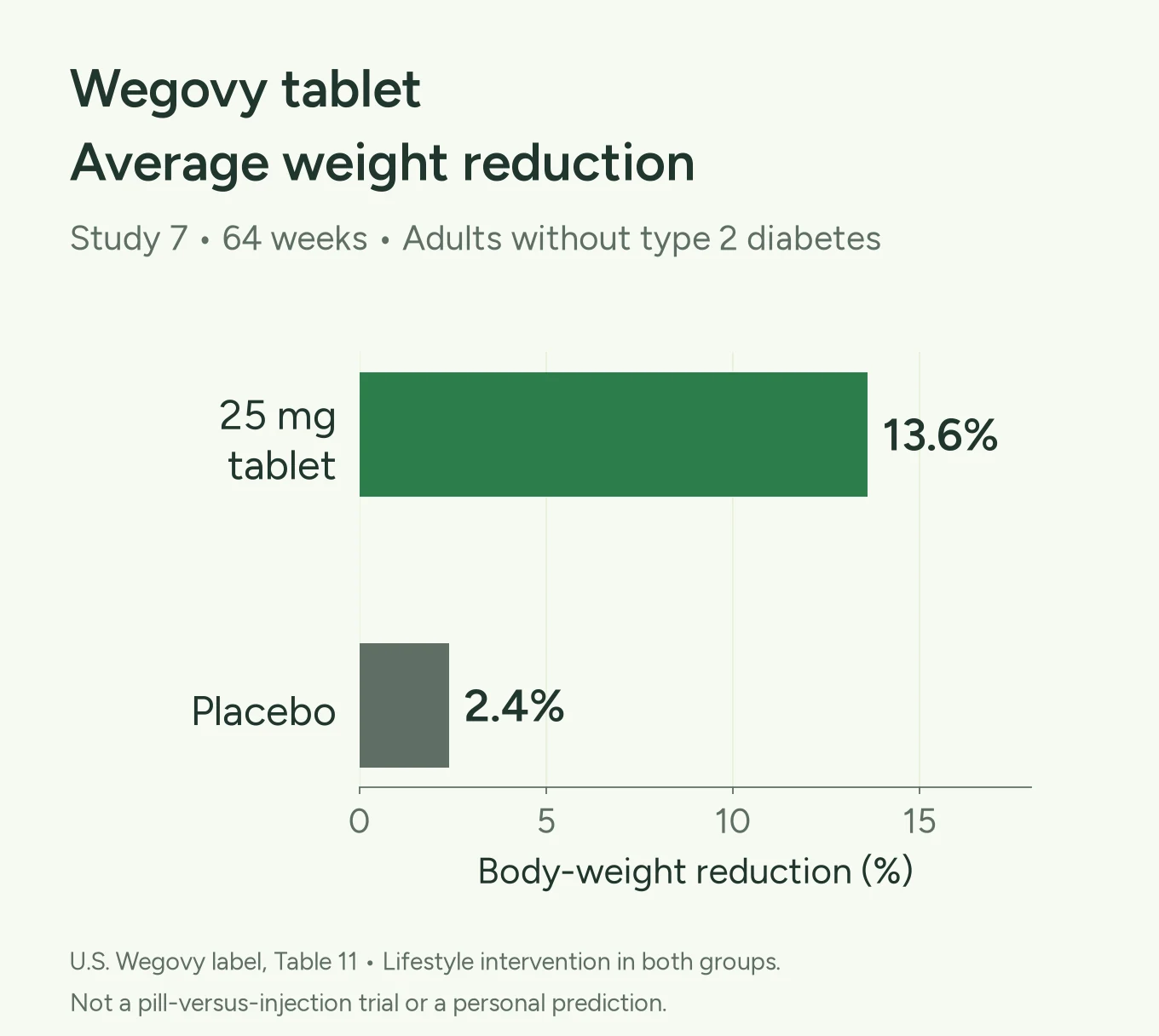
The label's injection Study 2 was a separate 68-week study of 1,961 adults without type 2 diabetes. It reported modeled average weight changes of −14.9% with 2.4 mg weekly injection and −2.4% with placebo. Both studies support their respective products. The numerical difference between the two treated groups is not a randomized comparison of a pill against a shot.
Why does that distinction matter? Study participants, duration, treatment schedules, dose-escalation rules, and analysis can differ. Results also describe groups, including a range of individual responses. Selecting whichever percentage looks larger ignores how the number was produced. Your prescriber can connect the evidence to your treatment goal, health history, tolerability, and previous response.
For the broader mechanism behind these effects, see how GLP-1 medicines work. For a comparison involving two specific newer products, our Foundayo and Zepbound comparison keeps their distinct evidence separate.
A pill does not remove side-effect considerations
Avoiding an injection avoids that administration step, but it does not remove effects of the medicine after absorption. Nausea, vomiting, diarrhea, constipation, or abdominal discomfort may still be relevant, depending on the product. The exact label determines the warnings, interactions, and populations for which it is appropriate.
An injection can also have local injection-site reactions. A tablet can have administration or absorption constraints. Those are different burdens; counting them is not enough to decide which matters most in an individual's treatment.
Tell the prescriber about other medicines, previous serious reactions, pregnancy plans, and any scheduled anesthesia or deep sedation. Ask about a symptom that is troublesome, persistent, or worsening rather than assuming a different form will solve it. For severe symptoms, follow the urgent instructions in the product's Medication Guide; a form comparison should never delay care.
Our GLP-1 side-effects guide explains the broader symptom categories. It supplements, rather than replaces, the instructions for a particular medicine.
Cost and insurance: compare what you would actually pay
“Pills are cheaper” and “injections cost more” are unreliable shortcuts. Coverage can depend on the approved indication, the specific product, your plan's formulary, prior authorization, and deductible. Manufacturer programs can change and have eligibility limits.
For each prescription being considered, request the same set of details:
| Cost question | Why it can change the comparison |
|---|---|
| Is this exact product covered for my diagnosis? | Coverage for a diabetes treatment does not automatically extend to a weight-management prescription |
| What will I pay now and after a deductible or offer changes? | An introductory or temporary price may not describe ongoing cost |
| Does the quoted amount cover the same length of treatment? | A package, a month's supply, and a subscription are not necessarily equivalent |
| Are visits, shipping, supplies, or renewals additional? | A medicine-only quote can omit parts of the total bill |
Use a dated quote from your insurer, pharmacy, or the manufacturer's current program. An affordable routine that remains available can matter as much as whether the medicine is swallowed or injected.
Switching is product-specific, not a conversion formula
The current Wegovy label contains a narrow switching pathway between named maintenance injection and tablet doses for specified adult indications. That pathway does not mean any weekly semaglutide dose can replace any tablet, and it does not apply across different molecules. Rybelsus and Ozempic tablets have their own product-specific mappings. The prescriber should confirm whether a labeled pathway applies and set the new starting schedule; the milligram numbers alone cannot do that.
Prepare a useful switching conversation
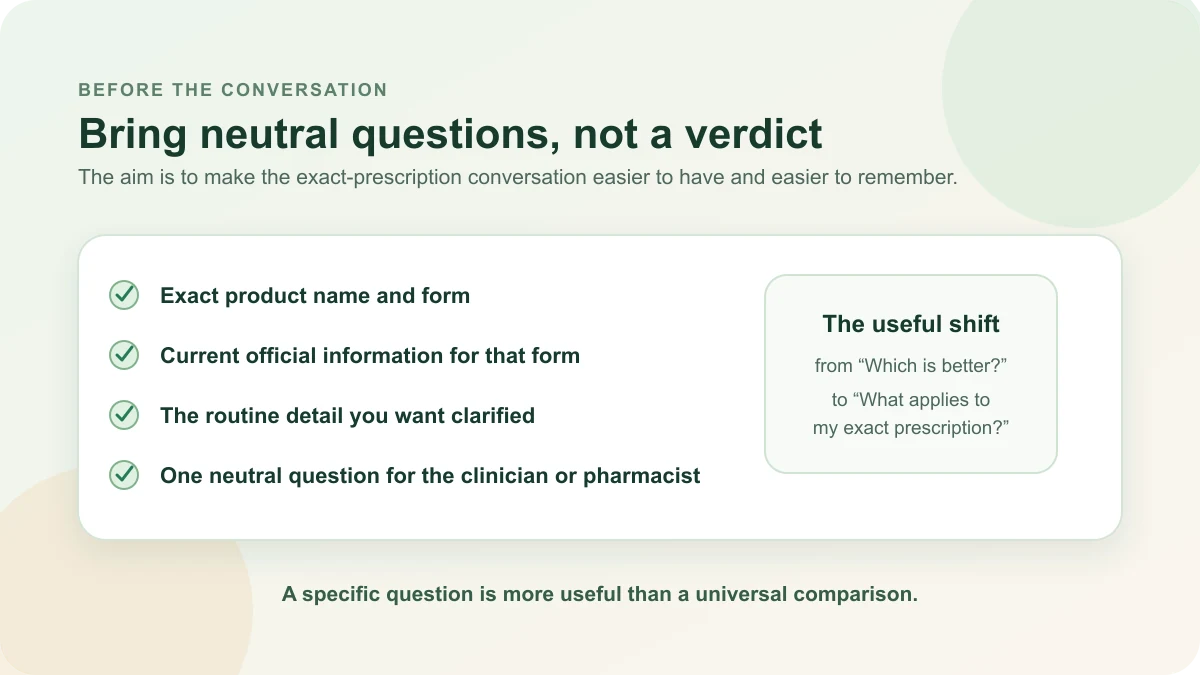
A useful conversation starts with the difficulty you want to solve: an administration problem, side effects, coverage, access, or a treatment goal that is not being met. Then bring the exact current product and the exact alternative being discussed.
For example: “My morning schedule makes the empty-stomach instructions difficult. Is there an appropriate option for my diagnosis with a different administration routine?” That gives the clinician a concrete problem without assuming all tablets share the same instructions.
Bring your medication list, prescribed schedule, recent symptoms, and current coverage information. Ask who will explain the new starting schedule, missed-dose instructions, and follow-up plan if a change is made. Do not combine products or convert a pill dose into an injection dose yourself.
A paper list may be enough. Glowise's GLP-1 tracker can help keep medication records, symptoms, food, water, and progress in one place so the discussion starts with remembered details. It does not choose a medicine or calculate a switch.
Frequently asked questions
Are all oral GLP-1 medicines taken on an empty stomach?
No. The current U.S. labels for Wegovy, Rybelsus, and Ozempic tablets have morning empty-stomach, water, and waiting instructions. Foundayo is taken with or without food. Follow the exact product's instructions rather than a rule for all GLP-1 pills.
Is an oral GLP-1 always easier to use?
It removes the injection step, but may add a daily task or a fasting window. Weekly injections have their own device and storage requirements. The easier routine depends on both the product and the person's circumstances.
Are Wegovy, Rybelsus, and Ozempic tablets the same prescription?
No. They contain semaglutide, but their labeled treatment goals and tablet strengths are not identical. Wegovy tablets are labeled for adult weight reduction and cardiovascular risk reduction in eligible adults. Rybelsus and Ozempic tablets are labeled for type 2 diabetes and cardiovascular risk reduction in high-risk adults with type 2 diabetes.
Can I switch between Rybelsus and Ozempic tablets using the same milligrams?
No. Their current combined label explicitly says they are not substitutable milligram for milligram. The label provides specific mappings only after the initiation phase; switching depends on the exact products and prescription.
Does a higher dose number mean a stronger medicine?
Not across different products or routes. Absorption, formulation, molecule, and dosing frequency all matter. A milligram number by itself cannot establish equivalent treatment or predict an outcome.
Sources

About the author
Maya Lee
Glowise Senior GLP-1 Content Editor
Maya Lee is a Glowise Health Content Editor. Her guides turn product records, authoritative sources, and everyday organization questions into clear, practical GLP-1 information.
She helps readers ask better questions and keep the details relevant to a care conversation together.
See more Glowise on Google
Add Glowise as a preferred source to find our GLP-1 guides more easily in Google Search.