
The most common Mounjaro side effects are nausea, diarrhea, decreased appetite, vomiting, constipation, indigestion, and abdominal pain. Many digestive reactions reported in trials occurred while the dose was being increased and became less frequent over time. That pattern does not mean every symptom should be endured or that severe pain is an ordinary adjustment.
This guide separates common reactions, general measures that may help, and warnings that need prompt action. It uses U.S. Mounjaro information checked on September 18, 2026. Mounjaro is tirzepatide, a GIP/GLP-1 receptor agonist. Its current U.S. indications concern type 2 diabetes and cardiovascular risk in specified patients; a different tirzepatide brand's label should not be substituted for it.
Common Mounjaro side effects, with trial context
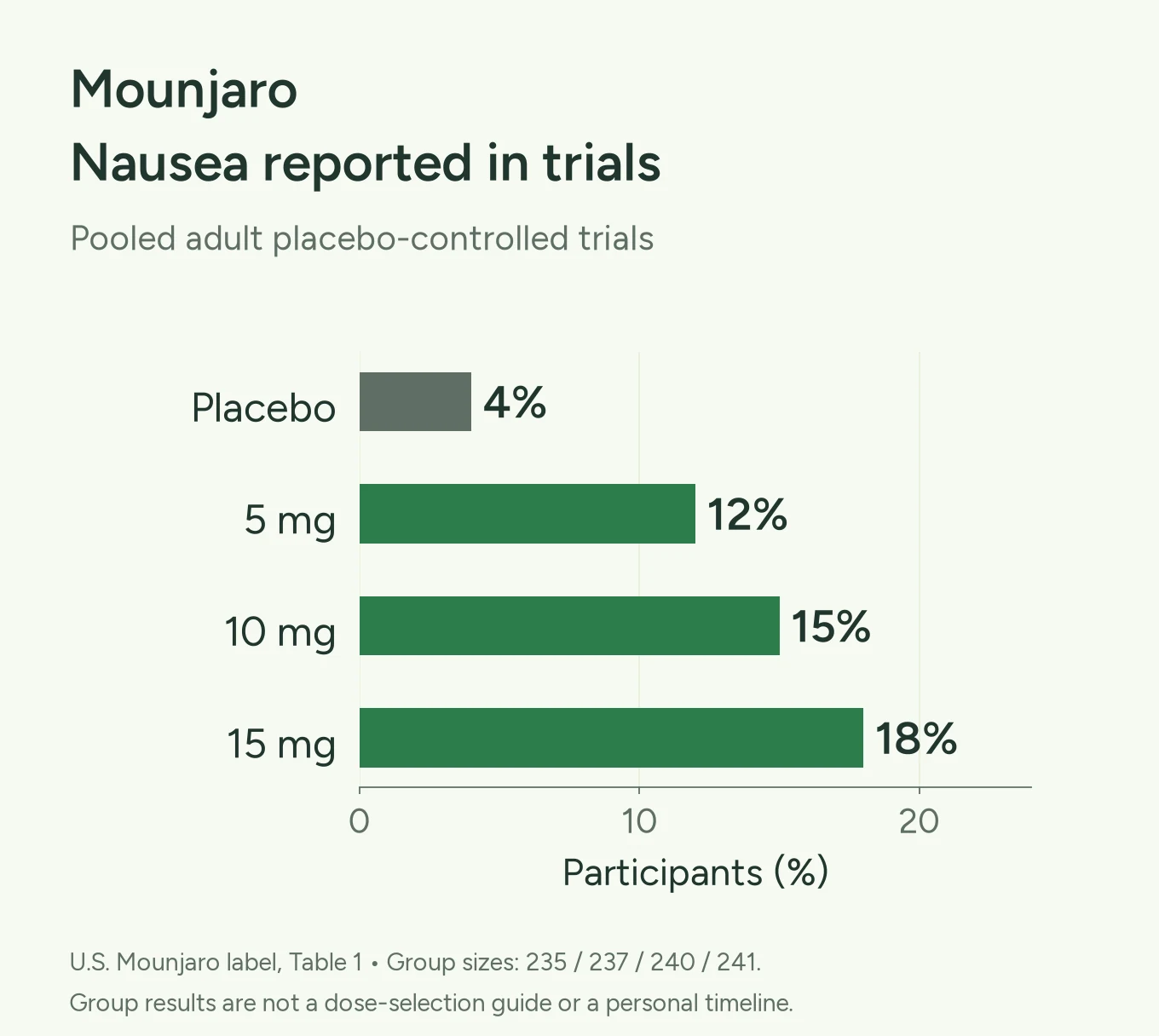
The current Mounjaro label identifies seven reactions reported in at least 5% of treated patients. In its pooled adult placebo-controlled trials, the reported percentages were:
| Reaction | Placebo | Mounjaro 5 mg / 10 mg / 15 mg |
|---|---|---|
| Nausea | 4% | 12% / 15% / 18% |
| Diarrhea | 9% | 12% / 13% / 17% |
| Decreased appetite | 1% | 5% / 10% / 11% |
| Vomiting | 2% | 5% / 5% / 9% |
| Constipation | 1% | 6% / 6% / 7% |
| Indigestion, also called dyspepsia | 3% | 8% / 8% / 5% |
| Abdominal pain | 4% | 6% / 5% / 5% |
These are group results, not predictions for an individual or a dose-selection tool. The adult trial groups contained 235 placebo participants and 237, 240, and 241 participants receiving the respective Mounjaro doses. Other studies and patient populations can report different rates.
“Nausea” means feeling sick; “vomiting” is a separate event. Indigestion may describe upper-abdominal discomfort, while constipation and diarrhea describe bowel changes. Saying which experience is occurring is more useful than grouping everything under “my stomach feels bad.”
The label also reports other reactions, including burping, gas, reflux, abdominal distension, injection-site reactions, and hypersensitivity. Those should not all be relabeled as the same seven most-common reactions. A long online list may combine common findings, less-frequent reactions, serious warnings, and reports whose frequency cannot be established.
Why symptoms may be more noticeable after a dose increase
Tirzepatide affects GIP and GLP-1 signaling, helps regulate blood glucose, and delays stomach emptying. Its effects on digestion help explain why fullness and gastrointestinal symptoms are part of treatment discussions. They do not establish the cause of every symptom.
In the adult placebo-controlled trials, the label says most reports of nausea, vomiting, or diarrhea occurred during dose escalation and decreased over time. The prescribing schedule is designed partly to reduce gastrointestinal reactions. That is a reason to follow the prescribed schedule, not to speed up, repeat, delay, or change a dose on your own.
If symptoms are becoming difficult after an increase, report the change to the treating team. “This started after my dose changed” is useful information. “It must be safe because I just increased the dose” is not a supported conclusion. There is no single number of days that makes every reaction normal.
For questions about continuing treatment over a longer period, our Mounjaro long-term side-effects guide covers that separate follow-up task.
What may help with nausea and mild digestive symptoms?
Lilly's patient guidance recommends talking to your doctor about nausea. It also says some people find the following helpful:
- Eat smaller meals rather than a few large meals.
- Stop eating when you feel full.
- Avoid fatty foods when they worsen tolerability.
- Try bland foods such as toast, crackers, or rice.
These are options for comfort, not a universal diet or a requirement to under-eat. For example, taking a smaller first portion can make it easier to notice fullness without forcing yourself through a large plate. If poor appetite or nausea is making it hard to get adequate food or fluids, tell the treating team.
Vomiting and diarrhea deserve a hydration check
The label warns that vomiting, diarrhea, and nausea can lead to fluid loss and kidney problems. Tell the clinician if symptoms persist, drinking is difficult, or fluids are not staying down. Follow any existing medical fluid restrictions instead of adopting an online water target.
A bland meal does not treat dehydration or explain severe abdominal pain. If symptoms are severe or will not go away, use the product's warning instructions rather than simply repeating home measures.
Constipation, reflux, and other problems need their own answer
A nausea tip is not automatically a constipation treatment. Describe the bowel change, duration, discomfort, and any other medicines when asking a pharmacist or clinician about relief. Ask before adding over-the-counter products so the proposed remedy fits the symptom and your circumstances.
For more detail on bowel changes, see GLP-1 constipation. Sudden, severe, or persistent abdominal symptoms should not be routed into a self-care article instead of assessment.
Serious warnings: what the product information says to do
The Mounjaro Medication Guide includes several distinct warnings. The table summarizes important examples; it is not a complete list or a tool for diagnosing a symptom.
| Warning pattern or situation | Official action or discussion |
|---|---|
| Severe stomach-area pain that will not go away, possibly reaching the back, with or without nausea or vomiting | Stop using Mounjaro and call your healthcare provider right away; this is the pancreatitis warning |
| Facial, lip, tongue, or throat swelling; breathing or swallowing difficulty; severe rash or itching; fainting/dizziness or a very rapid heartbeat | Stop using Mounjaro and get medical help right away; these are serious-allergy symptoms |
| Severe stomach problems or problems that do not go away | Tell your healthcare provider |
| Upper-abdominal pain, fever, yellowing of the skin or eyes, or clay-colored stools | Tell your healthcare provider right away; these may be gallbladder-problem symptoms |
| Changes in vision | Tell your healthcare provider during treatment |
| Planned anesthesia or deep sedation | Tell all involved healthcare providers that you use Mounjaro; stomach-emptying effects matter to procedural planning |
The boxed warning concerns thyroid C-cell tumors found in animal studies; whether Mounjaro causes such tumors in humans is unknown. It must not be used in people with a personal or family history of medullary thyroid carcinoma or MEN 2. Report a lump or swelling in the neck, persistent hoarseness, trouble swallowing, or shortness of breath as the Medication Guide directs. An animal finding should not be rewritten as proof that the drug causes thyroid cancer in people.
Low blood sugar depends partly on other treatment
The risk of low blood sugar is higher when Mounjaro is used with insulin or a medicine such as a sulfonylurea. The guide lists symptoms including sweating, shakiness, dizziness, confusion, hunger, weakness, and a fast heartbeat. Ask your clinician about the prevention and response plan appropriate to your diabetes treatment, and follow that plan. Do not independently adjust insulin or another medicine based on this article.
The current U.S. label covers blood-glucose control with diet and exercise in adults and children aged 10 and older with type 2 diabetes, plus cardiovascular-event risk reduction in high-risk adults with type 2 diabetes. The adult reaction table above should not be presented as a pediatric risk estimate.
Injection-site changes are a separate question
A local red, itchy, or sore area at an injection site is a different observation from nausea or a wider allergic reaction. The product information includes injection-site reactions, while the administration instructions call for rotating sites. A local pattern alone cannot prove that a reaction is harmless.
Report persistent, spreading, worsening, or recurring skin changes, and follow the urgent instruction for serious-allergy symptoms. Our Mounjaro injection-site reaction guide focuses on describing those changes and the product-specific questions they raise.

A short symptom record can improve follow-up
After taking the appropriate care steps, record the exact medicine and prescribed dose, the most recent start or dose-change date, when the symptom began, how it changed, and relevant accompanying symptoms. Include other medicines and any difficulty eating or drinking.
A concrete statement could be: “Nausea started the day after the increase; I vomited twice yesterday and have had trouble keeping fluids down.” That gives the treating team more useful information than a single severity score. It is not a template to complete before calling about those problems.
Glowise's Side Effect Tracker can organize personal notes and medication timing so the sequence is easier to recall. Its role is organization, not determining causation, urgency, or the next dose.

Frequently asked questions
How long do Mounjaro side effects last?
The label reports that nausea, vomiting, and diarrhea often occurred during dose escalation and decreased over time in trials. It does not supply a universal personal timeline. Report bothersome or persistent symptoms, and follow urgent instructions for severe pain or serious-allergy symptoms.
Do side effects mean Mounjaro is working?
They do not measure benefit. Treatment response should be assessed against the goal of the prescription, while side effects are assessed for tolerability and safety. Having few side effects does not by itself mean the medicine is ineffective.
Are burping and gas on the same list as the seven most common reactions?
They are reported in the label, but they are not part of the same seven-item most-common list. Keeping the study categories distinct helps avoid presenting every mentioned symptom as equally frequent.
Should I stop Mounjaro if I feel unwell?
Do not make a blanket rule for every symptom. The Medication Guide explicitly instructs stopping and seeking prompt help for specified serious-allergy or pancreatitis-warning symptoms. For other troublesome reactions, contact the treating team for an individual plan rather than adjusting treatment yourself.
Sources

About the author
Maya Lee
Glowise Senior GLP-1 Content Editor
Maya Lee is a Glowise Health Content Editor. Her guides turn product records, authoritative sources, and everyday organization questions into clear, practical GLP-1 information.
She helps readers ask better questions and keep the details relevant to a care conversation together.
See more Glowise on Google
Add Glowise as a preferred source to find our GLP-1 guides more easily in Google Search.