
Yes—GLP-1 medicines can improve blood-sugar control and, for products studied and approved for weight management, produce substantial average weight loss. They work through signals involved in appetite, insulin, glucagon, and digestion. The result depends on the medicine, the condition being treated, the treatment program, and the person's response.
That answer needs more than a percentage. A diabetes study and a weight-management study measure different goals; a trial average does not predict one person's outcome. This guide explains the mechanisms, what product-specific research demonstrates, and the limits that matter when deciding what “working” means.
The product examples use U.S. prescribing information checked on September 18, 2026. They are examples of evidence, not recommendations for a particular prescription.
How GLP-1 medicines work in the body
GLP-1 is a hormone involved in the body's response to eating. GLP-1 receptor agonist medicines activate the relevant receptor, allowing a drug to influence several connected processes. The National Academy of Medicine's overview describes the relationship between appetite, fullness, stomach emptying, and treatment effects.
Blood sugar: insulin and glucagon
Insulin helps the body handle glucose in the blood. Glucagon helps signal the liver to release glucose. GLP-1 receptor activity can support insulin release and reduce glucagon in a glucose-dependent way, helping lower elevated blood sugar.
“Glucose-dependent” is an important part of the explanation: the response relates to blood-glucose levels rather than representing a fixed amount of insulin delivered by the medicine. It does not mean low blood sugar is impossible. Risk can increase when treatment is combined with insulin or a sulfonylurea, so the whole medication plan matters.
Appetite and digestion
GLP-1 signaling can increase fullness and reduce appetite and food intake. Some medicines also delay stomach emptying. These effects help explain why eating patterns and body weight may change during treatment, and why digestive side effects are relevant.
They do not mean a person must feel sick to benefit. Nausea is an adverse effect, not a test of whether enough medicine is working. Someone with little nausea can still respond, while someone feeling very unwell needs a safety and tolerability review rather than reassurance that discomfort proves success.
Tirzepatide acts on two receptors
Not everything commonly called a “GLP-1” is the same molecule. Semaglutide is a GLP-1 receptor agonist. Tirzepatide activates both GIP and GLP-1 receptors, as described in the Mounjaro clinical pharmacology information.
That is a mechanism distinction, not proof that one product will work better for a particular person. Different formulations and approved uses still need their own evidence.

What does “working” mean for different treatment goals?
The first useful question is what the prescription is intended to accomplish. Less hunger, a lower weight, and better blood-glucose control are related but different observations.
| Treatment question | Evidence that is relevant | What should not be substituted for it |
|---|---|---|
| Is diabetes treatment improving glucose control? | Measures such as HbA1c and glucose readings, interpreted within the treatment plan | Appetite change or a few days of weight change alone |
| Is a weight-management medicine helping? | Weight change over an appropriate follow-up period, tolerability, and the goals of the prescribed program | A prediction taken from another person's result |
| Does the product reduce a particular health risk? | Trials and an approved indication for that product and population | Assuming every medicine in the class has every benefit |
For example, the current U.S. Mounjaro label covers blood-glucose control in adults and children aged 10 and older with type 2 diabetes, and a separate cardiovascular-risk indication in high-risk adults with type 2 diabetes. Zepbound contains the same active molecule, tirzepatide, but has its own weight-management and sleep-apnea indications. The brand, purpose, and evidence cannot be swapped simply because the ingredient is shared.
A clinician can help define what response will be assessed and when. That makes follow-up more useful than asking whether a medicine is “working” without naming the goal.
What do weight-loss studies actually show?
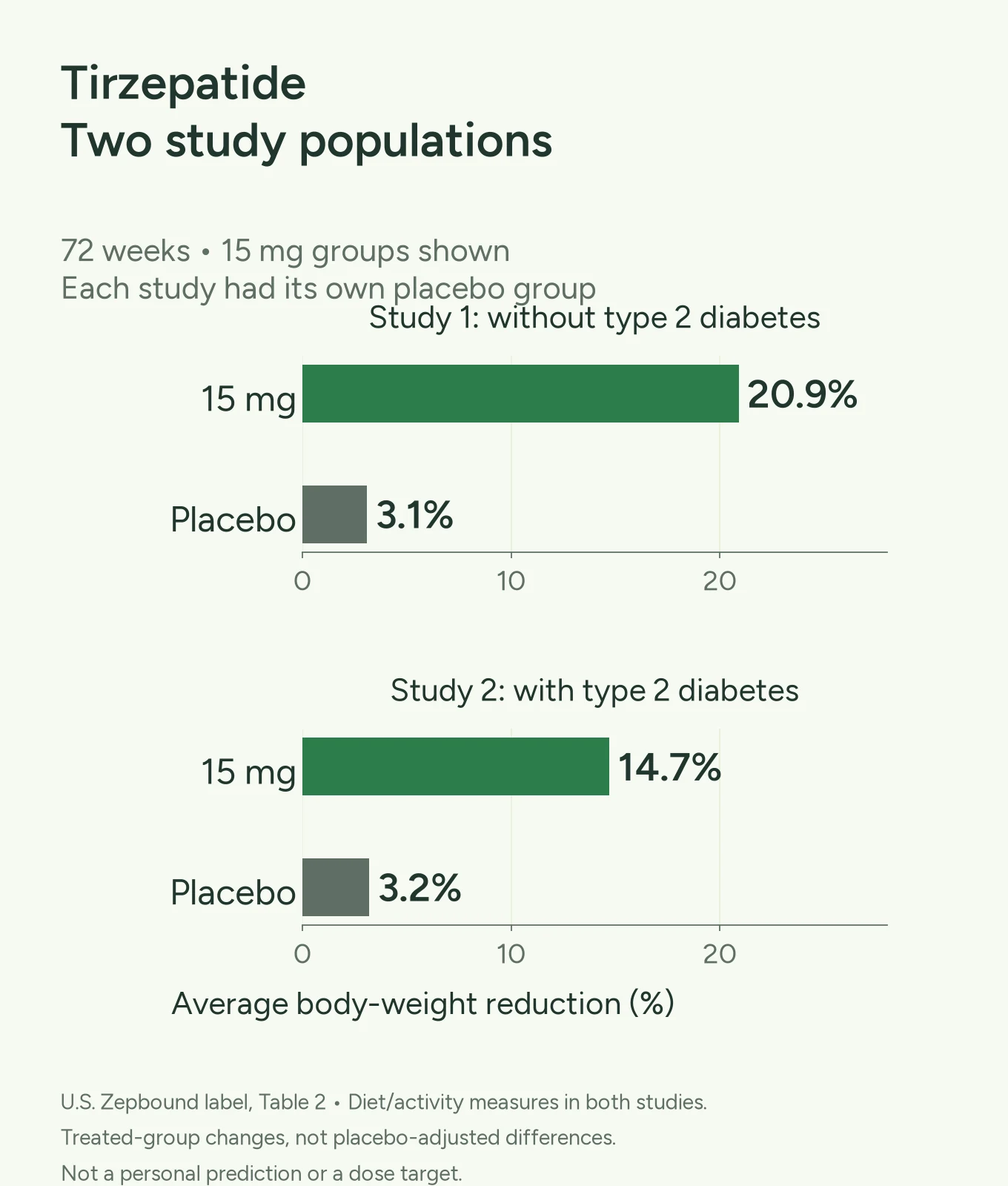
The current Zepbound label illustrates why study conditions matter. Its first two weight-reduction studies followed participants for 72 weeks and compared tirzepatide with placebo, alongside the study's diet and physical-activity program.
The table below uses the 15 mg groups as one documented example. This is a studied dose, not a recommendation to aim for it.
| Study population | Modeled average body-weight change with 15 mg tirzepatide | Placebo group |
|---|---|---|
| Study 1: adults with obesity, or overweight with a weight-related condition, without type 2 diabetes | −20.9% (630 participants) | −3.1% (643 participants) |
| Study 2: adults with BMI of at least 27 and type 2 diabetes | −14.7% (311 participants) | −3.2% (315 participants) |
Two distinctions prevent misleading interpretations:
- Group change versus treatment difference. In Study 1, the treated group's average change was −20.9%. The difference from placebo was −17.8 percentage points. Those are different numbers describing different comparisons.
- Study result versus individual prediction. The averages include varying responses under the trial's conditions. They do not mean every participant lost that amount or that another person will do so by a chosen date.
The different findings between the two study populations also show why a single headline percentage is incomplete. The clinical context changes the question. Nor can a Zepbound trial prove the equivalent performance of a compounded preparation or declare a winner against a different medicine tested in a separate study.
Oral medicines also have their own trials. The current Wegovy label, for example, contains separate tablet and injection studies. Our GLP-1 pill versus injection comparison explains their practical differences and why separate trial averages are not a head-to-head contest.
Why individual results vary
Even with an appropriate prescription, people can differ in their response, treatment duration, tolerability, other health conditions, and ability to follow the routine. A dose-escalation period is not the same as completing the treatment period reported in a trial.
The relevant question is therefore how your actual course compares with the plan your clinician set—not whether a short-term observation matches a headline from a 64-, 68-, or 72-week study. If doses are missed, access is interrupted, or side effects make eating and drinking difficult, those details matter to the review.
A stalled scale reading alone does not establish that all treatment benefit has stopped, particularly if the prescription also has a glucose-control goal. Conversely, reduced appetite alone does not establish adequate benefit or safety. Bring the measured outcomes, the time course, and any practical barriers to follow-up.
For early-treatment questions, the first month on GLP-1 treatment addresses that narrower period. Do not independently increase a dose to chase a trial average or try to reproduce someone else's result.
Benefits come with side effects and practical limits
A medicine can be effective and still be unsuitable or difficult to tolerate for a particular person. Common gastrointestinal reactions can include nausea, vomiting, diarrhea, constipation, indigestion, and abdominal pain, depending on the product. The exact label identifies its warnings and who should not use it.
Serious warnings can include pancreatitis, gallbladder problems, dehydration-related kidney problems, and severe allergic reactions. Product-specific Medication Guides explain which symptoms call for stopping the medicine and getting prompt help. Do not replace those instructions with a generic “wait for your body to adjust.”
The Harvard Health explanation of GLP-1 medicines discusses mechanisms, benefits, and risks as separate topics. That separation is helpful: a benefit in one area does not cancel out a serious symptom in another.
Eating enough still matters
Less appetite is not the same as having no nutritional needs. If food aversion, persistent nausea, or vomiting is making adequate intake difficult, tell the treating team. A clinical review of excessive restriction and other concerns during treatment highlights why follow-up should consider eating patterns and hydration, not only the amount of weight lost. Its clinical observations should not be treated as a frequency estimate for all users.
Access and ongoing treatment are part of the result
Affordability, supply, and tolerability can affect whether someone can continue the prescribed routine. Ask what the longer-term plan involves, including monitoring and what to do if treatment is interrupted. Weight regain after stopping has been observed in research; it is a separate question from whether a medicine had an effect while it was being taken. Our guide to weight regain after stopping GLP-1 treatment examines that evidence and its limits.
What to ask at a follow-up
A short set of questions can turn this information into a useful conversation:
- What outcome are we trying to improve with my exact prescription?
- Which measures and follow-up period will we use to assess it?
- How do my symptoms, other medicines, or medical conditions change the plan?
- What should I do if treatment becomes difficult to obtain or tolerate?
- Which symptoms require immediate action rather than waiting for the next visit?
For instance, “My appetite is lower, but I do not know how that relates to my glucose-control goal” asks a more answerable question than “Is this working?” It identifies both an observation and the uncertainty.

Glowise's GLP-1 tracker can organize medication timing, food, water, symptoms, and progress for recall. Those records may make a conversation clearer, but they do not establish clinical effectiveness or tell you which treatment to choose.
Frequently asked questions
Does GLP-1 work for everyone?
No medicine produces the same result in everyone. Evidence of an average benefit in a studied population does not guarantee an individual response. The exact product, treatment goal, health context, tolerability, and follow-up findings matter.
How quickly should I know whether it is working?
There is no single timeline for every medicine or treatment goal. Some prescriptions involve gradual dose escalation, and trial outcomes are measured over a defined period. Ask your clinician when and how your response will be assessed rather than comparing a few days with a long-term trial average.
Is GLP-1 the same thing as semaglutide?
No. GLP-1 is a naturally occurring hormone; semaglutide is a GLP-1 receptor agonist medicine. Tirzepatide is another molecule with both GIP and GLP-1 receptor activity. Their products have different labels and evidence.
Do nausea or other side effects prove the medicine is effective?
No. Side effects and treatment benefit are separate questions. A person can respond without feeling nauseated, and troublesome symptoms need review even if other measures are improving.
Can tracking prove that a medicine caused weight loss?
A personal record can show changes over time, but it cannot isolate a medication's effect from all other influences. Controlled trials and clinical assessment answer different questions from a personal diary.
Sources

About the author
Maya Lee
Glowise Senior GLP-1 Content Editor
Maya Lee is a Glowise Health Content Editor. Her guides turn product records, authoritative sources, and everyday organization questions into clear, practical GLP-1 information.
She helps readers ask better questions and keep the details relevant to a care conversation together.
See more Glowise on Google
Add Glowise as a preferred source to find our GLP-1 guides more easily in Google Search.