
Weight loss with a GLP-1 medicine can include both fat mass and non-fat tissue. That deserves attention, but it does not mean GLP-1 medicines universally “melt muscle.” The number often reported as lean mass includes much more than skeletal muscle, and the most useful response is broader than trying to defend one body-composition reading.
To support muscle health during substantial weight loss, coordinate three things: give muscle a regular resistance-training signal, eat enough protein and overall nourishment to support that work, and watch strength and daily function alongside any measurement. If eating, drinking, strength, or mobility is getting worse, bring that pattern to a clinician sooner rather than waiting for a particular number.
Why weight loss can affect muscle-related measures
A sustained energy deficit means the body is using stored tissue. Ideally, fat provides most of the lost mass, but weight loss is not biologically limited to fat. Changes in water, glycogen, organs, connective tissue, and muscle can all contribute to non-fat weight change. This pattern existed in research on calorie restriction and bariatric surgery before modern GLP-1 medicines were available.
There is also a mechanical reason. Moving a heavier body through ordinary life provides a certain amount of loading. As body weight decreases, standing up, climbing stairs, and walking may require less force. Some tissue that helped support the heavier body may no longer receive the same everyday demand unless deliberate training supplies a reason to retain and adapt capacity.
GLP-1 treatment can add a practical complication: appetite suppression, early fullness, nausea, vomiting, taste changes, or food aversion may make it harder for some people to eat and drink enough. If intake falls sharply, the issue may not be protein alone. Energy, fluid, vitamins, minerals, and the variety needed for an adequate diet can decline together.
Resistance exercise and nutrition address different parts of the problem. Protein supplies amino acids—the building material. Resistance training is the renovation order that tells the body where functional capacity is needed. Materials without a training signal do not decide what structure to maintain; an ambitious training order without enough material, energy, or recovery is constrained too.
Age, hormones, previous activity, chronic disease, illness, sleep, recovery, and the speed and magnitude of weight loss can change the result. A population average cannot provide a fixed percentage for one person.
“Lean mass” is not another name for skeletal muscle
Before reacting to a headline or report, check the label. Body-composition terms describe different levels of the body, and similar-looking numbers may be answering different questions.
| Measure | What it represents | What it cannot tell you by itself |
|---|---|---|
| Body weight | Everything represented by the scale | How much is fat, water, muscle, bone, or another component |
| Fat mass | An estimate of fat molecules | Strength, physical function, or the exact condition of muscle tissue |
| Fat-free mass or lean body mass | A broad non-fat category containing water, protein, minerals, glycogen, and non-fat parts of many tissues | A directly isolated amount of skeletal muscle |
| DXA lean soft tissue | Estimated non-fat, non-bone-mineral soft tissue | Anatomically measured skeletal muscle or muscle quality |
| Skeletal muscle mass | Anatomically defined muscle tissue, measured or estimated with methods such as MRI, CT, or validated appendicular estimates | How strong or capable someone is in every task |
| Strength | Force in a defined task | Total muscle mass or overall daily function |
| Function | Ability to perform meaningful activities safely and effectively | The single tissue or mechanism responsible for a change |
A 2024 body-composition review by Tinsley and Heymsfield explains the scale of this distinction. In reference models, fat-free mass is approximately 74% water, 19% protein, and 6.5% mineral, and its absolute mass is more than twice skeletal muscle mass. Even adipose tissue contains water and protein. Losing adipose tissue can therefore reduce measured fat-free mass without that whole reduction being contractile muscle.
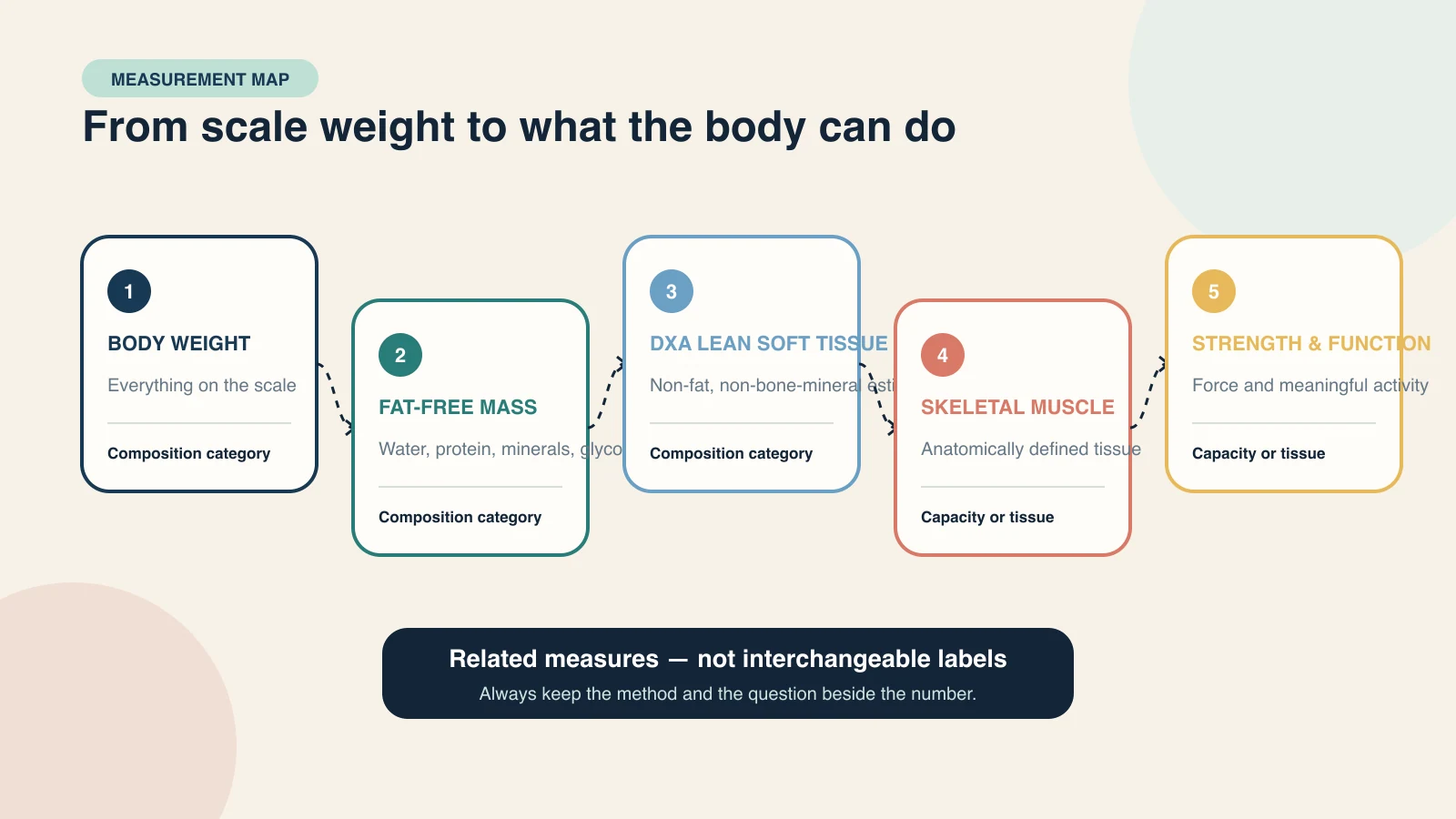
This is why the statement “25% of the group’s lost weight was lean mass” cannot honestly become “25% was muscle.” It is also why dismissing every lean-mass decline as “just water” would be a mistake. The measurement is broader than muscle, but muscle can be part of it.
Mass, quality, strength, and function may also move in different directions. Someone new to resistance exercise may become stronger early through improved coordination and neural adaptation without showing a rise in estimated lean mass. Conversely, a stable estimate does not guarantee stable function. Protecting muscle health means caring about tissue and what the body can do.
What GLP-1 body-composition studies actually show
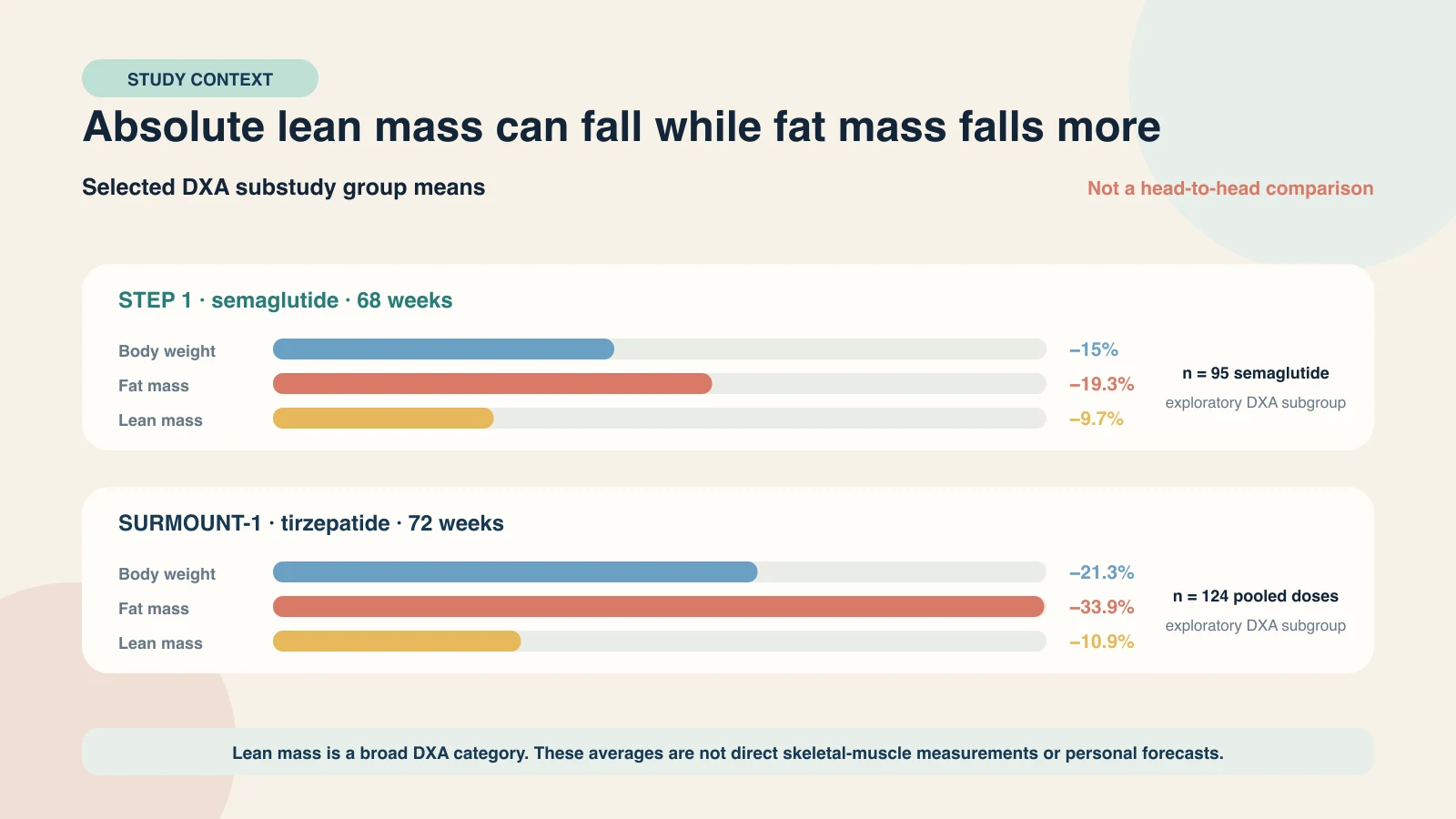
The major substudy findings are useful when their populations, methods, and timeframes stay attached. They describe averages in selected research groups; they do not forecast one reader’s body composition.
Semaglutide in the STEP 1 DXA substudy
The STEP 1 parent trial included 1,961 adults with overweight or obesity, without diabetes, who received lifestyle intervention and were assigned to semaglutide 2.4 mg weekly or placebo for 68 weeks. An exploratory DXA substudy at nine sites included 140 participants: 95 receiving semaglutide and 45 placebo. Seventy-six percent were female, and mean baseline weight and BMI were 98.4 kg and 34.8 kg/m².
In the semaglutide group, mean body weight decreased by 15.0%, total fat mass by 19.3%, regional visceral fat mass by 27.4%, and total lean body mass by 9.7%. Absolute lean body mass fell, while lean mass as a proportion of total body mass increased by 3.0 percentage points and the lean-to-fat-mass ratio improved.
Two statements can therefore be true at once: absolute lean mass decreased, and the group’s body composition became less adipose overall. This was a small exploratory subgroup using DXA to report total lean body mass—not a direct skeletal-muscle measurement, strength assessment, or personal prediction.
Tirzepatide in the SURMOUNT-1 DXA substudy
Of 2,539 SURMOUNT-1 participants, 160 had DXA data at baseline and week 72. The substudy included 124 participants receiving pooled tirzepatide doses and 36 receiving placebo. They were adults with obesity or overweight plus a weight-related complication, without type 2 diabetes. Lifestyle counseling included an estimated 500 kcal/day deficit and at least 150 minutes of weekly physical activity, but no specified resistance-training protocol.
At week 72, mean changes in the tirzepatide group were −21.3% for body weight, −33.9% for fat mass, and −10.9% for lean mass. Researchers reported that approximately 75% of weight lost was fat mass and 25% lean mass in both the tirzepatide and placebo groups. A later correction clarified that one figure’s axis for fat and lean mass should have been labeled in kilograms, not percent.
Again, this is a group-level DXA finding, not proof that one quarter of an individual’s loss is skeletal muscle. The dedicated Mounjaro and muscle-loss evidence guide explains the tirzepatide result in more detail.
The broader weight-loss context
The often-repeated idea that one quarter of lost weight is fat-free mass is a rough group-level approximation, not a biological rule. In older, pre-GLP-1 literature summarized in the 2024 review, the median share reported as fat-free mass was about 14% for low-calorie diets, about 23% for very-low-calorie diets, and roughly 18% to 31% across surgical procedures.
Those ranges vary with sex, adiposity, age, diet, activity, metabolic state, and the measurement method. They show why medication exceptionalism is unhelpful: non-fat tissue change is not unique to GLP-1 treatment. They do not justify false reassurance either. Direct evidence is stronger for changes in broad DXA categories than for long-term, directly measured skeletal muscle and function across diverse GLP-1 users.
Make resistance training a repeatable signal
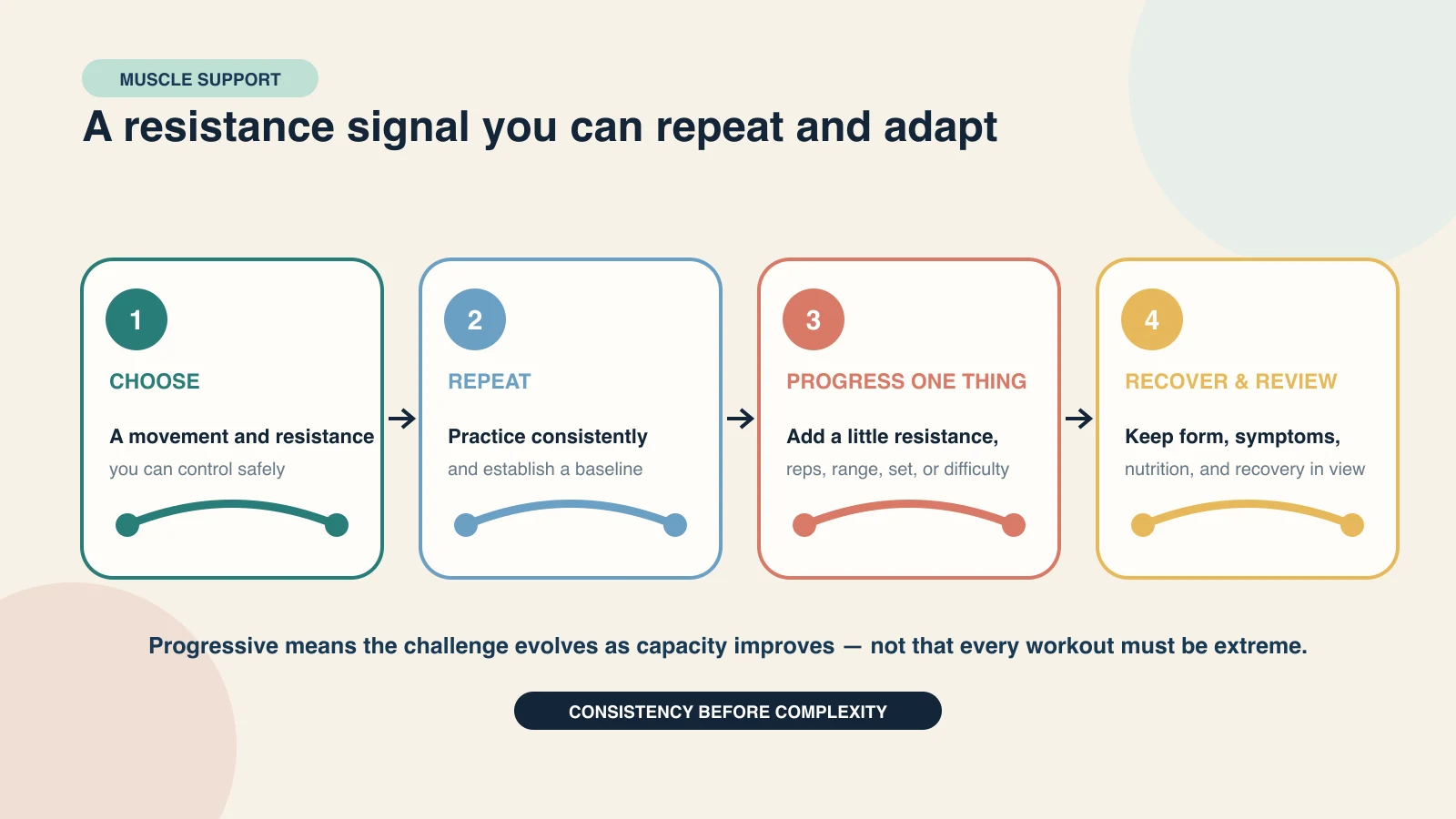
Resistance training gives muscle a recurring reason to preserve force-producing capacity during weight reduction. “Progressive” does not have to mean extreme, highly technical, or endlessly heavier.
A practical progression looks like this:
- Choose a movement and resistance you can control safely.
- Repeat it consistently enough to learn the movement and establish a baseline.
- When it becomes reliably manageable with good form, increase one variable modestly: resistance, repetitions, a set, range of motion, or movement difficulty.
- Allow for recovery and adjust the plan to your medical and physical context.
Movement categories might include a chair rise or squat, a push, a pull or row, a hip hinge, a step, and a carry. Bands, body weight, machines, dumbbells, and home-friendly setups can all provide resistance. The point is not to collect every exercise. It is to train major muscle groups in a form that is safe enough to repeat and challenging enough to create a signal.
The evidence supporting this principle is not limited to GLP-1 users. A 2018 systematic review and meta-analysis included six randomized trials in generally sedentary older adults with obesity who performed resistance training three times weekly for 12 to 24 weeks during calorie restriction. Compared with calorie restriction alone, adding resistance training reduced lean-body-mass loss by 93.5%, with a raw mean difference of 0.819 kg (95% CI 0.364–1.273), while fat and total weight loss were similar. This was not a GLP-1 trial, and it does not promise complete preservation for everyone. It supports resistance exercise as a strong countermeasure during an energy deficit under those study conditions.
Should it be two or three days per week?
Different recommendations answer slightly different questions. General US public-health guidance uses muscle strengthening on at least two days each week as a population baseline. ACSM’s 2026 guidance emphasizes consistency and training all major muscle groups at least twice weekly, with equipment and setting adapted to preference and safety.
A corrected 2026 multi-society advisory for clinical care during GLP-1 treatment proposes a more intensive goal: strength training at least three times weekly, plus at least 150 minutes of moderate aerobic activity, individualized to the person’s capacity.
For many readers, at least two major-muscle-group sessions per week is a practical starting reference. Some GLP-1 experts propose three during active weight loss. The better schedule is the one that provides an adequate, progressive signal while fitting baseline ability, recovery, medical status, and adherence. More sessions are not automatically better if pain, fatigue, poor intake, or an unrealistic setup makes them inconsistent. The broader GLP-1 and exercise guide can help place strength work within a weekly activity routine.
Older adults, people with low baseline strength, prior falls, frailty, limited mobility, arthritis, disability, balance concerns, or cardiovascular conditions may benefit from supervised exercise, physical therapy, or exercise-physiology support earlier. Progress may initially mean better control, range, confidence, or tolerance—not adding weight.
Protein helps, but the denominator matters
Protein is necessary for maintaining and repairing tissue, but a high number on paper is not a complete muscle-preservation plan. The training stimulus, total energy intake, overall diet, and recovery still matter.
Readers may encounter several numerical references in GLP-1 nutrition guidance:
- The adult protein Recommended Dietary Allowance is 0.8 grams per kilogram per day.
- Intakes around 1.2 to 1.6 grams per kilogram per day have been proposed during active weight reduction.
- A corrected 2026 multi-society advisory also describes 80 to 120 grams per day as a practical absolute alternative that may be easier to apply.
These figures need conditions. For a person with obesity, multiplying a grams-per-kilogram target by actual body weight may substantially overestimate needs. There is no consensus on whether actual weight, adjusted or ideal weight, or fat-free mass should be the denominator. The 80-to-120-gram range is an expert reference, not a universal prescription. None of these numbers can account for an individual’s health history in an article.
Kidney disease, liver disease, pregnancy, older age, prior bariatric surgery, eating-disorder history, and other circumstances may change the appropriate plan. A clinician or registered dietitian can help choose both the amount and the denominator. The protein on GLP-1 guide explores these target discussions and logging questions without turning a broad range into a personal calculation.
When appetite is the limiting factor
When a full plate feels unrealistic, a smaller eating opportunity can still do useful work. Depending on preferences and tolerance, yogurt, eggs, lentil soup, fish, tofu, nut or seed butter, or a clinician- or dietitian-approved shake can provide protein in a smaller volume. Pairing these with varied nutrient-dense foods across the day matters because muscle support is not only a protein problem.
Notice the practical difference between “I missed a protein target” and “I have been able to manage only a few bites and little fluid.” The second pattern raises broader nutrition and hydration concerns. If medication effects repeatedly prevent adequate eating or drinking, record what is happening and contact the prescriber. Do not change the dose or schedule on your own, and do not try to force an extreme eating or training plan through persistent symptoms.
Persistent low intake, recurrent vomiting, very rapid weight loss, highly restrictive eating, prior bariatric surgery, or an eating-disorder history justify earlier nutrition assessment. Persistent inability to eat or drink, signs of dehydration, fainting, or marked or new weakness warrant prompt medical attention; urgent or emergency symptoms need urgent or emergency care.
Review two signals: measurement and capacity
A body-composition result becomes more useful when it is paired with something the body can do. A simple review has two columns:
- Measurement signal: body weight or a body-composition result, recorded with its date, device or method, and reasonably comparable conditions.
- Capacity signal: strength or function in a repeatable activity.
For example, a smart scale may estimate falling lean mass while controlled chair rises improve and the resistance used for band rows increases. That creates a different question from weight falling while stairs, chair rises, and familiar training loads all become harder. Neither pattern diagnoses a cause. The second gives a clearer reason for timely professional review.
Useful repeatable observations include controlled chair rises, a familiar flight of stairs, carrying usual grocery bags, a familiar band or machine setting, or the same body-weight exercise variation. Meal capacity matters too: note whether regular meals have become just a few bites. These observations are communication aids, not home diagnostic tests.
| Tool or observation | Useful job | Main limitation |
|---|---|---|
| Bathroom scale | Shows total weight trend | Cannot separate fat, lean soft tissue, muscle, bone, glycogen, or water |
| Consumer smart-scale BIA | Convenient trend when conditions stay similar | Hydration and device equations affect estimates; it is not a direct muscle measure or diagnosis |
| Clinical BIA | Can provide repeatable estimates in some settings | Remains model-based and method-sensitive; devices are not interchangeable |
| DXA | Estimates fat mass, bone mineral, and lean soft tissue | Lean soft tissue is not skeletal muscle, and infrequent tests may miss earlier change |
| MRI, CT, or ultrasound | Provides anatomical information in selected settings | Access, cost, CT radiation, protocol, and clinical indication matter |
| Grip, chair rise, stair climb, or timed-up-and-go | Adds strength or function context, especially for older adults | One task does not represent every muscle and may be insensitive for younger trained adults |
| Training log or repeated everyday task | Tracks personally meaningful capacity | Pain, technique, sleep, illness, motivation, and equipment can change performance |
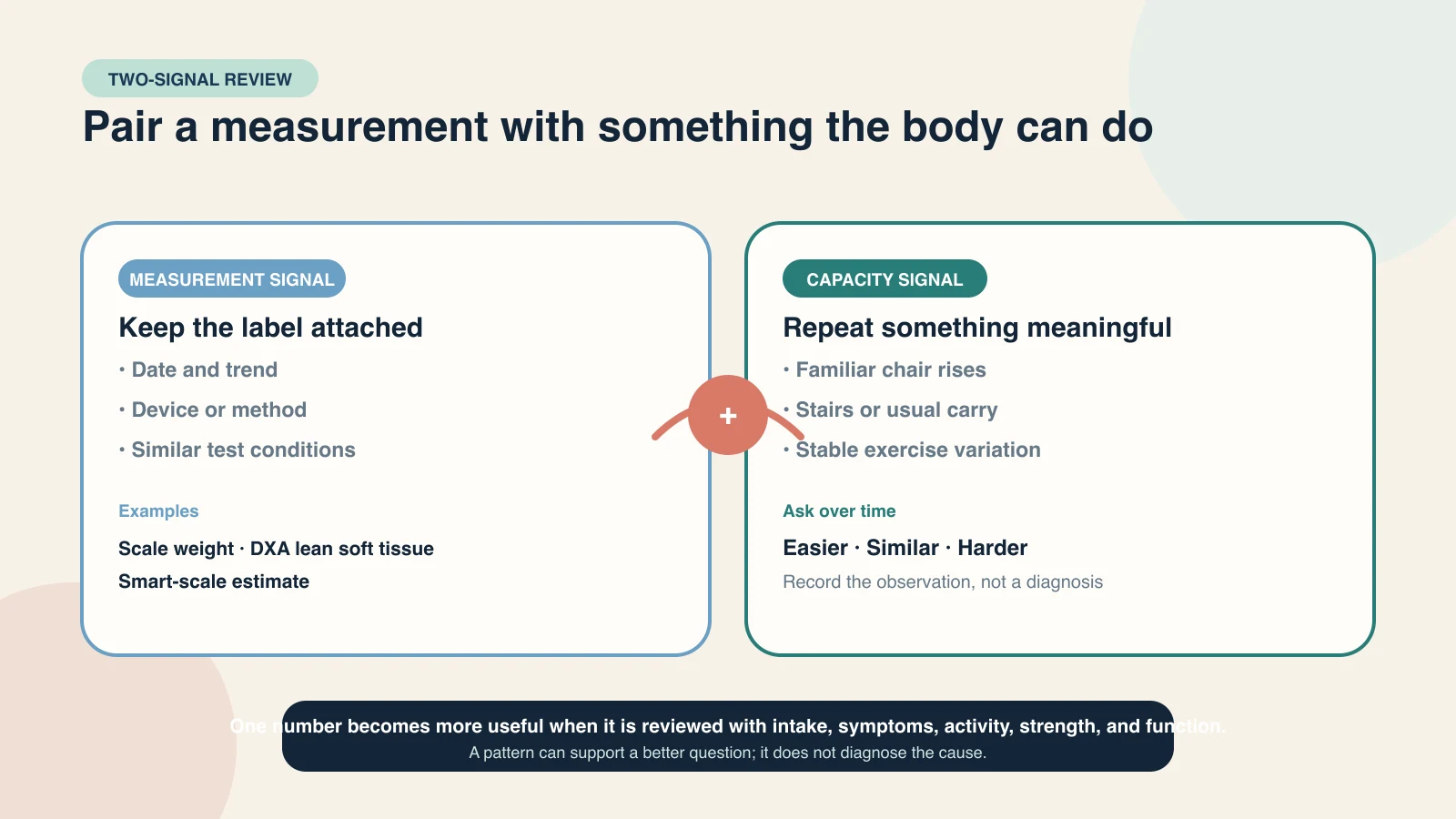
Compare the same method under reasonably similar conditions rather than treating different devices as interchangeable. Keep the original label—“DXA lean soft tissue” or “smart-scale estimate,” for example—along with the date. Interpret it beside symptoms, intake, activity, strength, and function. A one-repetition maximum is not a casual home test and is not recommended by the multi-society advisory unless the person is highly trained.
Younger, healthy, already-trained adults may learn more from consistent training-performance trends or a professionally selected measure than from an older-adult function screen. Hormonal contexts such as perimenopause, menopause, or low testosterone can add muscle and bone considerations that merit clinician assessment when strength or function is declining.
Turn your notes into a useful review
A clinician or dietitian does not need a perfect dashboard. They need enough context to see whether several changes may be traveling together. Before a visit or message, gather:
- The weight or body-composition result, including date and measurement method.
- A repeatable strength or function observation and how it has changed.
- Typical food and fluid intake, especially a pattern of missed or very small meals.
- Nausea, vomiting, early fullness, taste changes, fatigue, pain, or another barrier.
- Current resistance and aerobic activity, plus recent changes in training or recovery.
- Medication timing and the speed of the recent weight trend.
Glowise can help organize user-entered medication, food and nutrition, water, side effects, weight, activity, progress, and personal strength or function notes. Reviewing those records together may make it easier to describe whether low intake followed medication days, whether training became less consistent, or when a daily task started feeling harder.
Glowise does not measure skeletal muscle or body composition. It cannot diagnose sarcopenia, decide whether medication caused weakness, choose a protein target, clear an exercise plan, prescribe treatment, or recommend a dose or schedule change. Its role is to keep context available for a better-informed conversation.
See the pattern, not just one number
Keep your GLP-1 routine and observations together
Track medication, meals, water, side effects, weight, activity, and personal progress notes so you can review the surrounding context with your care team.
The practical takeaway
A coordinated muscle-health approach
- Treat lean mass as a broad measurement category, not a synonym for skeletal muscle.
- Give major muscle groups a repeatable, appropriately progressive resistance-training signal.
- Pair protein with adequate energy, fluids, varied nutrients, and recovery.
- Use two weekly strength sessions as a public-health starting reference; some GLP-1 experts propose three during active loss.
- Record the date and method beside body-composition results, then compare them with strength and meaningful function.
- Seek earlier professional help when intake, hydration, strength, mobility, or daily function is worsening.
Frequently asked questions
Do GLP-1 medicines always cause muscle loss?
No. Research shows that substantial weight loss can include decreases in broad lean-mass categories, but the amount and meaning vary with the person, intervention, activity, nutrition, timeframe, and measurement method. Current studies do not justify claiming that every GLP-1 user loses a fixed amount of skeletal muscle.
If 25% of lost weight is lean mass, does that mean 25% is muscle?
No. That percentage is sometimes reported as a group-level division of weight loss in a study. Lean mass includes water, protein, minerals, glycogen, and non-fat components of many tissues. It is not a direct muscle-only measurement or a personal forecast.
Can protein alone prevent lean-mass loss?
Protein supplies amino acids, but expert guidance says increased protein alone is likely inadequate without structured resistance training. Total nourishment, energy, hydration, micronutrients, recovery, health conditions, and the training stimulus all affect the context.
How often should I strength train while taking a GLP-1 medicine?
General US guidance supports strengthening major muscle groups at least twice weekly. A corrected 2026 multi-society GLP-1 advisory proposes at least three strength sessions weekly during treatment, individualized to capacity. Your starting point, loading, supervision, progression, and recovery should reflect your health and physical context.
Can a smart scale tell whether I am losing muscle?
A consumer smart scale uses bioelectrical impedance and device equations to estimate body composition. Hydration and testing conditions can shift the result, and it does not directly measure skeletal muscle or diagnose muscle loss. Use it as a consistently collected trend, if useful, and pair it with strength, function, intake, symptoms, and professional assessment when needed.
Sources
- Body composition during weight loss: fat-free mass and skeletal muscle distinctions — Tinsley and Heymsfield’s 2024 review of measurement categories, tissue composition, historical weight-loss findings, and interpretive limits.
- STEP 1 exploratory DXA substudy — 68-week semaglutide body-composition results in a 140-participant exploratory subgroup.
- SURMOUNT-1 DXA substudy — baseline-to-week-72 tirzepatide body-composition findings in 160 participants.
- SURMOUNT-1 figure correction — correction of the fat- and lean-mass axis unit in Figure 4.
- Corrected multi-society GLP-1 nutrition and activity advisory — contextual protein references, strength and aerobic activity guidance, and assessment considerations.
- Advisory corrigendum — related correction notice for the multi-society advisory.
- Resistance training during calorie restriction in older adults with obesity — 2018 systematic review and meta-analysis of six randomized trials lasting 12 to 24 weeks.
- ACSM resistance-training guidance, 2026 — consistency, major-muscle-group frequency, and adaptable training approaches.
- Physical Activity Guidelines for Americans, second edition — US public-health reference for muscle-strengthening activity.

About the author
Maya Lee
Glowise Senior GLP-1 Content Editor
Maya Lee is a Glowise Health Content Editor. Her guides turn product records, authoritative sources, and everyday organization questions into clear, practical GLP-1 information.
She helps readers ask better questions and keep the details relevant to a care conversation together.
See more Glowise on Google
Add Glowise as a preferred source to find our GLP-1 guides more easily in Google Search.