
A rash while taking Zepbound can describe several different problems. A red or itchy area around an injection site is different from a widespread rash, hives, or skin changes accompanied by breathing difficulty or swelling. Zepbound's label reports both injection-site reactions and hypersensitivity reactions, but the appearance or timing of a rash alone cannot tell you which explanation applies.
The useful next step is to recognize the warning signs first, then describe the location, spread, and associated symptoms clearly. This guide uses U.S. Zepbound information checked on September 23, 2026, with a published dermatology review for additional context.
Injection-site reactions and wider rashes are different categories
An injection-site reaction occurs where the medicine was injected. The Zepbound label groups several reported findings under that name, including redness, itching, pain, and a rash at the injection site.
Hypersensitivity is a different category. It refers to an allergic-type response, and the label says most hypersensitivity reactions in its trials were skin reactions such as rash or itching. Serious hypersensitivity reactions, including anaphylaxis and angioedema, have also been reported. A trial category is not a diagnosis you can assign by comparing your skin with a list.
| What you notice | How to describe it accurately |
|---|---|
| A change limited to the injection area | State its location, size or spread, appearance, tenderness, and when it appeared |
| A rash away from the injection site or over several areas | Note all affected areas and any hives, swelling, or other symptoms; do not assume it is only local irritation |
| Pain, burning, or unusual sensitivity without a visible rash | Describe the sensation separately; pain without visible skin changes is not the same observation as a rash |
| Skin changes with serious-allergy symptoms | Follow the urgent Medication Guide instruction, rather than using a checklist to rule out danger |
The last distinction matters when searching “Zepbound skin sensitivity.” A sensation can be real even when there is no visible rash, but this does not establish its cause. Tell the clinician what you feel and what, if anything, you can see.
How common are these reactions in studies?
In the pooled adult weight-reduction trials reported in the current label, injection-site reactions occurred in 6% to 8% of Zepbound-treated participants, depending on the studied dose, versus 2% with placebo. Hypersensitivity reactions occurred in 5% of the Zepbound groups versus 3% with placebo.
| Trial group | Injection-site reactions | Hypersensitivity reactions |
|---|---|---|
| Placebo | 2% | 3% |
| Zepbound 5 mg | 6% | 5% |
| Zepbound 10 mg | 8% | 5% |
| Zepbound 15 mg | 8% | 5% |
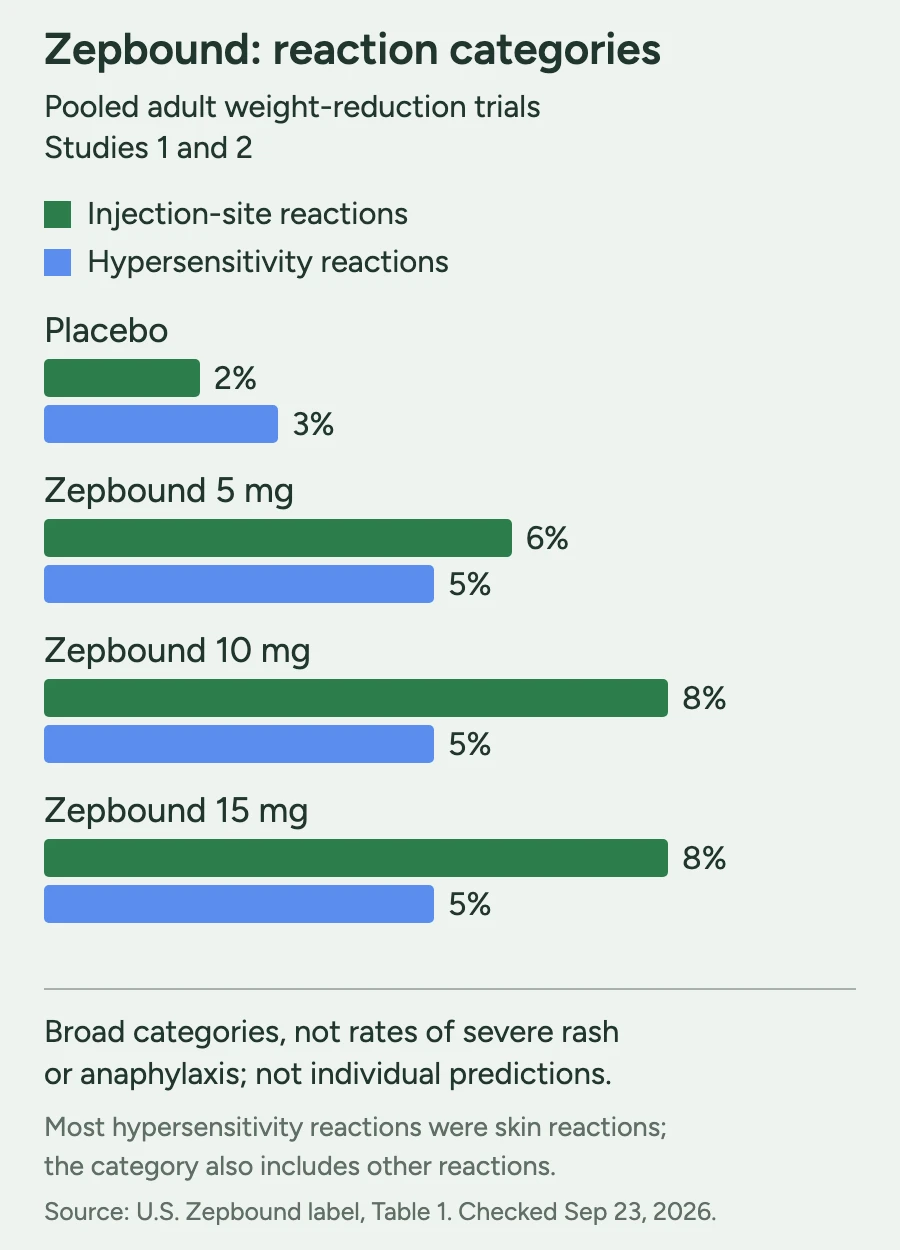
These are broad adverse-reaction categories from the pooled trials, not the percentage of people who developed a severe rash or anaphylaxis. Injection-site reactions include findings other than rash, and the hypersensitivity category includes reactions of different kinds and severity. The percentages cannot diagnose an individual's skin change or establish that one dose is appropriate for them.
The current label also reports the timing and severity categories separately. In pooled Studies 1 and 2, severe hypersensitivity reactions occurred in 0.1% of Zepbound-treated participants and no placebo-treated participants. Immediate reactions—defined in the label as occurring within one day after administration—were reported in 2.1% versus 0.4%, while non-immediate reactions were reported in 3.5% versus 2.7%. These categories show that reactions were reported on more than one timeline; they do not provide a clock for deciding whether a rash is safe or whether another dose is appropriate.
Why can the skin react after an injection?
A review of tirzepatide-related skin events describes local redness, mild swelling or firmness, itching, and discomfort around injection sites. It discusses several possible contributors, including the injection itself, formulation-related factors, and immune responses. Those possibilities are not a way to identify the cause of a particular rash at home.
The review also draws on different kinds of evidence: controlled trials, individual case reports, and adverse-event reports. A case report is valuable for recognizing a possible event, but it cannot tell us how often it occurs. Similarly, a proportion in a reporting database is not the same as a risk measured in everyone taking the medicine.
Skin changes can also have causes unrelated to Zepbound. A new skin product, adhesive, detergent, another medication, or an infection may belong in the clinical assessment. Timing helps describe the problem, but “it happened after the injection” does not establish the entire explanation.
How long can an injection-site reaction last?
The dermatology review describes some local reactions appearing within hours and resolving over roughly one to three days. That is a description of reported local reactions—not a rule to wait three days before asking for help, and not a promise that every reaction will follow that course.
A patch becoming larger, more painful, hot, or associated with drainage, fever, or other symptoms needs assessment rather than an assumption that it is a normal adjustment. Contact a healthcare professional about a rash that persists, worsens, spreads, or returns after successive injections. Follow the urgent allergy instruction immediately when the listed symptoms occur.
For recurring reactions, it is useful to report whether each change is at a new injection site, how the appearances compare, and whether symptoms occur elsewhere. That helps distinguish a repeated pattern from one episode without deciding its medical meaning.
What can you do about a local reaction?
Start with the instructions supplied with the exact Zepbound presentation. The Medication Guide directs users to rotate the injection site with each weekly injection. The same body area may be used, but the injection should be at a different site within that area. Rotation is an administration instruction; it does not guarantee that a rash will not recur or treat an allergy.
The product's Instructions for Use also address selecting a site and handling the particular pen or vial. Have a pharmacist or clinician review your technique if the steps are unclear. Do not transfer needle, device, or preparation advice from another product, and do not inject into an affected area without clarifying the appropriate next step.
For itching or discomfort that is not an emergency, ask a pharmacist or prescriber what relief is appropriate for your symptoms and other medicines. A generic online recommendation for an antihistamine or steroid cream may not fit the cause, body location, or health history. Do not use a new remedy to postpone help for serious-allergy symptoms.
A useful initial description is short: where the reaction is, when it began, whether it is spreading, and whether there are symptoms elsewhere. If taking a photograph helps you show a change over time, keep the date and avoid delaying care to obtain a better picture.

When should you get medical help?
The Medication Guide is the primary source for product-specific action. It separates important urgent symptoms from ordinary discussions about tolerability.
| Situation | Next step |
|---|---|
| Serious-allergy symptoms, including facial or throat swelling, trouble breathing or swallowing, or severe rash or itching | Stop using Zepbound and get medical help right away, as the Medication Guide instructs; use emergency services when appropriate |
| A skin change that is spreading, increasingly painful, hot, draining, or accompanied by fever | Seek prompt professional assessment rather than deciding from appearance that it is a routine local reaction |
| A persistent or recurring local reaction without those urgent features | Contact the treating team about the reaction and review the exact product instructions and injection technique |
| Uncertainty about the next dose after a new rash | Ask the prescriber for an individual plan; a general article cannot clear a person to continue |
This is not an exhaustive list of possible problems, and a small-looking skin change is not automatically harmless. The serious-allergy warning includes severe itching as well as visible rash. For broader product warnings, see our Zepbound side-effects guide.
Record the details after arranging the right care
A useful note keeps observations separate from conclusions. Record the date and time first noticed, the affected area, whether it is at the injection site, what you can see or feel, any spread or change, accompanying symptoms, and the medicine's timing. If the reaction recurs, retain separate dated entries rather than replacing the old note.
For example: “A raised itchy area appeared near the injection site that evening. By the following morning it had spread beyond the original area.” That is more useful than “I definitely have an allergy,” but it is still a reason to communicate—not a method of determining whether care can wait.
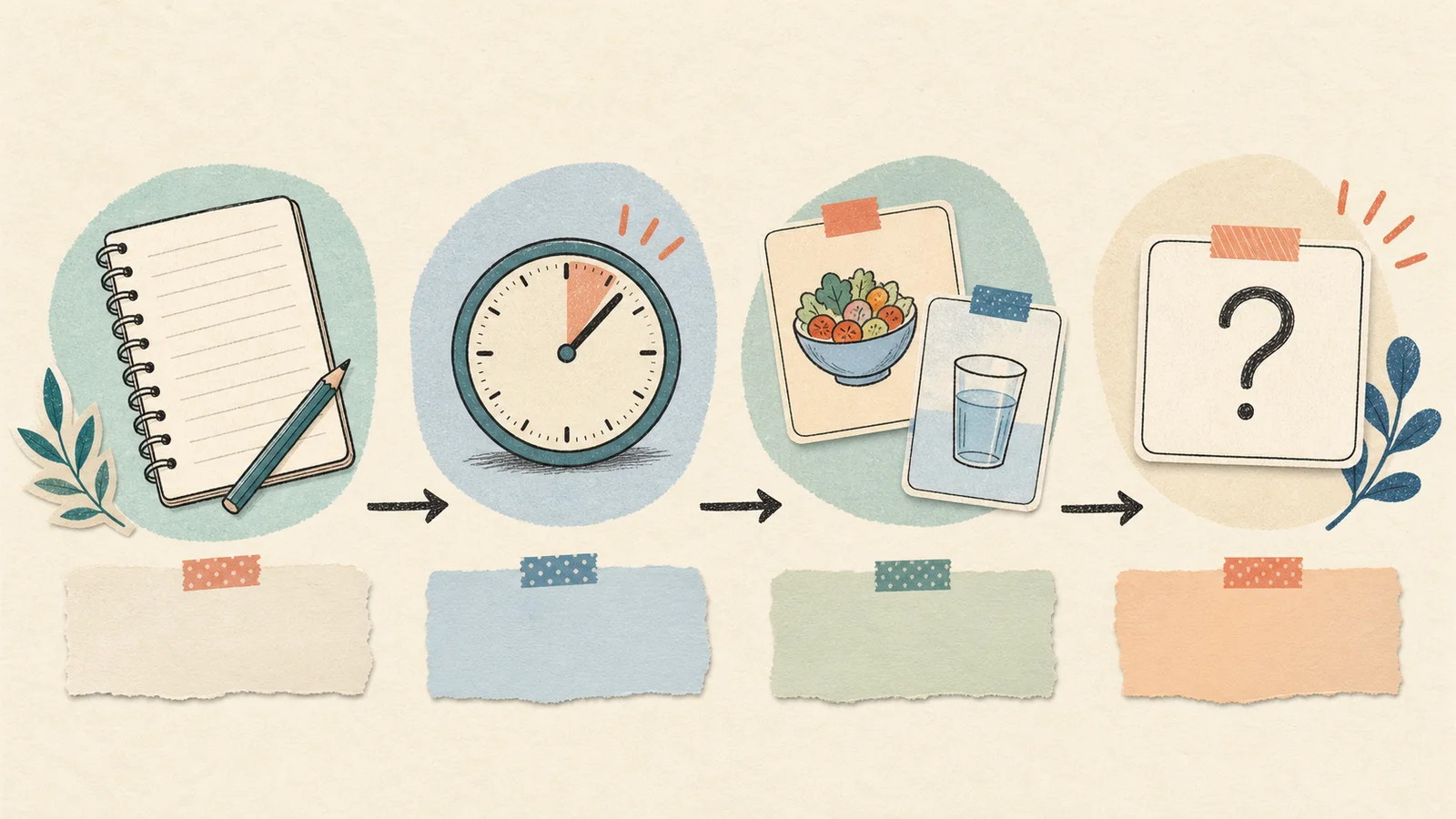
Glowise's Side Effect Tracker can organize personal symptom notes alongside medication timing and day-level context. It supports recall; it cannot classify a rash, decide urgency, or authorize another dose.
Keep dated symptom details together
Organize your notes and medication timing for follow-up after taking the appropriate care steps.
Frequently asked questions
Is every rash after Zepbound an allergic reaction?
No. Injection-site findings and hypersensitivity reactions are different reported categories, and skin changes can have other causes. Location and timing alone cannot establish the cause. Follow the label's urgent instructions for serious-allergy symptoms.
Is it safe to continue if the rash is only at the injection site?
A location alone cannot establish safety. Contact the prescribing team about a new, persistent, worsening, or recurring reaction and ask about the next dose. Serious-allergy symptoms require the Medication Guide's stop-use and immediate-help action.
Does the 6% to 8% figure mean severe rash is common?
No. That figure is for the broad injection-site-reaction category in the pooled weight-reduction trials. It includes several local findings, not just rash, and does not represent the rate of severe allergy.
Can skin hurt without a visible rash?
Pain or unusual sensitivity is a different observation from a visible rash. Describe both what you feel and what you can see to a clinician. This article does not establish that such a sensation is caused by Zepbound or is a particular diagnosis.
Sources
- Zepbound U.S. prescribing information and Medication Guide, revised August 2026
- DailyMed: Zepbound label and Instructions for Use
- Lilly: Zepbound prescribing information and Medication Guide
- Tirzepatide in dermatology: comprehensive review of cutaneous adverse events and evidence limitations
- Mayo Clinic: tirzepatide, precautions and side effects

About the author
Maya Lee
Glowise Senior GLP-1 Content Editor
Maya Lee is a Glowise Health Content Editor. Her guides turn product records, authoritative sources, and everyday organization questions into clear, practical GLP-1 information.
She helps readers ask better questions and keep the details relevant to a care conversation together.
See more Glowise on Google
Add Glowise as a preferred source to find our GLP-1 guides more easily in Google Search.