
If you take semaglutide and have a drug test coming up, the test order matters more than the medicine's reputation or half-life. A drug screen is built to look for named drugs or metabolites; it is not a complete inventory of everything in your body.
Semaglutide is not one of the five drug categories named in the DOT panel, and routine blood work does not report it as a named result. Many routine employment panels are built around named targets, but employer, court, sports, and clinic panels vary. A laboratory could measure semaglutide with a purpose-built assay, but that is a different order from a routine screen or checkup. The panel and specimen—not the fact that semaglutide is a prescription injection—determine what the result can show.
What an employment drug screen is looking for
MedlinePlus describes drug testing as testing a sample—such as urine, blood, saliva, hair, or sweat—for particular drugs or their metabolites. That wording matters: the laboratory must have a target in the ordered panel.
For a U.S. Department of Transportation regulated test, 49 CFR § 40.82 lists marijuana metabolites, cocaine metabolites, amphetamines, opioids, and phencyclidine (PCP). The section also says DOT specimens may not be tested for other drugs. Semaglutide is not one of those listed targets.
“Employment drug test” still does not describe one universal panel. A private employer, court, sports organization, or clinic may order a different set of analytes, use a different specimen, or follow rules from another program. If the question affects a job, license, or legal matter, ask the testing provider for the panel name and specimen type. That is more reliable than assuming that every test called “standard” is identical.
A prescription can matter to the review process without being an analyte on the screen. Give the collection site or medical review professional an accurate medication list when the instructions request it. You do not need to treat semaglutide as an explanation for a positive result for a different substance without evidence from the report.
How routine blood work is different
Routine blood work measures selected health markers. A CBC counts blood cells. A metabolic panel may include glucose, electrolytes, and kidney or liver markers. A lipid panel measures cholesterol and triglycerides. None of these panels is automatically a search for every medication molecule.
Semaglutide treatment can coincide with changes in the values a clinician is monitoring. The current U.S. Wegovy prescribing information lists gastrointestinal reactions such as nausea, vomiting, and diarrhea and describes decreased appetite and weight reduction in its clinical-study information. Those effects or treatment-related changes may be part of the clinical context; the label does not let us infer that a particular change in glucose, A1C, weight, or hydration was caused by semaglutide in one person. They do not mean the routine panel detected semaglutide itself.
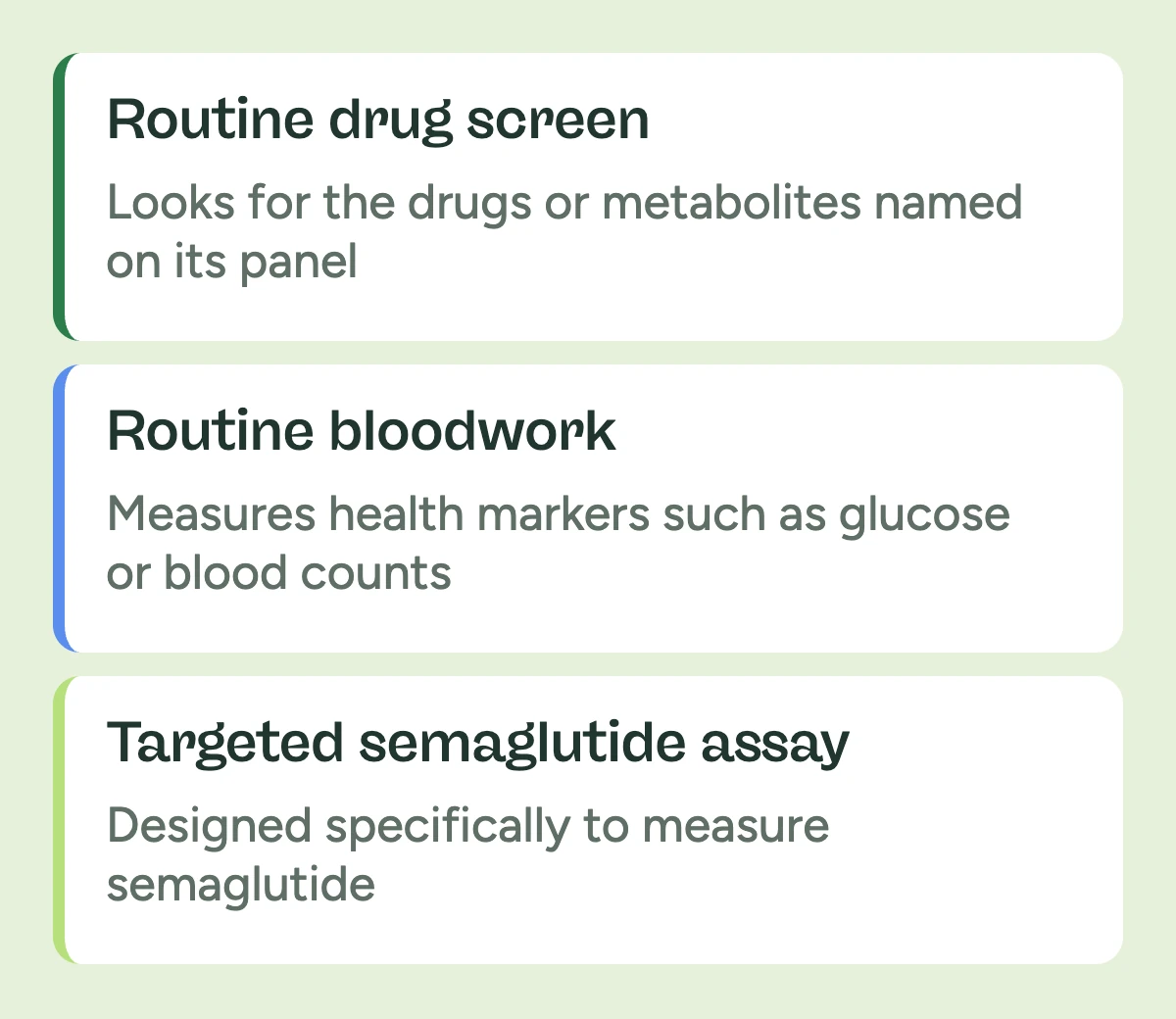
_The test order and its named targets determine what a report can show; this illustration is a comparison of test purposes, not a medical result._
If a clinician is reviewing an unexpected value, tell them the exact product, dose, date of the last dose, and any symptoms that could affect hydration or nutrition. That context can help with interpretation. It cannot prove that semaglutide caused a particular result.
When could a test measure semaglutide itself?
A laboratory can develop and validate an assay for a particular molecule. That technical possibility does not establish that a routine blood draw, a workplace urine screen, or a commercial toxicology panel includes a semaglutide method.
A targeted assay should have its own order, specimen requirements, validation, reporting range, and clinical or research purpose. This article does not establish that such an assay is available through your employer or local laboratory. If someone says a test “found semaglutide,” ask for the test name, specimen, analyte, and method. A glucose, A1C, CBC, urine drug screen, or standard toxicology result should not be relabeled as a semaglutide result.
The same caution applies to the phrase “blood work.” A test can use blood as its specimen and still look for a specific drug class, a hormone, an antibody, or a routine chemistry marker. The specimen alone does not tell you what was measured.
Could semaglutide cause a false positive?
A result cannot be interpreted from the medication name alone. Test design, specimen, cutoff, and confirmation method all matter. The narrower and more useful point is that semaglutide is not a target in the DOT panel described above.
MedlinePlus notes that an initial urine screen can produce a false positive and that a more specific confirmatory test is generally used. If a result is unexpected, find out whether it is a screening result or a confirmed result, and which drug or metabolite was reported. Do not use semaglutide as a catch-all explanation for a confirmed finding for another substance.
What to do when a result surprises you
Ask for these four details before trying to interpret the result:
- Specimen: Was it urine, blood, saliva, hair, or another sample?
- Target: Which drug, metabolite, or class was reported?
- Stage: Was this an initial screen or a confirmatory result?
- Reviewer: Who is responsible for the explanation—laboratory staff, a medical review officer, a clinician, or a program administrator?
Then provide the requested medication and supplement list. Include semaglutide's brand or compounded product name when relevant, your prescribed dose, and the last-use date. Follow the testing program's instructions and your prescriber's medication instructions. Do not skip, delay, or change a dose to try to influence a test result; contact the prescriber if a medication question comes up.
For DOT testing, 49 CFR § 40.137 describes how the medical review officer verifies a confirmed result involving the panel's drug categories, including considering a legitimate medical explanation when the employee presents relevant information. § 40.141 describes obtaining information through the employee interview and review of relevant medical history and other biomedical factors; the MRO may seek further medical evaluation or contact medical personnel as the rule allows. Those conditions belong to the DOT process. They do not set the appeal procedure or verification steps for every employer, court, or sports program.
If the test affects employment, a license, court proceedings, or eligibility, ask that organization for its written review or appeal instructions and deadline. A laboratory or medical review officer can explain the assay and confirmation. A clinician or pharmacist can help you provide an accurate medication history.
A useful question to bring with you
You can ask: “Which substance did this test measure, was the result confirmed, and what information do you need about my prescriptions?”
That keeps three separate questions from being blended together: whether semaglutide is in the body, whether treatment may affect ordinary health markers, and what a particular test was designed to detect. A timeline for how long a medicine remains in the body cannot identify the analytes in a panel or tell you how to change treatment.
Glowise's GLP-1 tracker can help you keep a simple record of medication dates, symptoms, and routine measurements for a conversation with a clinician. A tracking record supports recall; it does not replace the laboratory report, the testing program's rules, or prescribing advice.
Sources
- MedlinePlus: Drug Testing — what drug tests look for, specimen types, and screening versus confirmation context.
- 49 CFR § 40.82 — DOT drug-panel analytes and restriction on testing DOT specimens for other drugs.
- 49 CFR § 40.137 and § 40.141 — DOT medical review and information-gathering process.
- Wegovy U.S. prescribing information — product-label context for listed gastrointestinal reactions, decreased appetite, and weight-related clinical-study information; it does not establish the cause of an individual routine-lab change.
- MeAgain: Does Semaglutide Show Up in Blood Work? — competitor framing reviewed as a lead; claims were narrowed to the checked sources above.
The article does not claim a universal detection window for semaglutide or give advice for avoiding, delaying, or defeating a test.

About the author
Maya Lee
Glowise Senior GLP-1 Content Editor
Maya Lee is a Glowise Health Content Editor. Her guides turn product records, authoritative sources, and everyday organization questions into clear, practical GLP-1 information.
She helps readers ask better questions and keep the details relevant to a care conversation together.
See more Glowise on Google
Add Glowise as a preferred source to find our GLP-1 guides more easily in Google Search.