“How long does a GLP-1 stay in your system?” sounds like it should have one answer. It does not. GLP-1 is a hormone; people often use “GLP-1 medicines” as shorthand for GLP-1 receptor agonists such as semaglutide (Ozempic, Wegovy) and liraglutide (Victoza), as well as tirzepatide (Mounjaro, Zepbound), which acts at both GIP and GLP-1 receptors. Their timelines differ. So do the questions of whether drug is still circulating, whether you feel an effect, and whether treatment should change.
The current U.S. labels give a direct answer for semaglutide: Ozempic says it remains in circulation for about five weeks after the last dose; Wegovy says about five to seven weeks after the last 2.4 mg or 7.2 mg injectable dose, or 25 mg oral dose. These statements are tied to the products and doses named in their labels. Other labels here report half-lives rather than an equivalent “in circulation until” window: about five days for Mounjaro, five to six days for Zepbound, and 13 hours for Victoza.
What “stays in your system” can mean
People use the phrase for several different questions:
- Can some drug still be present? This is a pharmacokinetic question about concentration and elimination.
- Could the medicine still be affecting me? This is a question about a lived symptom or response.
- Is it safe to take another dose, have a procedure, or change treatment? This is a clinical decision that depends on the exact medicine, dose, indication, health history, and plan from the responsible healthcare professional.
A lower concentration does not necessarily mean the same felt effect at lower intensity. Conversely, a symptom after the last dose may need assessment even when the medicine’s concentration has fallen. Keep the date and the concern together rather than trying to read one from the other.
The named medicines do not share one timeline
The labels report these elimination half-lives. They are useful for comparison, but the semaglutide circulation windows above are the more direct label answer to “how long” for those specified products and doses:
| Medicine and common U.S. brands | Label-reported half-life | What the comparison helps explain |
|---|---|---|
| Semaglutide (Ozempic, Wegovy) | About one week | Why measurable exposure declines over several weeks after a dose |
| Tirzepatide (Mounjaro) | Approximately five days | Why the medicine is designed for weekly administration and declines over multiple days |
| Tirzepatide (Zepbound) | Approximately five to six days | Why this product’s exposure also tapers over multiple days rather than disappearing at once |
| Liraglutide (Victoza) | About 13 hours | Why a daily medicine has a much shorter elimination interval than the weekly products above |
After one half-life, the amount of drug in the body is roughly half the starting amount. After another, roughly a quarter remains. That simple halving illustration explains why one half-life does not mean “gone”; it is not a measurement of your own concentration or a forecast of symptoms.
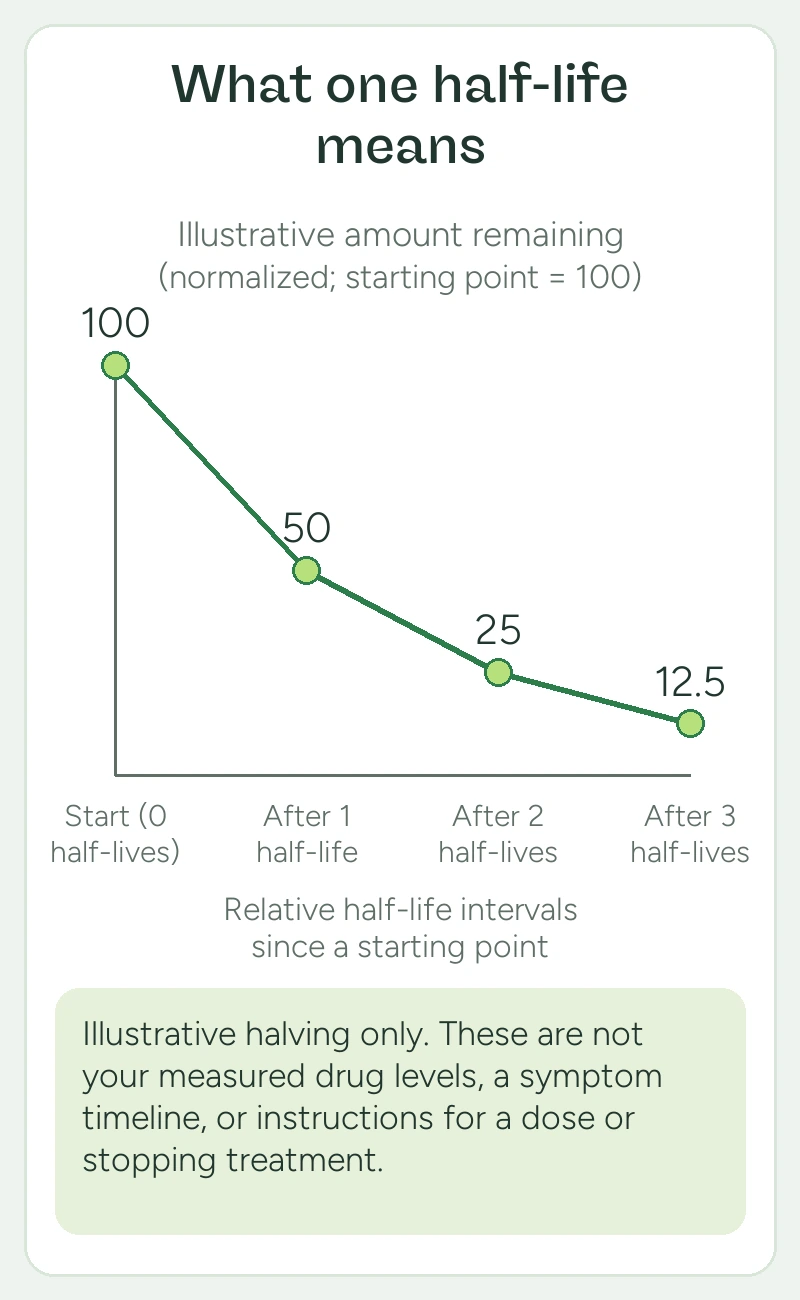
“Cleared” may mean a lower concentration, a laboratory detection threshold, or a clinical timing threshold. The tirzepatide and liraglutide half-lives above do not supply product-label “fully cleared” dates. Multiplying a half-life by a chosen number of intervals would be an illustration of decline, not a measured clearance date or a safe-stop rule.
Why the last dose is not the whole story
A single last dose is easy to picture, but repeated doses can accumulate. The product, dose, dosing history, and timing shape the concentration before the final dose; a half-life by itself does not reconstruct that history. The official labels for tirzepatide report that renal impairment does not have a clinically relevant effect on its pharmacokinetics, while still warning clinicians to monitor renal function when vomiting or diarrhea could cause volume depletion. That is a good example of why a general internet rule can mislead: a pharmacokinetic statement and a safety-monitoring instruction answer different questions.
For semaglutide and liraglutide, use the product-specific prescribing information for the product and indication you actually received. Do not substitute an Ozempic rule for Wegovy, or a daily liraglutide rule for a weekly semaglutide or tirzepatide product, simply because all of them are discussed as GLP-1 medicines.
Half-life does not predict your symptoms
A concentration estimate cannot diagnose the cause of a symptom. Nausea, vomiting, diarrhea, constipation, abdominal pain, reduced appetite, fatigue, or a change in how meals feel may have more than one possible explanation. The timing of a dose is useful context, but timing alone does not prove causation.
The Mounjaro Medication Guide gives a more concrete safety example: if you have severe abdominal pain that will not go away, with or without nausea or vomiting, stop using Mounjaro and call your healthcare provider right away; the pain may spread to your back. The prescribing information frames this as a possible pancreatitis warning. The pattern calls for prompt assessment, not self-diagnosis from mild stomach discomfort and not a wait for drug “clearance.” For severe, persistent, or rapidly worsening symptoms with any product, seek prompt medical advice.
If a symptom appears after the last dose, note when it began and what else changed. Drug presence alone cannot establish the cause or a resolution date.
Half-life does not decide whether treatment should stop
A decision to stop, restart, taper, or switch treatment needs the exact product and reason for treatment, your response and symptoms, other medicines, and any pregnancy or procedure plans. The half-life is one piece of context, not the decision rule.
Pregnancy instructions show why the product matters. The current Ozempic and Wegovy U.S. labels say to discontinue semaglutide at least two months before a planned pregnancy because of its long half-life. The Zepbound label instead says to discontinue Zepbound when pregnancy is recognized; it also says weight loss offers no benefit during pregnancy and may cause fetal harm. These are distinct product-specific instructions, not a two-month rule for tirzepatide or every medicine discussed as a GLP-1. If pregnancy is possible or planned, discuss the exact product and treatment indication with your healthcare professional early enough to follow its label and make a care plan.
If you are considering a change, ask: “Given my product, last dose, reason for treatment, symptoms, and other medicines, what should happen next?” Bring that question to the professional managing your care rather than choosing a date from a half-life chart.
For the separate question of what may happen to weight after treatment ends, see what research can and cannot show about weight regain after stopping a GLP-1 medicine. For a question about how quickly Mounjaro may begin to act, see how long Mounjaro takes to work. Those are related topics with different reader questions.
What to write down before you ask
A short record is more useful than trying to calculate a personal “washout” date. Include:
- The exact product name, strength, and date of the last dose.
- Whether your recent doses were taken on schedule or changed.
- The symptom or concern, when it began, and whether it is improving, stable, or worsening.
- Other medicines, supplements, illness, dehydration, or major routine changes that may be relevant.
- The question you want answered: symptom assessment, next dose, procedure timing, pregnancy planning, or treatment review.
Glowise can help you keep medication, symptom, food, water, weight, activity, and progress notes together so a dated pattern is easier to describe. It cannot diagnose a cause, determine urgency, calculate a safe stop date, or recommend a dose change. Use the record as context for a conversation with the healthcare professional responsible for your care.
The practical takeaway
What to remember
- Ozempic’s label says semaglutide remains in circulation for about five weeks after the last dose. Wegovy gives about five to seven weeks after the specified 2.4 mg or 7.2 mg injection or 25 mg oral dose.
- Mounjaro, Zepbound, and Victoza labels report shorter half-lives, but those values are not product-label “fully cleared” dates.
- A drug-timing estimate does not decide symptoms or treatment. Bring the exact product, last-dose date, concerns, and relevant context to your healthcare professional.
Frequently Asked Questions
Does one half-life mean the GLP-1 is gone?
No. After one half-life, roughly half the starting amount remains. The next interval halves that remainder again. This is an illustrative decline, not a personal drug measurement or a symptom timer.
Is semaglutide still in the body five weeks after the last dose?
It can be. Ozempic’s U.S. label says semaglutide is present in circulation for about five weeks after the last dose. Wegovy’s U.S. label says about five to seven weeks after the last 2.4 mg or 7.2 mg injectable dose, or 25 mg oral dose. These are label-reported windows for the named products and doses, not a guarantee of what one person’s blood test would show at week five or when symptoms will end.
Can I flush a GLP-1 out of my system faster?
Do not try to speed clearance with a home remedy, extra fluids, skipped meals, or an unapproved dose change. If you are worried about a symptom or an upcoming procedure, contact the healthcare professional responsible for your care and give them the exact product and last-dose information.
Should I stop a GLP-1 because it may still be in my body?
No. Ask the healthcare professional managing your treatment to review the reason for treatment, your response and concerns, and the product-specific instructions. If you have a severe or persistent symptom, seek prompt care instead of waiting for an estimated clearance date.
Sources
- Ozempic U.S. Prescribing Information
- Wegovy U.S. Prescribing Information
- Victoza U.S. Prescribing Information
- Mounjaro U.S. Prescribing Information
- Zepbound U.S. Prescribing Information
This article is educational information for a U.S. adult audience. It does not provide a diagnosis, treatment plan, prescription, or emergency assessment.

About the author
Maya Lee
Glowise Senior GLP-1 Content Editor
Maya Lee is a Glowise Health Content Editor. Her guides turn product records, authoritative sources, and everyday organization questions into clear, practical GLP-1 information.
She helps readers ask better questions and keep the details relevant to a care conversation together.
See more Glowise on Google
Add Glowise as a preferred source to find our GLP-1 guides more easily in Google Search.