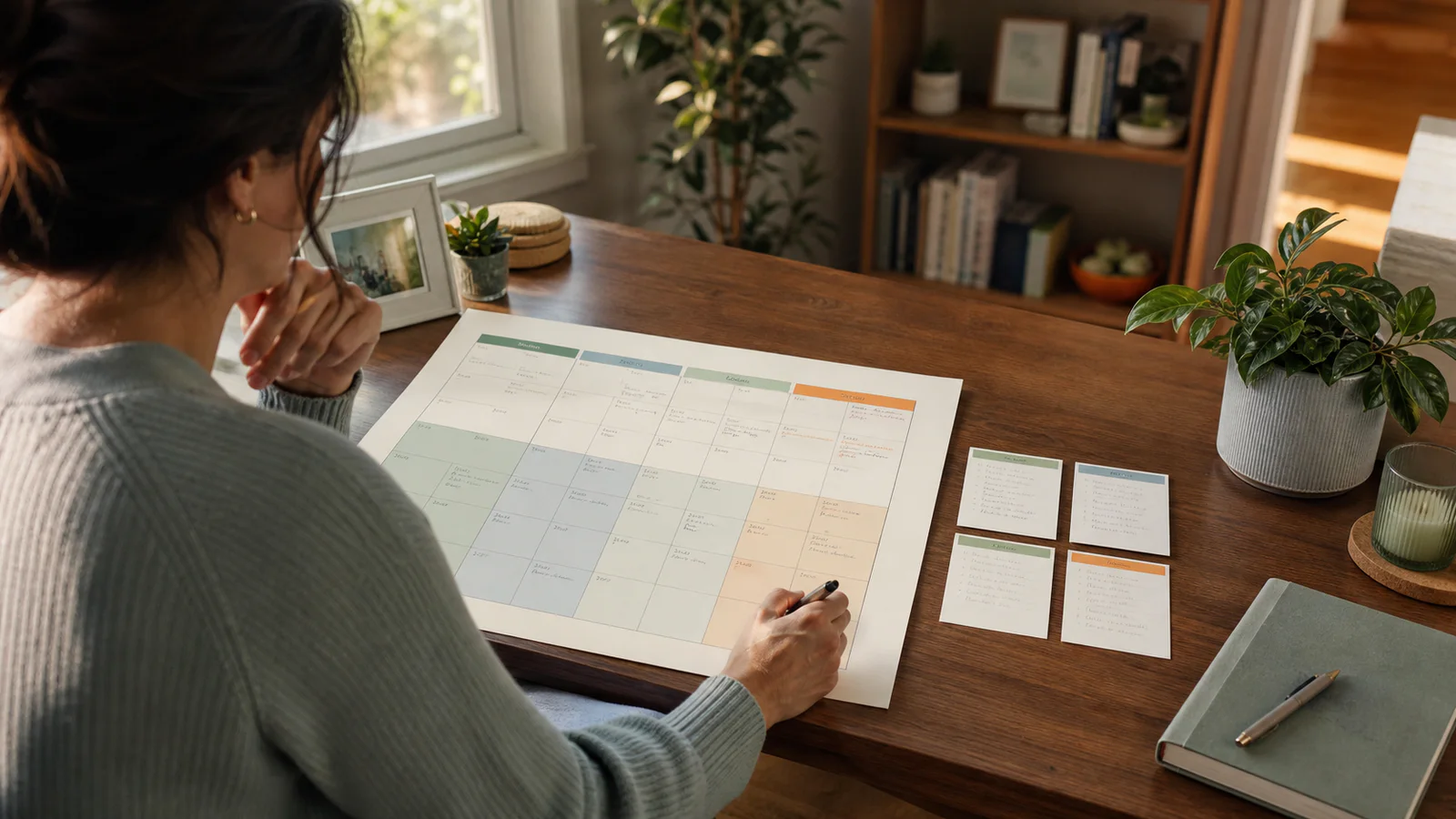
For an Ozempic gallbladder question, the current prescribing information says that acute gallbladder disease, including cholelithiasis or cholecystitis, has been reported in people taking the medication. That is a fact about the official document — and it is also the boundary of what the document can tell any individual reader. It does not say why a symptom happened to you, and neither can this article. What this article can do is explain what the label says, show why a remembered sequence of events is not the same thing as a cause, and offer a simple way to keep your own observations and one focused question together before a qualified follow-up.
What the Ozempic label says
The most reliable starting point for this question is not a search-result summary but the document itself. The official Ozempic prescribing information includes a section on acute gallbladder disease. In plain terms, it says that events such as cholelithiasis and cholecystitis have been reported. If acute gallbladder disease is suspected, the label directs gallbladder studies and appropriate clinical follow-up.
Two parts of that matter. The first is descriptive: these events have been reported. The second belongs to qualified professionals, not to self-interpretation at home. The label's scope is product information, not a personal explanation, and this article will not try to supply one.
Use the exact product information
It is worth pausing on the word “Ozempic” itself. Broad online discussions often fold this question into statements about GLP-1 medications as a class. But different products in that class have their own prescribing information, their own wording, and their own described events. A sentence that is accurate for the class may not match the exact language of the specific product a person is taking.
This article stays inside one boundary: the current Ozempic prescribing information. It does not borrow claims made about other products, does not add risk numbers, and does not turn a general class-level discussion into a statement about Ozempic specifically. If you are taking a different medication, its own label is the document to read.
Why timing is not a diagnosis
When something feels wrong after starting or adjusting a medication, the mind naturally connects the two events. You took a dose, and some time later you noticed a symptom. That sequence feels like an explanation. It is not one, and understanding why it is not one is genuinely useful — not as a dismissal of what you felt, but as a way to keep the facts clean.
A sequence is not a conclusion
A remembered sequence answers the question “what happened, and in what order?” A cause answers a different question entirely. The first question is something you can document yourself. The second belongs to a qualified professional with tools and training that a personal timeline cannot replace.
Many things happen in the same stretch of days as a medication dose: meals, stress, sleep changes, other medications, ordinary illness, and events you may not connect at the time. A symptom that follows a dose sits inside all of that context. Noticing the order of events is a real observation worth keeping. Treating that order as proof of cause skips every step in between.
This is also where a broad reference can help keep categories straight. A GLP-1 side effects guide can show how reported effects are described across the class in general terms, which is a different job than explaining your own week. Keeping the general list and your personal timeline in separate mental buckets makes a later conversation clearer.

The practical takeaway is modest but real: your timeline is information you bring, not a conclusion you reach. Write down what you noticed. Let someone qualified do the interpreting.
When to seek care rather than keep recording
The exact symptom still needs professional evaluation, but some symptoms should not wait for a tracker entry or a later follow-up. The NIDDK advises seeking care right away for abdominal pain lasting several hours, nausea or vomiting, fever or chills, yellowing of the skin or eyes, tea-colored urine, or light-colored stools during or after a gallbladder attack. Those signs can overlap with more serious conditions, so a record should never delay care. If you think the situation may be an emergency, use local emergency services.
Make a record that keeps the facts together
A vague worry is hard to discuss. A short, factual note is much easier — for you to remember and for a professional to work with. The goal is not to build a case or a log that proves anything. The goal is simply to prevent the details from blurring together before you have a chance to ask your question.
Four details that make a question clearer
A useful note has four parts, and each part stays neutral:
| Field | What to write | Example of neutral wording | What to avoid |
|---|---|---|---|
| Observation | What you noticed, in your own plain words | “Felt discomfort Tuesday evening” | Labels or self-diagnoses |
| Timing or duration | When it started and how long it lasted | “Started around 7 pm, eased by morning” | Guesses about cause |
| Nearby context | Ordinary details you chose to note | “Dose day; ate later than usual” | Interpretations of the context |
| One question | The single thing you want to ask | “Is this something to check?” | Demands for a specific answer |
The pattern across all four fields is the same: describe, do not conclude. “Felt discomfort” is a fact you own. “My gallbladder is reacting to the medication” is a conclusion that a note cannot support. The first version travels well into a professional conversation. The second has already closed the question it was supposed to open.

You do not need special tools for this. A phone note, a paper notebook, or a dedicated tracker can all hold the same four fields. What matters is the habit of keeping observation, timing, context, and question in one place, written while the details are still fresh.
How Glowise can support a clearer question
If you prefer to keep these notes in one structured place, the Glowise Side Effect Tracker is an optional way to do exactly that — nothing more. It lets you record what you noticed in your own words, add timing and duration, keep selected everyday context such as medication timing, food, water, and personal notes beside each entry, review your entries as a personal timeline across days or weeks, and write down the questions you want to bring to a qualified professional.
Use a tracker for recall, not interpretation
The tracker’s role ends at recall. It cannot assess a condition, identify a cause, assess urgency, or recommend treatment or any change to your dose. Every entry in it is something you wrote. The timeline it shows you is your own record, organized so you can review it — not an analysis of what your symptoms mean.
That limitation is deliberate. The same discipline described above — describe, do not conclude — is built into how the tool is framed. A first-month GLP-1 record shows what this kind of early routine recordkeeping looks like in practice: ordinary observations kept in one place so they stay available when you need them, without the tool pretending to explain them.
A typical use looks like three small steps. Record what you noticed in plain language. Add the timing, duration, and any everyday context you want to remember. Then, before a follow-up, review the timeline and write the one question you most want answered. The record stays yours, and the interpretation stays with the professional.
A calm place for your own details
Keep your observations together
Record the details you want to remember, then bring a focused question to a qualified follow-up.
What to bring to a qualified follow-up
When you speak with a qualified professional, three things travel well together: the exact product label, your neutral record, and your one focused question.
Keep the label, record, and question together
The label matters because it is product-specific. If your question involves a stomach-area concern, the exact wording of the exact product’s prescribing information is the reference point — a principle that holds across this medication class, as a Wegovy stomach-pain guide illustrates for a different product with its own label. Bringing the product name and the relevant label section keeps the conversation anchored to the right document rather than to a general impression of the class.
Your record matters because it preserves what memory tends to lose: when things happened, how long they lasted, and what else was going on. A professional can ask better questions of a written timeline than of a recollection reconstructed in the moment.

And the single question matters because it keeps the conversation focused. “Is this something worth checking, given what the label says about gallbladder disease?” is a question that respects both the source boundary and the professional’s role. It does not pre-load an answer, and it does not ask the internet’s job to be done in the exam room. Preparing well for that conversation — bringing the label, the record, and the question — is the part that belongs to you.
The practical takeaway
Keep the question clear
- Start with the exact Ozempic label rather than a broad class-level statement.
- Treat timing as something to record, not as proof of a cause.
- Keep an observation, its timing, nearby context, and one question together.
- Use a tracker for recall only, then bring the record to a qualified follow-up.
Frequently asked questions
Does the Ozempic label mention gallbladder disease?
Yes. The current prescribing information includes a section on acute gallbladder disease and states that events including cholelithiasis and cholecystitis have been reported. That is the extent of what the label says on this topic, and this article does not go beyond it.
Does noticing a symptom after a dose prove that Ozempic caused it?
No. A sequence of events is an observation about order, not an explanation of cause. Many ordinary things happen in the same window of time as a dose, and sorting out what actually caused a symptom requires qualified clinical evaluation. The useful move is to record the sequence accurately and bring it to a professional, not to treat the sequence as a conclusion.
What details are useful to keep with a follow-up question?
Four neutral details: what you noticed in plain words, when it started and how long it lasted, any ordinary context you chose to note such as medication timing or food, and the single question you want to ask. Keeping these factual and separate from interpretation makes the record more useful to the person evaluating it.
Can a symptom tracker tell me whether I have a gallbladder condition?
No. A tracker, including the Glowise Side Effect Tracker, is a recordkeeping aid. It holds what you enter — observations, timing, selected context, a personal timeline, and questions. It cannot assess whether you have a gallbladder condition, identify causes, assess urgency, or recommend treatment or dose changes. Those determinations belong to qualified professionals.
Sources
- DailyMed: Ozempic prescribing information — the official U.S. prescribing information for Ozempic specifically, including the Acute Gallbladder Disease section that this article paraphrases. Other products in the GLP-1 class have their own prescribing information and their own wording.
- NIDDK: Symptoms and causes of gallstones — general red-flag symptoms that warrant prompt medical attention.

About the author
Maya Lee
Glowise Senior GLP-1 Content Editor
Maya Lee is a Glowise Health Content Editor. Her guides turn product records, authoritative sources, and everyday organization questions into clear, practical GLP-1 information.
She helps readers ask better questions and keep the details relevant to a care conversation together.
See more Glowise on Google
Add Glowise as a preferred source to find our GLP-1 guides more easily in Google Search.