
A small mark where you injected Ozempic and new bruises appearing elsewhere are different questions. A needle can break a tiny blood vessel, leaving a localized bruise. But if you are bruising more easily across your body, especially without a remembered bump, the injection alone does not explain it. Tell a healthcare professional about that change rather than assuming Ozempic is the cause—or dismissing it because you recently started Ozempic.
The Ozempic prescribing information reports _injection-site reactions_ in 0.2% of Ozempic-treated patients in placebo-controlled trials, giving discomfort and redness as examples. That figure is not a measured rate of bruising, and it does not tell us how often Ozempic causes easy bruising away from an injection. The label's instructions do acknowledge that blood can appear at the injection site. Neither fact can diagnose your particular mark.
Start with where the bruises are
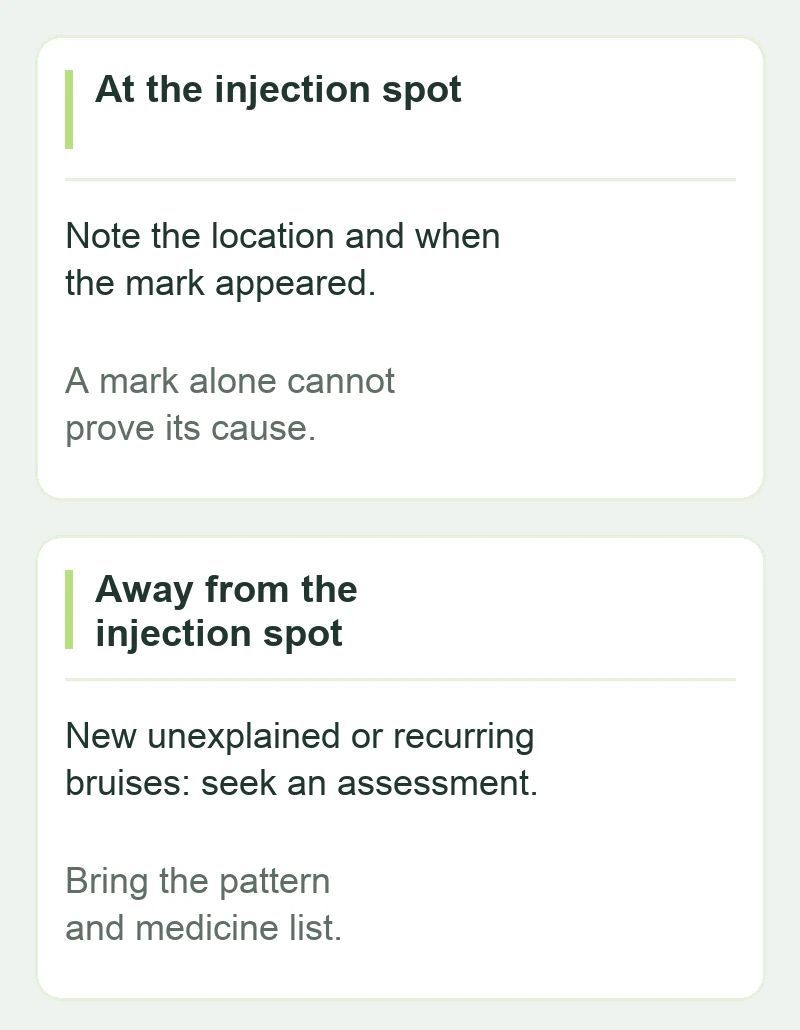
At the injection spot: If you noticed a small, isolated mark after the shot, the needle itself is one possible explanation. If you see blood immediately after injecting, the Ozempic Instructions for Use say to press lightly with gauze or cotton and not rub the area. Note the location, when the mark appeared, and whether it is changing. Its appearance alone cannot prove the cause; if the site becomes more painful or develops red streaks, drainage, or fever, seek medical advice.
Away from the injection spot: Bruises on your arms, legs, or elsewhere without a clear injury raise a separate question. A weekly shot in one location does not account for every new mark on the body. The National Heart, Lung, and Blood Institute lists frequent or large bruises, pinpoint red, purple, or brown spots, and bleeding that is hard to stop among signs that can occur with bleeding disorders. These signs have many possible causes; they are reasons to seek an assessment, not proof that you have a bleeding disorder.
One bruise may have an ordinary explanation you did not notice. The pattern matters more than trying to identify the medicine from a photograph: Are the marks new or recurring? Are they only where you inject, or also elsewhere? Are you also having nosebleeds, gum bleeding, or bleeding that takes longer than usual to stop? A clinician can put those details alongside your health history and medicines.
What Ozempic can—and cannot—explain
Ozempic is injected under the skin. Its Instructions for Use say to rotate injection sites. The separate instruction for blood at the injection spot acknowledges local bleeding. Neither instruction establishes that semaglutide thins the blood or causes unexplained bruising throughout the body.
Medicines and health conditions unrelated to Ozempic can affect bruising. For example, the NHLBI explains that blood-thinning medicines and some medical conditions can increase bleeding risk. If you take an anticoagulant, aspirin, or another medicine that may affect bleeding, include it in the conversation with your prescriber or pharmacist. NHLBI's patient guidance specifically identifies aspirin among medicines that can raise bleeding risk. Do not stop or change a prescribed medicine based on a bruise or an article.
This distinction also keeps the Ozempic trial number in its proper place. “Injection-site reaction” is a reported category, not a bruise counter. It cannot tell you that an individual bruise is harmless, nor can its low reported frequency rule out a problem that needs attention.
Make a useful note without delaying care
You do not need a detailed skin diary. A short note can preserve what is easy to forget:
- Where the mark is, including whether it is at an injection site.
- When you first noticed it and, if relevant, when and where you last injected.
- Whether it is stable, expanding, becoming more painful, or appearing in new places.
- Any other bleeding or symptoms, plus medicines that may affect bleeding.
A photo with a date can help show change, if you choose to take one, but it cannot identify a cause. If a mark is concerning, contact a healthcare professional; do not wait to assemble a perfect record. For future injections, follow the instructions for your exact Ozempic presentation and ask your pharmacist or prescriber to review technique if you are unsure. A bruise is not evidence that you should alter your dose or schedule.
Glowise's Side Effect Tracker can keep your own timing and duration notes beside medication, food, and hydration context. It cannot assess severity, identify the cause of bruising, or recommend treatment changes. The value of the record is that you can explain the sequence more clearly to someone who can assess it.
When to reach out
Contact your healthcare professional promptly for new unexplained or recurring bruises, large bruises, or bruising with other unusual bleeding. The MedlinePlus bruise guide also advises contacting a clinician for a bruise without an apparent injury or for red streaks, drainage, or fever around a bruised area. Seek urgent medical help if bleeding will not stop, or if a large or very painful bruised area has a feeling of extreme pressure. These cues do not identify the cause or provide a size or time cutoff for judging a bruise at home.
A different urgent warning in the Ozempic Medication Guide concerns serious allergic reactions: swelling of the face, lips, tongue, or throat; trouble breathing or swallowing; severe rash or itching; fainting or dizziness; or a very rapid heartbeat. The guide says to stop using Ozempic and get medical help right away if these occur. A localized bruise by itself is not the same as that warning pattern.
For a small local mark, note what happens to it and raise any concern with your care team. For new unexplained or recurring bruises elsewhere, seek a clinician's assessment and bring the pattern and your medicine list. Do not let tracking delay either urgent care or the immediate help described in the Ozempic allergy warning.
Sources

About the author
Maya Lee
Glowise Senior GLP-1 Content Editor
Maya Lee is a Glowise Health Content Editor. Her guides turn product records, authoritative sources, and everyday organization questions into clear, practical GLP-1 information.
She helps readers ask better questions and keep the details relevant to a care conversation together.
See more Glowise on Google
Add Glowise as a preferred source to find our GLP-1 guides more easily in Google Search.