Nausea is one of the most common Ozempic side effects, and the official prescribing information says nausea, vomiting, and diarrhea were reported most often during dose escalation. Mild queasiness may be manageable with a few short-term food and drink adjustments. Tell your healthcare provider right away if nausea, vomiting, or diarrhea does not go away. If you keep vomiting and cannot keep fluids down, seek urgent medical advice rather than continuing home measures.
The key is to separate three questions: what may make an ordinary queasy day more comfortable, when to contact your healthcare team, and when the Ozempic Medication Guide specifically says to stop using the medicine and get help.
How Common Is Nausea With Ozempic?
In two placebo-controlled trials in adults with type 2 diabetes summarized in the current US prescribing information, nausea was reported by 15.8% of people taking Ozempic 0.5 mg and 20.3% taking 1 mg, compared with 6.1% taking placebo. Those are group results from that defined trial population, not a forecast of what will happen to you.
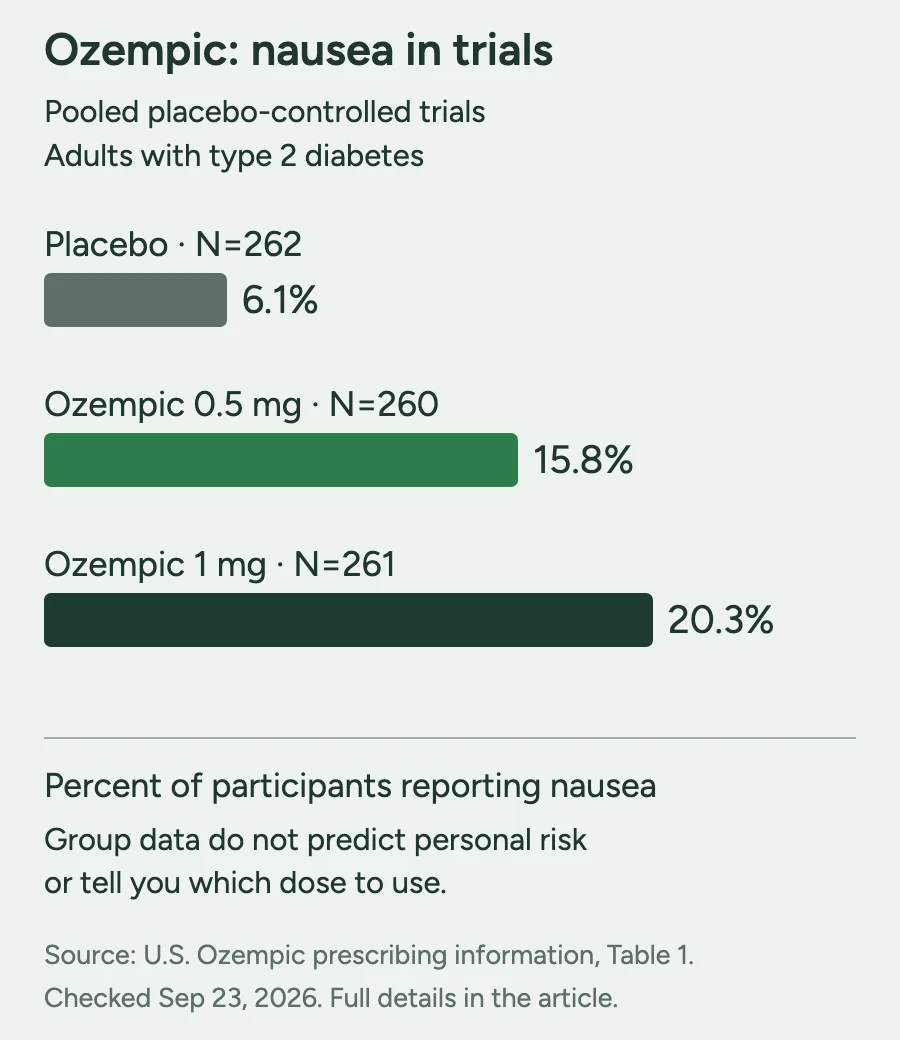
The same label says most reports of nausea, vomiting, and/or diarrhea happened during dose escalation. That fits the practical pattern many readers are trying to understand: symptoms may appear after starting treatment or become more noticeable after a prescribed increase. It does not make every new stomach symptom harmless, and it does not mean you should change the schedule yourself.
Ozempic delays gastric emptying, meaning food may leave the stomach more slowly. That is one plausible reason digestive comfort can change. But a label mechanism cannot prove what caused a particular episode, so persistent or unusual nausea deserves individual review.
Why Dose Escalation Matters
The current US prescribing information starts Ozempic at 0.25 mg once weekly for four weeks, followed by 0.5 mg once weekly. If additional glucose control is needed, the prescribed dose may later be increased to 1 mg and then 2 mg, with at least four weeks at the preceding dose. The label says this escalation is used to reduce the risk of gastrointestinal adverse reactions.
That schedule is background, not an instruction to manage your own routine dosing. If nausea begins after a dose change, tell the prescriber what changed and when. Outside the Medication Guide's specific urgent stop instructions, do not skip, stretch, reduce, or repeat doses based on an article. Your healthcare team can decide whether the symptom calls for more time, a medication review, a different plan, or an examination.
Current US labeling includes both multi-dose pens and single-dose prefilled syringes. Check the device and dose on your own prescription rather than relying on an older article or another person's device.
What May Help Mild Ozempic Nausea?
The official Ozempic patient website offers several general nausea tips. They are comfort measures for a mild episode, not treatment for severe or persistent symptoms.
- Try bland, low-fat foods such as crackers, toast, or rice for a short period. The manufacturer notes that this kind of bland diet is not meant to last more than a couple of days.
- Choose foods that contain fluid, such as soup or gelatin, if those are comfortable and fit your health needs.
- Avoid fried, greasy, or very sweet foods when they make nausea worse.
- Eat slowly.
- Stay upright after eating instead of lying down immediately.
- Try clear or ice-cold drinks. If you keep vomiting and cannot keep fluids down, seek urgent medical advice rather than chasing a universal water target.
If you have diabetes, kidney or heart disease, a prescribed fluid limit, or a nutrition plan for another condition, follow your clinician's guidance. A short list of nausea-friendly foods should not override the plan that manages your overall health.
Protect fluids without turning hydration into a test
The Medication Guide warns that nausea, vomiting, and diarrhea can cause dehydration and kidney problems. It advises drinking fluids to reduce the chance of dehydration and telling your healthcare provider right away if nausea, vomiting, or diarrhea does not go away.
There is no single online fluid number that fits everyone. The useful question is whether fluids stay down and whether symptoms are continuing. General NHS guidance advises urgent clinical help when a person keeps vomiting and cannot keep fluid down. In the United States, contact your healthcare team or an urgent-care service promptly for local guidance; use emergency services if you believe the situation is an emergency.
Ask before taking an anti-nausea medicine
Do not assume an over-the-counter product is automatically compatible with your prescriptions and health conditions. A pharmacist or prescriber can check interactions and side effects and advise what to do next. If nausea is bothersome enough that you are considering medication for it, that is a reasonable time to contact the team managing Ozempic.
How Long Does Ozempic Nausea Last?
There is no label-backed countdown that applies to every person. The prescribing information supports one useful pattern—gastrointestinal reactions were commonly reported during dose escalation—but it does not promise that nausea will end after a fixed number of hours, days, or weeks.
Track your own duration instead of judging the symptom against someone else's timeline. Note when it started, whether it followed a new prescription or dose increase, whether it is improving, and whether you can eat and drink. Contact your healthcare provider if nausea keeps bothering you or does not go away. A symptom that is severe, worsening, or paired with a label warning sign should be assessed sooner.
When Ozempic Nausea Needs Prompt Medical Help
Nausea by itself and nausea with a serious warning sign are different situations. The current Medication Guide gives specific actions:
| What you notice | What the Ozempic Medication Guide says |
|---|---|
| Severe abdominal pain that will not go away, with or without vomiting; pain may reach the back | Stop using Ozempic and call your healthcare provider right away because these can be pancreatitis symptoms |
| Nausea, vomiting, or diarrhea that does not go away | Tell your healthcare provider right away because fluid loss can lead to kidney problems |
| Stomach problems that are severe or will not go away | Tell your healthcare provider |
| Upper-abdominal pain, fever, yellowing of the skin or eyes, or clay-colored stools | Tell your healthcare provider right away because these can be gallbladder-problem symptoms |
| Swelling of the face, lips, tongue, or throat; trouble breathing or swallowing; severe rash or itching; fainting or dizziness; very rapid heartbeat | Stop using Ozempic and get medical help right away because these can be serious-allergy symptoms |
This table does not cover every possible problem and cannot diagnose one. If you think you may be having an emergency, use local emergency services.
A Short Record for Your Healthcare Team
Once you have taken the appropriate care step, a concise record can make follow-up easier. You do not need a diary essay. Capture the details that affect the question:
- the exact Ozempic device and prescribed dose;
- when you started it and the date of the most recent dose change;
- when nausea began, how long it lasted, and whether it is improving or worsening;
- vomiting, diarrhea, abdominal pain, fever, vision changes, allergy symptoms, or other changes that occurred with it;
- whether you could keep food and fluids down;
- what you ate or drank and any comfort measure or medicine you tried;
- other medicines taken that day, especially insulin or a sulfonylurea if those are part of your diabetes treatment.

Glowise's Side Effect Tracker can keep your own symptom words, timing, medication, food, water, and notes together across days. It organizes what you enter; it does not determine the cause, urgency, or correct dose.
Keep the details together
Bring a clearer timeline to your next conversation
Record symptom timing and the context you want to remember without asking the tracker to diagnose or change your treatment.
The practical takeaway
What to remember about Ozempic nausea
- Nausea was common in two Ozempic trials in adults with type 2 diabetes, and gastrointestinal reactions were reported most often during dose escalation.
- For mild queasiness, short-term bland low-fat foods, clear or cold drinks, slow eating, and staying upright after meals may be worth trying.
- Do not change the dose schedule or add an anti-nausea medicine without checking with the healthcare team managing your treatment.
- Nausea, vomiting, or diarrhea that does not go away needs prompt contact because fluid loss can affect the kidneys.
- Severe persistent abdominal pain or serious-allergy symptoms carry explicit stop-and-get-help instructions in the Medication Guide.
Frequently Asked Questions
Is nausea a common side effect of Ozempic?
Yes. In two placebo-controlled trials in adults with type 2 diabetes summarized in the current US prescribing information, nausea was reported by 15.8% of participants taking 0.5 mg and 20.3% taking 1 mg, compared with 6.1% taking placebo. Your own likelihood and severity cannot be predicted from those group averages.
Does nausea mean Ozempic is working?
No. Nausea is a side effect, not a measure of glucose control or treatment success. Do not use the presence or absence of nausea to decide whether a dose is effective.
Should I stop Ozempic because I feel nauseated?
Do not make a blanket change for ordinary nausea without contacting the prescriber. The Medication Guide does give a specific stop instruction for severe abdominal pain that will not go away, with or without vomiting, and for serious-allergy symptoms. Follow those urgent instructions when they apply.
Is it better to take Ozempic in the morning or at night for nausea?
The prescribing information says Ozempic may be taken once weekly at any time of day, with or without meals. It does not identify morning or night dosing as a proven nausea treatment. Keep the prescribed weekly schedule and ask your healthcare team before changing it.
Does changing the injection site prevent nausea?
The label permits injection under the skin of the abdomen, thigh, or upper arm and says to rotate injection sites. It does not say one approved site prevents nausea better than another.
Can I take an over-the-counter nausea medicine with Ozempic?
Ask a pharmacist or prescriber first. They can check your other medicines and health conditions and advise what to do next.
What if I use a single-dose Ozempic syringe rather than a pen?
The current US prescribing information includes multi-dose pens and single-dose prefilled syringes. Use the instructions packaged with your exact device and verify the prescribed dose. The nausea, dehydration, and serious-warning information still needs to be taken seriously.
Sources

About the author
Maya Lee
Glowise Senior GLP-1 Content Editor
Maya Lee is a Glowise Health Content Editor. Her guides turn product records, authoritative sources, and everyday organization questions into clear, practical GLP-1 information.
She helps readers ask better questions and keep the details relevant to a care conversation together.
See more Glowise on Google
Add Glowise as a preferred source to find our GLP-1 guides more easily in Google Search.