
A non-scale victory is a change you value that a weight reading does not capture. It might be walking to a familiar destination with less effort, preparing a lunch that works for your schedule, sleeping more comfortably, or getting through an appointment with better questions. The word _victory_ can make it sound as if every day needs a win. It does not. These observations are simply another way to notice what is happening in your life.
Start with something you actually want more of, then describe the change in plain terms: “I took the stairs to my apartment without stopping this week,” rather than “I am fitter now.” The first statement is an observation you can revisit. The second reaches beyond what one week can establish.
Examples beyond the scale
| Area | A possible observation | A fair way to read it |
|---|---|---|
| Daily capacity | A familiar walk feels easier, or you can carry groceries more comfortably | Meaningful to your day; it does not identify why your capacity changed. |
| Movement skills | You can complete a familiar exercise with better control or take part in an activity you enjoy | A useful performance note; compare the same task under similar conditions. |
| Food routines | You prepared a meal that kept you satisfied, ate more regularly, or made room for foods you enjoy without a rigid rule | A routine that works for you can matter even before any body measurement changes. |
| Rest and attention | You wake feeling more rested or can concentrate through a usual task | Worth noticing; sleep and attention also change for many reasons. |
| Comfort and participation | Your clothes feel more comfortable, or you join an outing you used to avoid | The value may be comfort or freedom, not a clothing size. |
| Care and support | You asked a clear question at a visit, kept a treatment note, or requested help when a plan was hard to follow | You made the next decision better informed, regardless of the scale. |
Your list need not include all these categories. A person training for a long walk may care about capacity; someone dealing with an unpredictable schedule may value reliable meals. Neither has to borrow the other's definition of progress.
Make an observation you can use later
Choose one or two things to notice for a few weeks. Record the date, what happened, and a little context. For example: “Tuesday: walked from the bus stop to the office without pausing; same route as last month; weather was cooler.” That note respects both the change and the conditions around it.
You can use a notebook, calendar, voice memo, or an app if one fits your habits. There is no need to convert every pleasant moment into a metric. The point is to preserve a detail you might otherwise forget when one scale reading catches your attention.
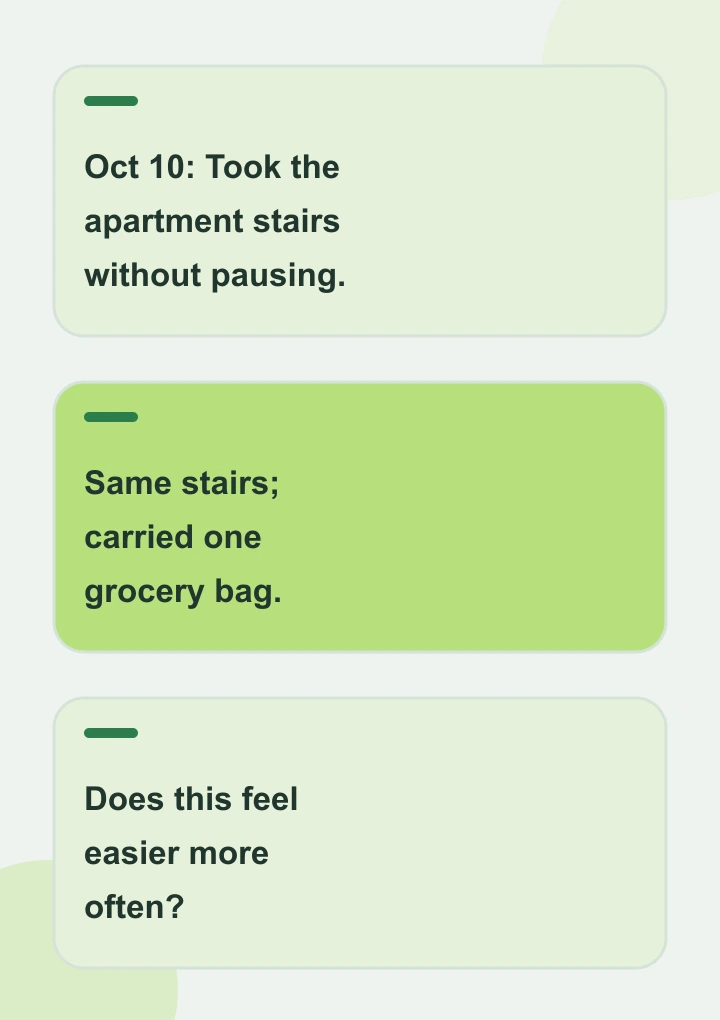
Record what happened, the conditions around it, and whether the same task becomes easier more often.
After a few entries, ask: Is this happening more often? Is the task genuinely similar? Does the change matter to me? If you cannot answer yet, keep it as a single good day rather than forcing a trend. If you notice a decline in ability, that belongs in the record too. A useful log does not edit out the hard days.
Avoid turning every good sign into a medical conclusion
Better sleep, comfort, stamina, or a calmer relationship with food can matter on its own. None of these alone proves fat loss, improved blood pressure, or a response to a particular medicine. If your goal includes a clinical outcome, use the measurements and follow-up your clinician recommends. A non-scale observation can tell them how the plan feels in daily life; it does not replace that assessment.
The reverse also matters. A flat or rising weight reading does not erase a real improvement in daily capacity. And a falling weight reading does not cancel a new problem with weakness, eating, or hydration. If your function worsens or a symptom concerns you, bring the specifics to a healthcare professional instead of labeling the pattern a victory or a failure.
For a separate method of recording circumferences, see the body measurements guide. If you are comparing yourself with dramatic progress photos, the before-and-after guide explains what a picture leaves out.
When counting victories stops helping
Tracking should serve your life. If a list of wins becomes another demand, reduce it to one question: “What has become a little easier or more possible lately?” Some weeks the honest answer will be “nothing I can name.” That is information, not a failure to notice correctly. Your worth and your care do not depend on producing evidence of progress every week.
Sources
- Healthline, Non-Scale Victories: 15 Weight Loss Victories to Celebrate — used to inspect the range of common examples, not as evidence that any example proves weight loss or a medical benefit.

About the author
Maya Lee
Glowise Senior GLP-1 Content Editor
Maya Lee is a Glowise Health Content Editor. Her guides turn product records, authoritative sources, and everyday organization questions into clear, practical GLP-1 information.
She helps readers ask better questions and keep the details relevant to a care conversation together.
See more Glowise on Google
Add Glowise as a preferred source to find our GLP-1 guides more easily in Google Search.