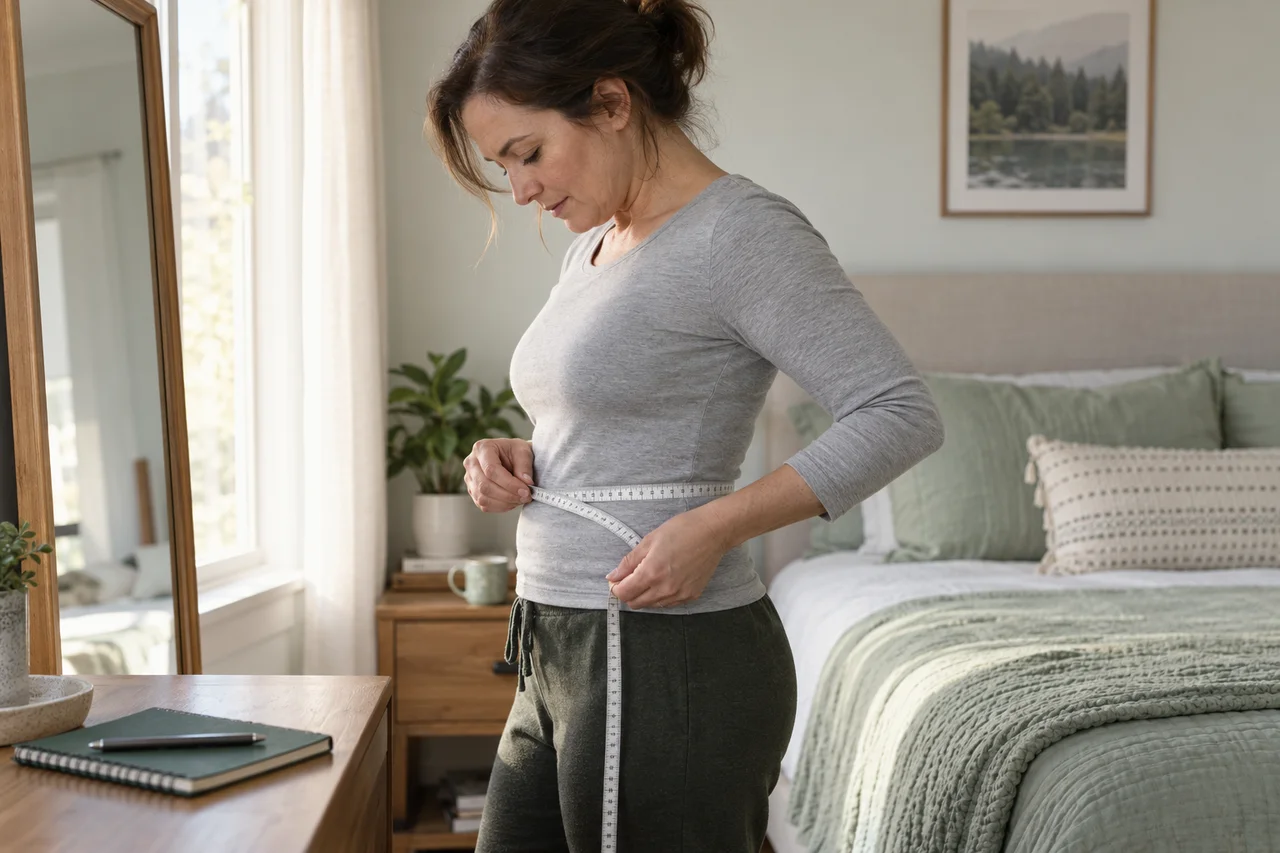
To take body measurements for weight loss, choose a few sites you can find again, use a flexible tape directly against skin when possible, keep it level and comfortably snug, and write down the date, site, and measurement in the same unit. For a waist reading, use light clothing only if measuring against skin is not possible; never measure over bulky clothing. Repeat under similar conditions. The useful comparison is between measurements taken the same way, not between every possible body part or against someone else's chart.
You can start with your waist and hips. Add another site only if it answers a question you care about. A tape can show that a circumference changed; it cannot tell you how much fat, muscle, or fluid changed, or whether a health condition improved.
Pick sites you can locate again
Different guides use different landmarks for the waist. Pick one definition and keep it with your record. If a clinician has asked you to use a particular method, follow that method so your numbers can be compared with theirs.
| Site | A repeatable home landmark | What to record |
|---|---|---|
| Waist | Midway between the lowest palpable rib and the top of the hip bone; wrap the tape horizontally around the body | Write “midpoint waist,” not just “waist.” This follows the WHO STEPS measurement site. |
| Hips | Around the fullest part of the buttocks, with the tape level all the way around | Note that you used the fullest point. |
| Upper arm, optional | Around the middle of the relaxed upper arm, using the same side each time | Note left or right, and avoid flexing. |
| Thigh, optional | Around a marked distance above the kneecap on the same leg each time | Record the distance from the kneecap as well as the circumference. |
The arm and thigh sites are optional personal tracking choices, not medical protocols. If locating a site feels awkward, skip it. A smaller number of dependable entries is more useful than a long list of measurements you cannot repeat.
Take the measurement without changing the body to fit the tape
- For the waist, stand with your feet together and weight evenly distributed, with arms relaxed at your sides. Breathe normally for a few breaths, then read the tape at the end of an ordinary exhale. Do not hold your breath or pull your stomach in.
- Wrap a nonstretch tape around the chosen landmark. Check in a mirror or ask someone you trust whether the tape is horizontal across your back as well as your front.
- Keep the tape snug against the surface without digging into skin. Read where the zero end meets the tape while looking straight at it.
- Write the value and unit down immediately. Include the landmark, side if relevant, and whether you measured against skin or over light clothing.
The WHO STEPS waist protocol uses a midpoint between the last palpable rib and the top of the hip bone, a horizontal tape, feet together with weight evenly distributed, a normal exhale, and a snug fit that does not compress skin. It prefers direct skin measurement and allows light clothing only when that is not possible. That is a sound method to borrow for a home waist routine. It does not make home readings clinical measurements, and it does not mean you need a clinical waist-risk cutoff to evaluate your own record.
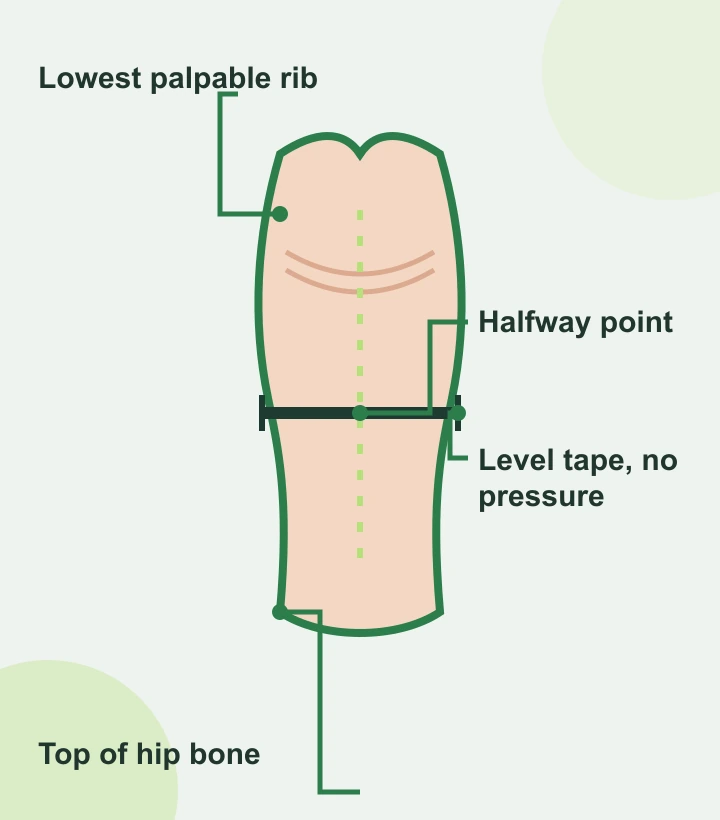
For a repeatable midpoint-waist reading, keep the tape level and snug without pressing into skin.
Make the next reading comparable
Measure at a pace that gives changes time to become interpretable, such as every few weeks. Doing it daily often adds detail about technique, meals, and ordinary fluctuation without answering a useful new question. Use a similar time of day, the same tape, the same landmarks, and similar clothing. You do not need to engineer a perfect morning; write down a changed condition when it matters.
Here is a record that will still make sense a month later:
| Date | Site and method | Reading | Context |
|---|---|---|---|
| October 10 | Midpoint waist, skin, after normal exhale | 39.2 in | First entry; soft tape A |
| November 7 | Midpoint waist, skin, after normal exhale | 38.8 in | Same tape and time of day |
Those numbers are an illustration, not a target or a claim that this amount of change is meaningful for everyone. If a later entry looks surprising, check the tape position and your notes before interpreting it. A second careful reading can catch an obvious placement error; there is no need to keep measuring until you get a preferred number.
Common errors that change the reading
- Moving from a waist measured at the belly button to one measured at the rib-to-hip midpoint, then treating the two numbers as a trend.
- Letting the tape slope upward across the back or twisting it.
- Pulling hard enough to compress skin, or leaving a gap.
- Switching inches and centimeters without labeling them.
- Comparing measurements over bulky clothing with measurements against skin.
- Treating one reading after a different meal, time of day, or posture as proof of a lasting change.
If your tape starts above zero because it has a metal tab or damaged end, check its markings before you begin. A soft tape that has stretched or frayed is worth replacing; consistent technique cannot fix an unreliable tool.
What the tape can and cannot tell you
Circumference is one description of your body at a particular place and time. It may move while scale weight is steady, or stay similar while weight changes. Neither pattern tells you the tissue involved. The tape cannot distinguish fat from muscle, estimate a medical risk change from one personal reading, or explain a medication effect. For questions about lean mass, strength, or body-composition tests, the GLP-1 muscle-loss guide covers those different measures.
If measurements make daily life more anxious or prompt repeated checking, you can choose another way to observe progress. The non-scale victories guide offers examples that do not require a tape. If a measurement changes alongside new symptoms, swelling, pain, or a concern raised by your clinician, share the pattern and dates rather than trying to diagnose it from the tape.
Sources
- WHO STEPS Surveillance Manual, section 3-5, Measuring Waist Circumference — landmark, horizontal tape, feet together, normal exhale, direct skin preferred, light clothing only when necessary, and avoiding skin compression.

About the author
Maya Lee
Glowise Senior GLP-1 Content Editor
Maya Lee is a Glowise Health Content Editor. Her guides turn product records, authoritative sources, and everyday organization questions into clear, practical GLP-1 information.
She helps readers ask better questions and keep the details relevant to a care conversation together.
See more Glowise on Google
Add Glowise as a preferred source to find our GLP-1 guides more easily in Google Search.