
A GLP-1 weight loss plateau is a description of a slower or flat change, not proof that a prescription has stopped working. Look at a short stretch of context instead of one number, use a percentage calculation only to describe the change you have recorded, and take medication or nutrition decisions back to the professional or official source that can address your exact situation.
What Counts as a Weight Loss Plateau
The word "plateau" sounds like a finding. In everyday use, though, it usually describes something much simpler: the number you expected to move did not move, or moved less than it did before. That is an observation about a stretch of days, not a verdict about a treatment.
A scale reading is one data point. A single flat week may not hold enough context to support a conclusion, and a few slower weeks can reflect a mix of routine changes and ordinary life rather than anything about a prescription.
For a broader introduction to the medicine without turning it into a verdict, see how GLP-1 medicines work.
A description is not a verdict
Calling a stretch "a plateau" is fine as a way to describe it. The trouble starts when the description quietly turns into a conclusion — that something has failed, that a change is required, that you should act now. Those are different claims, and a slower week cannot carry them by itself.
A more useful frame is: here is what my record shows over this window, and here is what was happening around it. The first part is descriptive. The second part is context. Neither part, on its own, answers the question of what to do next.
Why a Slowdown Is Not One Diagnosis
When weight change slows, there is rarely a single story. Routines shift. Appetite, schedule, sleep, stress, and the time of year all move around, and any of them can be part of what a record is reflecting. Sorting out which factor matters — if any — is exactly the kind of question a short list of numbers cannot settle.
This is also where research findings get misread. A clinical trial describes group outcomes in a defined study population, measured and reported in a specific way. It can tell you what happened on average across the people in that study. It cannot tell you what your next month will look like, and it was never designed to. An individual trajectory is its own record, not a prediction drawn from a chart.

The part worth slowing down for
The moment that deserves your attention is not the flat number itself. It is the urge to resolve the discomfort of the flat number by doing something immediately — changing a food rule, adding a target, reconsidering a prescription on your own. That urge is understandable, but acting on it turns an observation into a decision without the information a decision needs.
The steadier move is smaller and less dramatic: write down what you actually know, and let the interpretation wait until it can be done properly. Slowing down here is not avoidance. It is how you keep a descriptive question ("what happened?") separate from a clinical one ("what, if anything, should change?").
Use a Short Review Window Before Drawing a Conclusion
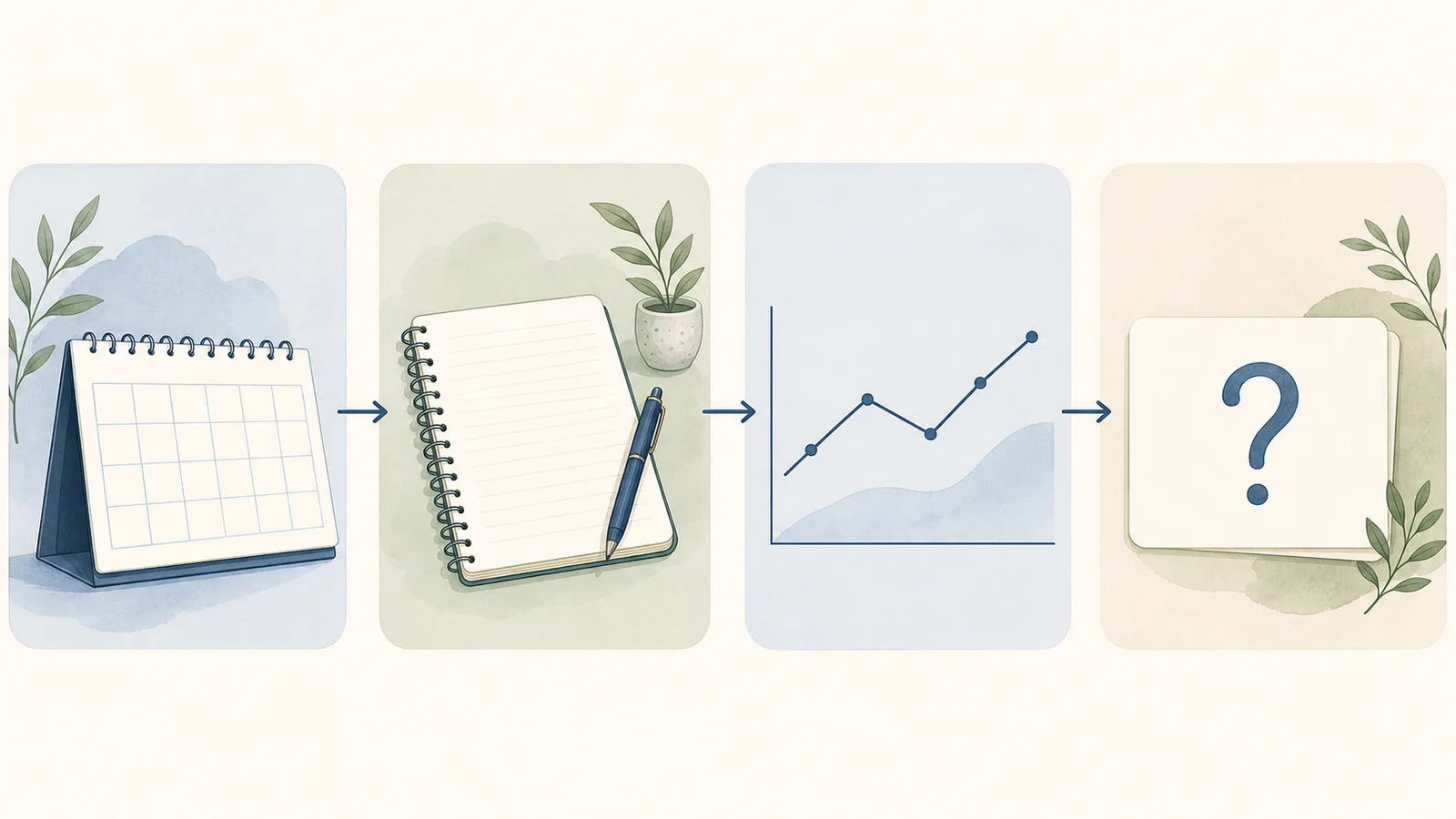
A short review window is a bounded look at your own record — long enough to gather more than one day, short enough that you can still remember what the days were like. The point of the window is not to produce a verdict. It is to give you a complete, calm picture to hold: the values you recorded, and the context that surrounded them. When you look at the window, you are asking "what does this stretch show?" rather than "is something wrong?"
What to keep in the same note
Whatever you choose to track, keeping it in one place matters more than tracking it perfectly. A useful note for a review window might include:
- The dates and the recorded values for the stretch you are looking at
- Anything notable about the routine those days — travel, schedule changes, disruptions
- The questions you would want answered, written down while they are fresh
A note like this does two jobs. It gives you something coherent to look at instead of a scattered memory of the weeks, and it gives any professional you talk to a clearer starting point than "the scale stopped moving."
What a Percentage Calculator Can and Cannot Show
Numbers from different starting points are hard to compare directly, which is why percentages come up so often in conversations about weight change. If you want a neutral way to describe what you recorded, you can calculate a percentage change from two values and get a transparent, reproducible answer.
What that gives you is a description. A percentage calculation takes the values you entered and expresses their relationship. It does not explain why the change happened. It does not interpret your starting point, your routine, or anything about your prescription, and it does not set a clinical target. Treating a calculated percentage as a goal to hit, or as evidence that something has gone wrong, asks the arithmetic to do a job it cannot do.

Used properly, the calculation is still worth doing. A clear, described number is easier to discuss than a vague feeling that things slowed down. It gives a conversation — with yourself or with a professional — a shared, concrete reference point, while the interpretation stays where it belongs: with people and sources that can see your full situation.
A clearer way to describe change
Turn two values into a transparent percentage
Use a simple calculation to describe a recorded change while keeping interpretation and treatment decisions where they belong.
Questions That Belong With the Exact Prescription
Some questions that come up during a slower stretch are not yours to answer alone, and trying to answer them from general information is where real risk creeps in. Anything about a specific medication — how it works for you, whether anything about it should change, how it fits your health history — belongs with the professional who prescribed it or the official information that accompanies it.
General background can still help you have that conversation. It can give you a clearer shared vocabulary, so your questions land better. But background reading is preparation for the conversation, not a substitute for it.
The same logic applies to nutrition and routine questions that are personal to you. A general article can describe common experiences. It cannot know your situation, and it should not tell you to adjust your food, your activity, or your dose. When a question depends on your specifics, the right move is to bring it — along with your notes — to the exact source that can answer it.
How to Keep the Week in Context
Between reviews, the practical job is simpler: keep the days together so the context is there when you want it. A single habit of recording — the values, the dates, a line or two about the week — is what makes a later review window possible at all. Without it, a flat stretch is just a feeling with no record behind it.
Whether you keep the week together in a tracker or a note, use a format that holds the dates and a line or two about the week. The record stays descriptive — a log of what happened — and the meaning of it stays a question you take up deliberately, with the right support, rather than something the scale seems to announce on a random Tuesday.
Consistency matters more than precision here. A simple record kept most weeks beats an elaborate one that collapses the first time life gets busy. The goal is a window you can actually look at, not a perfect dataset.
The practical takeaway
A steadier way to review a slowdown
- Treat a short flat stretch as an observation, not a verdict.
- Keep the dates and routine context you want to remember in one place.
- Use a percentage only to describe recorded values.
- Bring medication and personal nutrition questions to the exact source or qualified professional that can answer them.
Frequently Asked Questions
Does one flat week mean I have a plateau?
One flat week is a single observation. A plateau, in the everyday sense, is a description of a pattern over a stretch of time, not something one week can establish. Looking at a short window of recorded values and context gives you a fairer picture than reacting to any single reading.
Can a calculator tell me why my weight changed?
No. A calculator works only with the values you enter. It can describe the relationship between two numbers — for example as a percentage change — but it has no information about your routine, your health, or anything else that might explain the change. Explanation and interpretation belong with qualified professionals and official sources, not with arithmetic.
Should I change my medication when weight loss slows?
That is a question for the professional who prescribed the medication, using your full situation — not something to decide from a slower stretch of numbers or from general information. A slower change is an observation about your record, not a diagnosis, and it cannot by itself answer what, if anything, should change about a prescription.
What questions are useful for a prescriber or pharmacist?
Questions tied to your specifics work best: what you recorded over a given stretch, what was happening in your routine during those weeks, and what you have been wondering about your prescription. Writing your questions down in advance, alongside your notes, makes the conversation more concrete and helps the professional address your exact situation rather than a general scenario.
Sources

About the author
Maya Lee
Glowise Senior GLP-1 Content Editor
Maya Lee is a Glowise Health Content Editor. Her guides turn product records, authoritative sources, and everyday organization questions into clear, practical GLP-1 information.
She helps readers ask better questions and keep the details relevant to a care conversation together.
See more Glowise on Google
Add Glowise as a preferred source to find our GLP-1 guides more easily in Google Search.