
A GLP-1 supplement is not the same thing as a prescription GLP-1 medicine. GLP-1 wording does not establish medication-like weight-loss effects. Do not treat a capsule, powder, drop, patch, or “GLP-1 booster” as equivalent to semaglutide or tirzepatide without direct human evidence on that exact finished product and the outcome it advertises.
The phrase can also mean something less dramatic: protein powder, fiber, or a vitamin used to address a specific nutrition problem while someone is taking a prescribed GLP-1. That is a different question. A supplement may help fill an identified gap, but it does not become a GLP-1 drug because the label mentions GLP-1.
What does “GLP-1 supplement” mean?
There is no single standard formula behind the term. One product might contain a multivitamin and minerals. Another might contain fiber, herbs, probiotics, berberine, or a blend with a trademarked name. Retailers also use “GLP-1 supplements” as a shelf category for products aimed at people taking weight-loss medicines.
That makes the phrase useful for marketing but weak as a health description. It does not tell you the ingredients, amounts, quality, evidence, or intended outcome.

GLP-1 medicines are a different product category
Prescription GLP-1 receptor agonists act on defined biological targets and are evaluated as drugs for specific uses. Tirzepatide acts on both GIP and GLP-1 receptors. A bottle of herbs or nutrients does not have the same evidence simply because “GLP-1” appears on the front.
In the United States, the FDA does not approve dietary supplements for safety and effectiveness before they are sold. Supplement companies are responsible for meeting the applicable rules, and the FDA can take action against unsafe or unlawfully marketed products. This is a different pathway from prescription-drug approval.
Can a supplement naturally boost GLP-1 enough for weight loss?
Some foods and ingredients may affect the body’s own GLP-1 response after eating. That biological observation is not proof that a capsule produces prescription-level weight loss. The clinically meaningful question is whether the exact finished product has been tested in people, against an appropriate comparison, for the outcome being advertised.
Do not assume that a product has medication-like evidence because it uses GLP-1 wording. Look for direct human evidence on the exact finished product and the outcome it advertises. Harvard public-health experts have warned that the shared name can make marketed supplements look more like Ozempic, Wegovy, Mounjaro, or Zepbound than they are.
Be especially skeptical when a product promises medication-like results, uses before-and-after stories instead of controlled evidence, or hides amounts inside a proprietary blend. One FDA enforcement record documents the recall of JaDera, a product marketed as a weight-loss supplement, after it was found to contain undeclared sibutramine. Separately, NCCIH warns that some products marketed for weight loss may contain prescription drugs or other undeclared ingredients. The JaDera record is one specific example, not an estimate of how often this occurs across the market.
Supplements during GLP-1 treatment: start with the problem, not a shopping list
Reduced appetite can make it harder to eat enough protein, fiber, vitamins, minerals, and fluids. Persistent vomiting or diarrhea can add another risk. But taking a GLP-1 medicine does not automatically mean that everyone develops the same deficiencies or needs the same daily pack.
The 2025 joint advisory from the American College of Lifestyle Medicine, American Society for Nutrition, Obesity Medicine Association, and The Obesity Society recommends a broader plan: nutrient-dense food, adequate protein and fluids, strength training, management of gastrointestinal side effects, and ongoing reassessment. It says supplements can be considered for at-risk nutrients and tailored to the person.
| What you are trying to solve | What may be reasonable to discuss | What the evidence does not establish |
|---|---|---|
| Low protein intake because full meals are difficult | Smaller protein-rich meals or a protein drink/powder as a practical food option | That a branded GLP-1 powder preserves muscle by itself or replaces resistance training |
| Constipation with low fiber intake | Gradually increasing fiber-rich foods; a fiber supplement may be an option when food is not enough | That more fiber is always better, or that it is appropriate during severe pain, vomiting, or inability to keep fluids down |
| A restrictive diet, very low intake, or a suspected deficiency | Review of food intake and, when appropriate, testing for a specific nutrient; a targeted supplement or multivitamin may then make sense | That every GLP-1 user needs iron, B12, vitamin D, magnesium, potassium, or a bundled daily pack |
| A desire for faster weight loss | Review of the prescribed treatment, nutrition pattern, activity, sleep, side effects, and adherence with the treating clinician | That an OTC “booster,” fat burner, or herbal blend safely adds medication-like weight loss |
Protein powder can be convenient, but it is not the whole muscle plan
Weight loss can include both fat and lean tissue. The joint advisory emphasizes adequate protein together with structured strength training. A protein drink can be useful when appetite is low or solid food is difficult, but the right amount depends on factors the product label cannot see, including usual intake, body size, kidney health, age, and activity.
Treat protein powder as a convenient food format. Look at the protein per serving, total calories, added sugar, sweeteners, allergens, and whether it displaces other foods you tolerate. Claims about a special “GLP-1 formula” require evidence for that exact formula.
Fiber may help constipation, but timing and tolerance matter
Fiber supplements such as psyllium can help some forms of constipation. Adding a large amount suddenly can also worsen gas, bloating, or discomfort, especially if fluid intake is low. Because GLP-1 medicines can slow stomach emptying and cause gastrointestinal symptoms, persistent or severe symptoms deserve assessment rather than another layer of self-treatment.
Seek prompt medical advice for severe or persistent abdominal pain, repeated vomiting, signs of dehydration, marked bloating with constipation, or inability to pass gas. The National Institute of Diabetes and Digestive and Kidney Diseases lists abdominal pain, bloating, constipation, not passing gas, nausea, and vomiting as possible symptoms of intestinal obstruction and advises getting medical help right away. Those are not situations to manage by simply taking more fiber.
Vitamins and minerals should match a real risk
Research on nutrient intake during GLP-1 treatment is still developing. Lower food intake may expose an existing gap, and vomiting or diarrhea may affect hydration and electrolytes. People who already have a restrictive diet, a history of bariatric surgery, anemia, kidney disease, or other conditions may need a different evaluation from someone eating a varied diet without ongoing symptoms.
A multivitamin can be a practical safety net in some cases, but it is not automatically necessary. Iron, potassium, calcium, magnesium, and fat-soluble vitamins can all cause problems when taken inappropriately or in excessive amounts. A symptom such as fatigue is not enough to identify which nutrient, if any, is low.
How to evaluate a GLP-1 supplement label
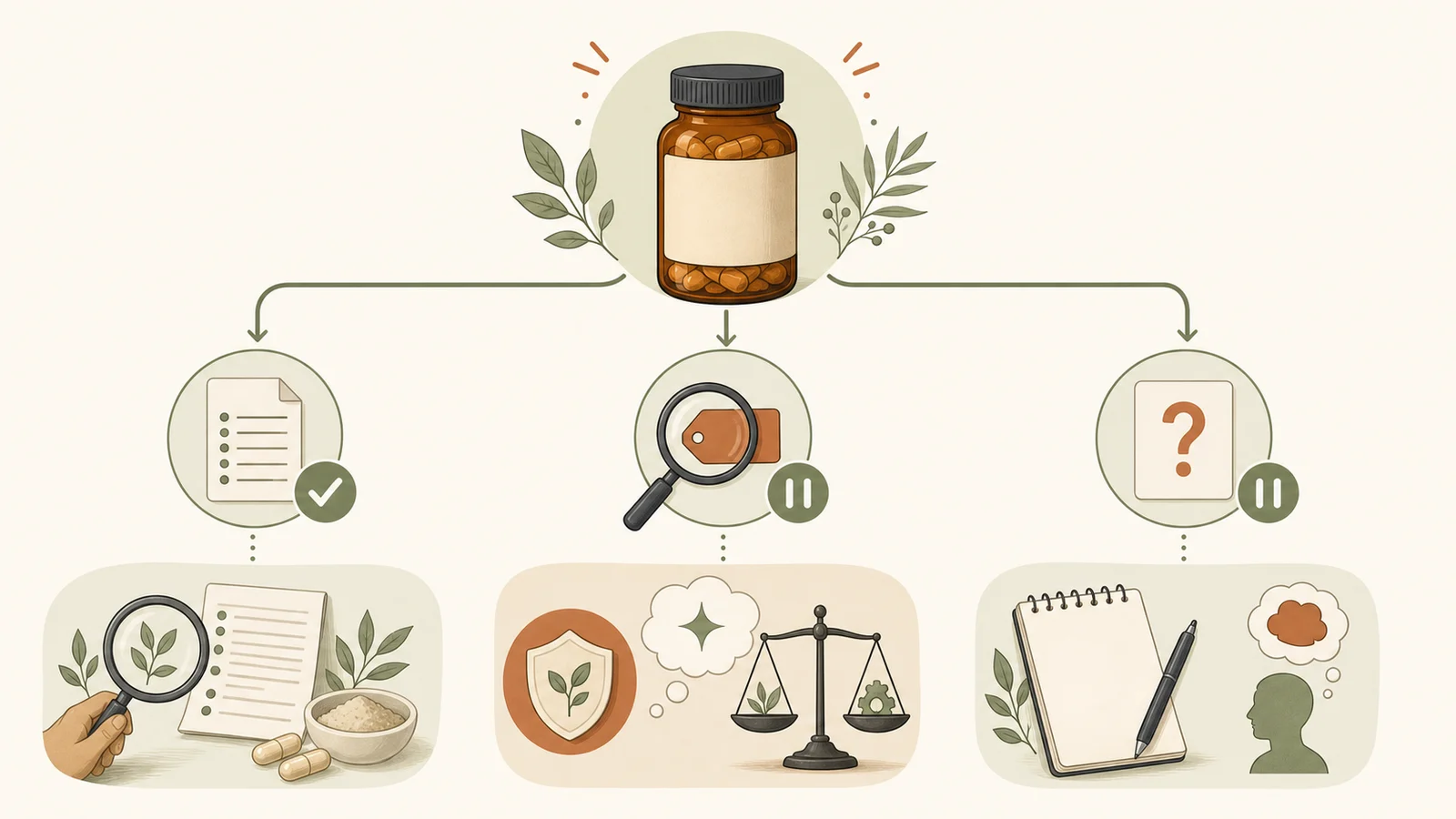
Turn the bottle around and connect each ingredient to a specific purpose.
- Name the job. Is the product claiming to replace a medicine, accelerate weight loss, support general nutrition, provide protein, or relieve constipation? Those are different claims with different evidence.
- Find every ingredient and amount. Be cautious with proprietary blends that disclose a total blend amount but not the amount of each ingredient.
- Check for overlap. A multivitamin, electrolyte powder, fortified protein drink, and “GLP-1 pack” may repeat the same nutrients.
- Check medication and condition warnings. Supplements can interact with medicines, affect lab tests, and create extra risk around surgery or conditions such as kidney disease.
- Separate quality information from effectiveness. Look for a complete Supplement Facts panel, named amounts, lot information, and a manufacturer contact. A quality mark should identify the organization and the standard or test it represents. None of these details, by themselves, prove that a product causes weight loss.
- Keep a photo of the Supplement Facts panel. The exact label is more useful than the phrase “GLP-1 support” when a pharmacist, dietitian, or prescriber reviews it.
What to avoid combining on your own
Avoid stacking a prescription GLP-1 with OTC weight-loss products until the exact ingredients have been reviewed. Stimulants, laxatives, and herbs marketed to affect glucose do not share one risk profile; each requires its own side-effect and interaction check. Products with several active ingredients create additional overlap and interaction questions. The JaDera recall is one documented undeclared-drug example, while the broader NCCIH warning explains why exact-product review matters; neither establishes current category-wide prevalence.
Also avoid assuming that “natural” means gentle. A concentrated extract can have stronger effects than the food it came from, and a longer ingredient list creates more opportunities for overlap and interactions.
If a new supplement appears to cause a serious reaction, stop taking it and seek medical care. Dietary-supplement problems can be reported through the US Health and Human Services Safety Reporting Portal, the route identified in FDA MedWatch’s reporting instructions for this product category.
The practical takeaway
What to keep in view
- GLP-1 wording does not establish the same weight-loss effect as a prescription medicine; check for direct human evidence on the exact finished product and advertised outcome.
- During prescribed treatment, supplements should solve an identified nutrition problem rather than follow a universal “GLP-1 stack.”
- Food quality, protein intake, fluids, strength training, symptom management, and follow-up matter more than a branded bundle.
- Protein powder, fiber, or a targeted vitamin may be useful in the right context, but the exact product, dose, overlap, and health history still matter.
- Medication-like claims, proprietary blends, stimulant stacks, and hidden-ingredient risk deserve extra caution.
Frequently asked questions
Is there an over-the-counter GLP-1 supplement that works like Ozempic or Wegovy?
Do not assume an over-the-counter product works like semaglutide or tirzepatide because it uses GLP-1 language. Treating an exact finished product as equivalent would require direct human evidence for its advertised outcome.
Should everyone on a GLP-1 take a multivitamin?
Not necessarily. A multivitamin may be useful when food intake is very limited or a diet leaves predictable gaps, but the decision should reflect actual intake, symptoms, health conditions, and any relevant test results. More is not always safer.
Is protein powder a GLP-1 supplement?
Retailers may place it in that category, but protein powder is simply a concentrated protein source. It can make protein easier to consume when appetite is low. A “GLP-1” label on protein powder does not establish a medication-like effect, and preserving strength also requires adequate overall nutrition and resistance exercise.
Can I take fiber with a GLP-1 medicine?
Fiber may help when constipation and low fiber intake are the real problems. Increase it gradually and pay attention to fluids and tolerance. Severe pain, repeated vomiting, marked swelling, dehydration, or inability to pass stool or gas calls for medical assessment rather than more fiber.
Are berberine or other “natural GLP-1” products a substitute for medication?
No. An ingredient may influence glucose metabolism or gut hormones without matching the tested benefits, dosing, quality controls, or safety monitoring of an approved medicine. Berberine can cause gastrointestinal side effects and may interact with medicines; it is not a medication substitute.
Sources
- Nutritional priorities to support GLP-1 therapy for obesity — joint advisory from four US professional organizations
- Using Dietary Supplements Wisely — National Center for Complementary and Integrative Health; summarizes US supplement regulation and safety reporting
- FDA drug-enforcement record for an undeclared ingredient in a weight-loss supplement — openFDA
- Safety Reporting Portal — US Health and Human Services reporting route for dietary-supplement problems
- FDA MedWatch reporting instructions — directs food and dietary-supplement reports to the Safety Reporting Portal
- Abdominal Adhesions — National Institute of Diabetes and Digestive and Kidney Diseases; includes intestinal-obstruction warning signs
- Berberine and Weight Loss: What You Need To Know — National Center for Complementary and Integrative Health
- Ozempic, Wegovy inspire wave of GLP-1 supplements—but are they safe or effective? — Harvard T.H. Chan School of Public Health
- Dietary supplement considerations during GLP-1 receptor agonist treatment — narrative review; interpret with its stated evidence limitations and author employment disclosures

About the author
Maya Lee
Glowise Senior GLP-1 Content Editor
Maya Lee is a Glowise Health Content Editor. Her guides turn product records, authoritative sources, and everyday organization questions into clear, practical GLP-1 information.
She helps readers ask better questions and keep the details relevant to a care conversation together.
See more Glowise on Google
Add Glowise as a preferred source to find our GLP-1 guides more easily in Google Search.