People taking a GLP-1 medication sometimes search can GLP-1 cause diarrhea after a lunch that was only a few bites, then a stretch of loose stools later. These are prescription medicines, and the useful first move is smaller than a pile of other people's stories: check whether the exact product in your hand lists diarrhea, write down a few details while they are still sharp, and save conclusions for a pharmacist or prescriber if you have access to one.
A listing is not a verdict about that afternoon. A personal note is not proof of cause. Kept together, they can turn a blurry hour into a question someone qualified can actually use.
What a label can confirm about GLP-1 and diarrhea
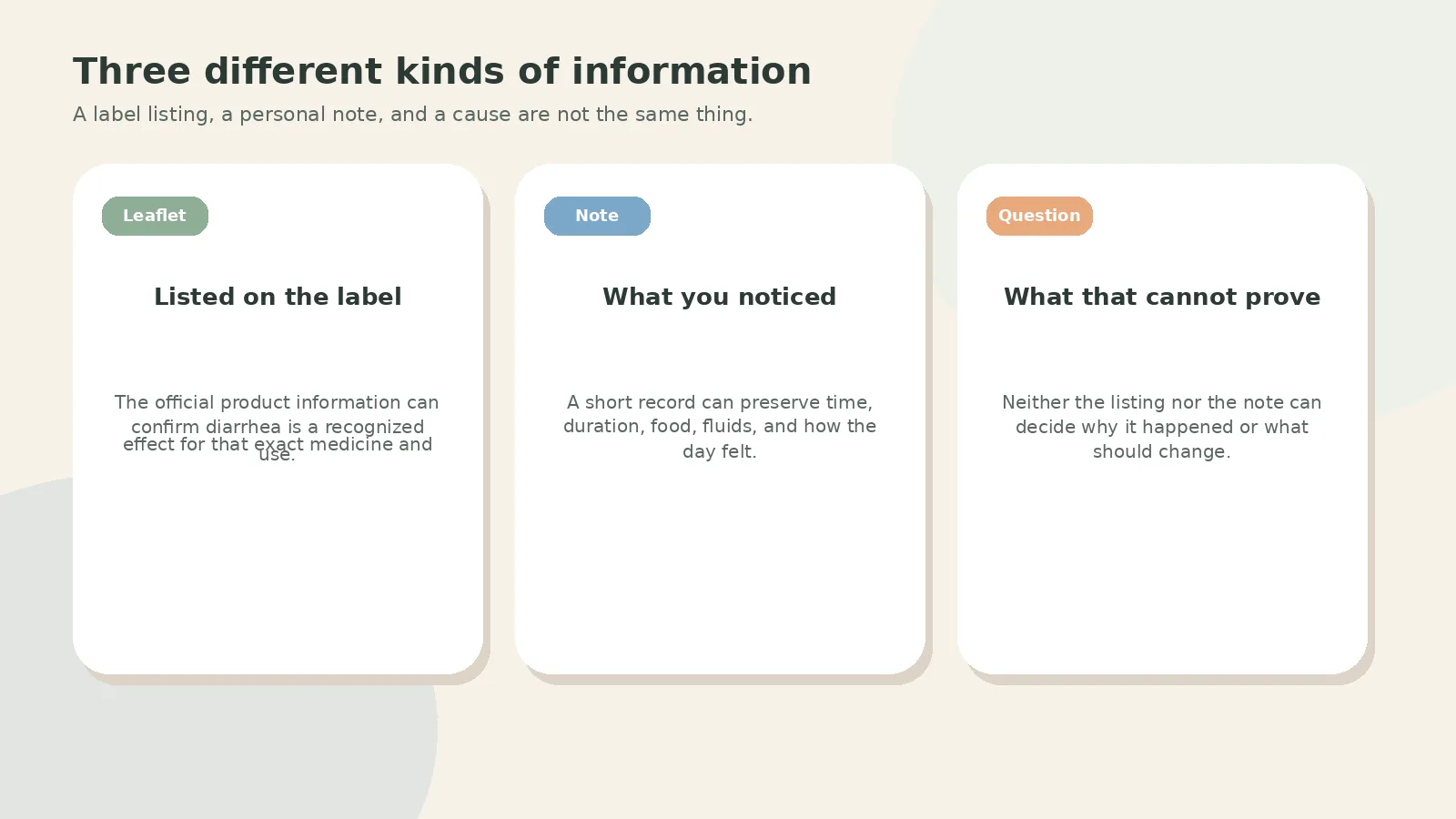
When the afternoon feels off, the first instinct is usually to search the symptom. That search mixes class-wide headlines with other people's days. None of it is the leaflet that arrived with your prescription.
A label question is narrower, and that is the point. It asks what the official product information for the medicine you are actually using says about diarrhea. That document has a fixed answer for that product and use. It is the calmest place to begin.
Why one medicine's numbers are not a class answer
Diarrhea is listed in the current DailyMed prescribing information for several widely used GLP-1 medicines, including Ozempic (semaglutide injection), Wegovy (semaglutide injection, 2.4 mg), Mounjaro (tirzepatide), and Zepbound (tirzepatide). The listing confirms the effect is recognized for those products. It does not confirm why your Tuesday looked the way it did.
The percentages below come from different trials, doses, and uses. They are not interchangeable, and they are not a forecast for any one person.
| Product in DailyMed | Diarrhea in the cited studies | Placebo in the same studies |
|---|---|---|
| Ozempic 0.5 mg and 1 mg | 8.5% and 8.8% | 1.9% |
| Wegovy, adult weight-reduction trials | 30% | 16% |
| Mounjaro 5 mg, 10 mg, 15 mg | 12%, 13%, 17% | 9% |
| Zepbound 5 mg, 10 mg, 15 mg | 19%, 21%, 23% | 8% |
Those rows answer one question only: did this product's studies report diarrhea more often than placebo. They do not answer whether your stools were caused by the medicine, by a small or partial meal, by something else that day, or by more than one of those at once.
For a wider map of listed gastrointestinal effects across products, the broader GLP-1 side-effect guide stays the owner of that list. This page stays on the diarrhea question.
Why listed rates still leave what you notice unexplained
A percentage is a study result. An afternoon is a day you still have to live through. Those two facts sit next to each other without one explaining the other.
I would not try to reconstruct a messy afternoon from a half-remembered "it was bad." The number on a table cannot tell you how long the loose stools lasted, whether lunch was only a few bites, or whether you had already been increasing a dose. Those details live in your day, not in a trial appendix.
Dose escalation is a timing pattern, not a personal forecast
Several of the same labels also say that most gastrointestinal effects, including diarrhea, were reported during dosage escalation and that they decreased over time in the study populations. That is a timing pattern from a trial. It is not a calendar you can circle for yourself.
If you want week-scale context for a new routine, there is a separate first-month GLP-1 record that treats observations as notes, not as a predicted sequence. Keep this page on the diarrhea question, and let that guide own the broader month.
The same label-first habit shows up in another label-first stomach guide. The useful move is identical even when the product and the symptom are different: exact document first, personal context second.
What to record before you ask
Memory is weakest exactly where a good question needs it to be strong. The details that feel unforgettable at 3 p.m.—the time, the duration, whether lunch was a few bites or a normal plate—are the first to blur by the next morning. Writing them down is not about building a case. It is about not losing them.
If appetite was lower that day, record the small or partial meal as context rather than as an explanation. A short note can hold "lunch was only a few bites" without turning that fact into a cause.
The details that are easiest to lose
A useful diarrhea note is short. You are capturing context, not writing a report.
| Detail | Why it slips away |
|---|---|
| Date and rough time | Days blend together within a week |
| How long it lasted | "A while" replaces the real length |
| Recent food, including a small or partial meal | A few bites are easy to edit out later |
| Fluids that day | They feel obvious until someone asks |
| Dose-change week, if one is underway | The calendar is harder to rebuild than it seems |
| Anything else that day | Context gets tidied out of memory |
None of this interprets anything. "Loose stools for about two hours after a small lunch, second time this month" is a fact you can hand to someone qualified. The meaning of that fact is their job, not the notebook's.
A short diarrhea note that is actually useful
The difference between a helpful note and an unhelpful one is mostly restraint. Helpful: what you noticed, when, and the surrounding context. Unhelpful: conclusions, theories, and comparisons to things you read online. The first travels well into a professional conversation. The second has to be unpacked before anyone can use it.
From a messy afternoon to a clearer question
Here is the shape of it. Something uncomfortable happens. You check the information for your exact prescription—is diarrhea listed for this product? You write down the details while they are fresh. Later, if you talk with a pharmacist or prescriber, you arrive with a question instead of a fog.
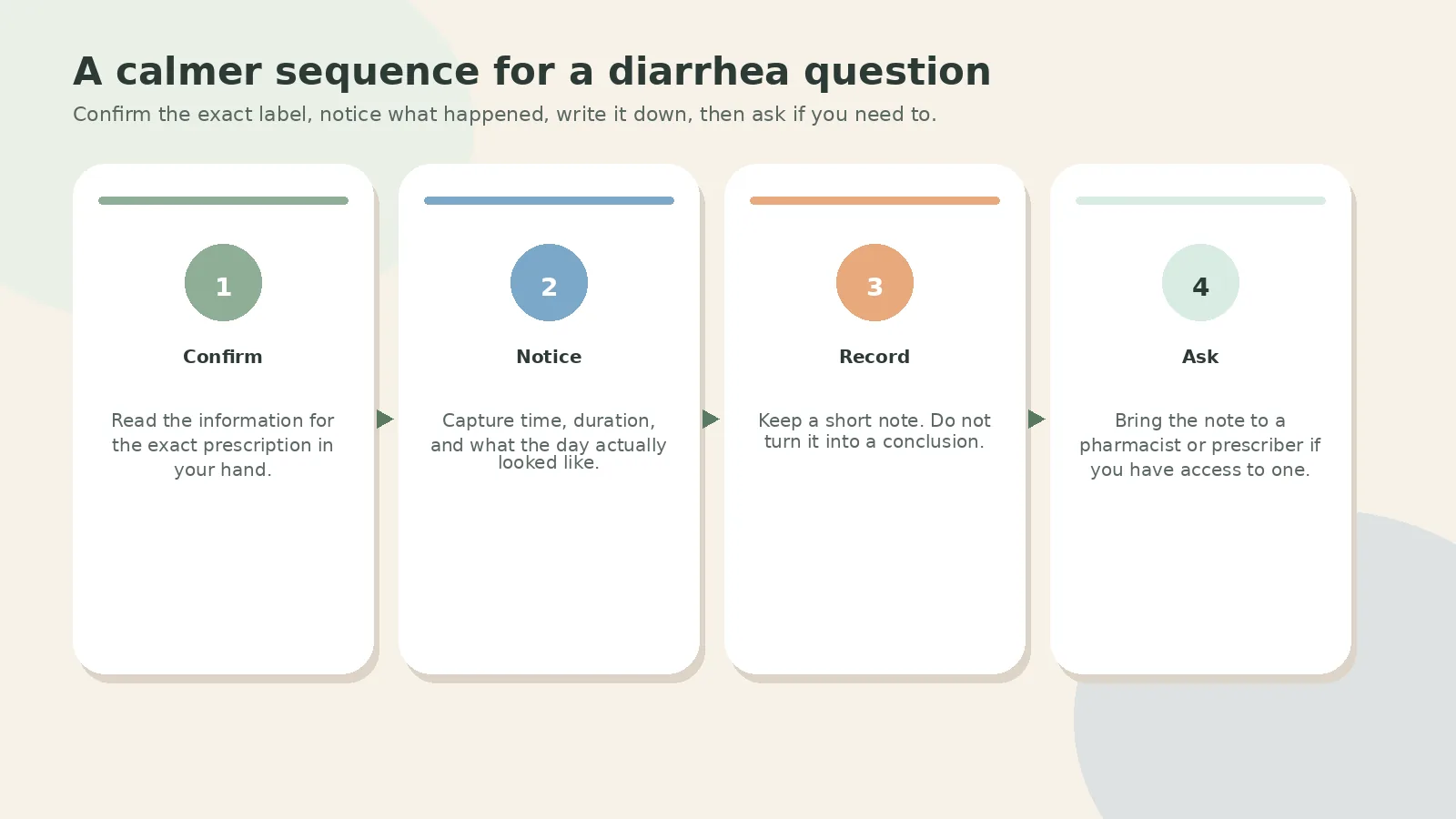
"Tuesday, about an hour after a lunch that was only a few bites, loose stools for roughly two hours; second time this month, during a dose-increase week" is a question with handles on it. It took a minute to record. It gives the person across the counter something real to work with. That is the entire ambition of a symptom note: not to explain, but to preserve.
When the situation needs prompt care
Note-keeping has limits, and it is worth being plain about them. Concerning, severe, persistent, or worsening symptoms are not a writing exercise. They are a reason to seek prompt professional advice. A record can support that conversation. It should never delay it.
Several product Medication Guides also connect ongoing nausea, vomiting, or diarrhea with the risk of getting dehydrated, and they tell readers to drink fluids and to tell a healthcare provider if those symptoms do not go away. That is label language for those products, not a home protocol and not a fluid target. If you cannot keep fluids down, or the situation feels concerning, treat that as a reason to get help rather than as a prompt to write a longer note.
If you believe the situation is an emergency, use your local emergency services. Do not spend the time documenting first.
How a side-effect record can keep the context together
The hard part is not understanding what to record. It is having one calm place to put timing, duration, and the ordinary details around the day so they are still intact later. Scraps of paper and half-finished phone notes scatter the context you were trying to keep.
The Glowise Side Effect Tracker is built for that later step. It lets you record what you noticed in your own words, with timing and duration. It can keep optional nearby context such as medication timing, food, water, and personal notes in one timeline. You can review that timeline across days or weeks and write one focused question for a pharmacist or prescriber if you have access to one. You can record side-effect context there without asking the app to decide what the entries mean.
A calmer place for the details
Keep the context you want to remember together
Organize timing, food, water, and symptom notes in one personal record without asking the app to decide what they mean.
The practical takeaway
A clearer next note
- Check the information for your exact GLP-1 prescription, not a class headline.
- Record what you noticed, when it happened, how long it lasted, and the day's food and fluids.
- If lunch was only a few bites, write that down as context, not as a conclusion.
- Keep the note short enough to use while the details are fresh.
- Seek prompt professional advice for concerning, severe, persistent, or worsening symptoms.
Frequently Asked Questions
Can GLP-1 medicines cause diarrhea?
Diarrhea is listed in the official product information for several GLP-1 medicines, including Ozempic, Wegovy, Mounjaro, and Zepbound. That confirms the effect is recognized for those products. It does not confirm why it happened in your individual case.
How do you stop diarrhea from a GLP-1 medicine?
This guide does not offer a home treatment, an over-the-counter plan, or a dose change. Check the information for your exact prescription, keep a short factual note, and bring the question to a pharmacist or prescriber if you have access to one. Seek prompt professional advice when symptoms are concerning, severe, persistent, or worsening.
Do GLP-1 medicines make you poop a lot?
Some product labels list diarrhea as a reported effect. How often stools change, and what that change looks like, is personal. A note can preserve frequency and duration. It cannot decide whether the medicine is the reason.
What is the most common side effect of a GLP-1 medicine?
That answer depends on the exact product, dose, and study. Gastrointestinal effects such as nausea, vomiting, diarrhea, and constipation appear often in product information, but the ranking is not identical across labels. Use the leaflet for your prescription, and use the broader side-effect guide when you need the wider list.
How long will GLP-1 diarrhea last?
Several labels say most gastrointestinal effects were reported during dosage escalation and decreased over time in the study groups. That is not a personal timeline. Record how long an episode lasted for you, and let a qualified professional interpret the pattern.
Can a symptom record prove a GLP-1 medicine caused diarrhea?
No. A personal record helps you recall timing, food, fluids, and what else was happening. Recall is not proof of cause. Only someone qualified, looking at your full picture, can assess what a symptom means for you.
Sources

About the author
Maya Lee
Glowise Senior GLP-1 Content Editor
Maya Lee is a Glowise Health Content Editor. Her guides turn product records, authoritative sources, and everyday organization questions into clear, practical GLP-1 information.
She helps readers ask better questions and keep the details relevant to a care conversation together.
See more Glowise on Google
Add Glowise as a preferred source to find our GLP-1 guides more easily in Google Search.