
Hair loss was reported more often by people taking Zepbound than by people taking placebo in its weight-reduction trials. The current US prescribing information lists it among common adverse reactions. It also says hair-loss reactions in Zepbound-treated patients were associated with weight reduction. These findings make shedding a real issue to discuss, while leaving an important question open: they do not establish whether tirzepatide itself, weight loss, changes in food intake, another condition, or several factors caused an individual's hair loss.
If you notice more hair in the shower or brush, start with the pattern and timing. A useful description is more informative to a clinician than simply saying “Zepbound made my hair fall out.”
What the Zepbound label actually reports
In the current US Zepbound prescribing information, the pooled placebo-controlled weight-reduction studies (Studies 1 and 2) report hair loss in 1% of placebo participants, versus 5% at 5 mg, 4% at 10 mg, and 5% at 15 mg of Zepbound. These are rounded group percentages, not your personal probability or a dose-by-dose prediction. The rates do not form a steady increase across doses; that pattern alone cannot identify the cause. The label’s table includes adverse reactions reported by at least 2% of Zepbound-treated patients and more often than placebo.
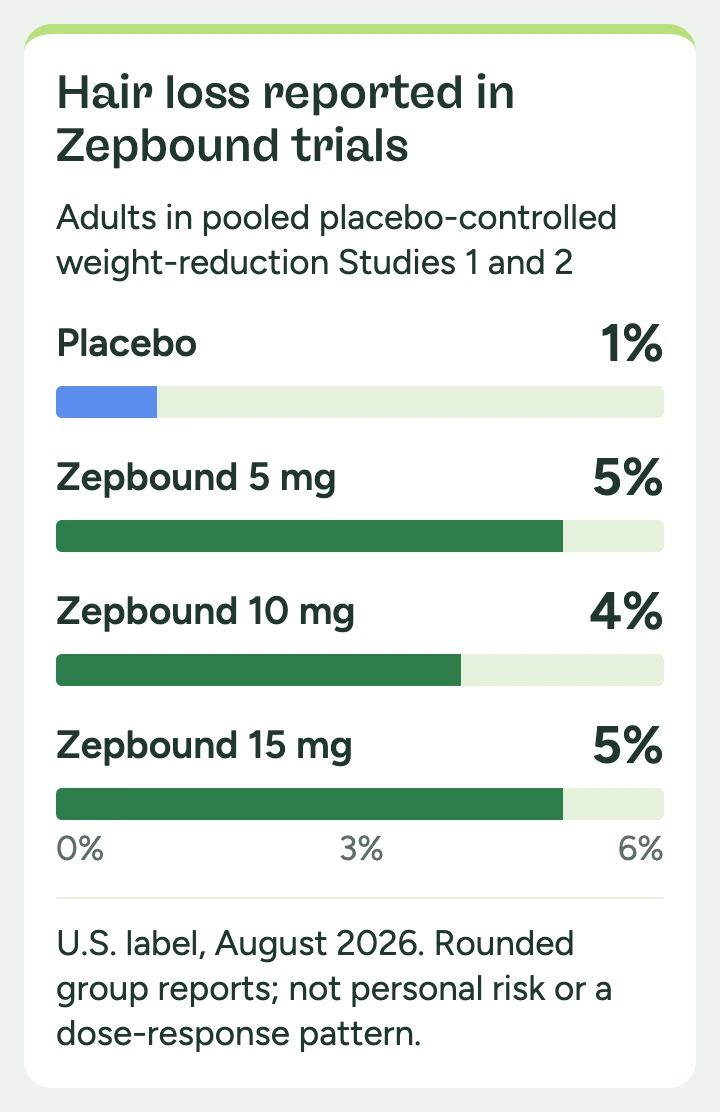
The same label states that hair-loss adverse reactions in Zepbound-treated patients were “associated with weight reduction.” Among Zepbound-treated patients in those pooled studies, hair loss was reported by 7.1% of female participants and 0.5% of male participants; the corresponding placebo figures were 1.3% and 0%. These subgroup figures describe the study population. They should not be used to predict what will happen to a particular person, and they do not explain why the difference appeared.
One distinction often gets lost online: the label does list hair loss. Saying it is “not a Zepbound side effect” because weight reduction may be involved misstates the official information. Saying the drug directly injures hair follicles goes beyond what the trials establish.
Why the timeline may lag behind the trigger
One possible explanation for diffuse shedding after a period of significant weight loss is telogen effluvium: more hairs enter a resting phase after a physical stressor, then shed later. The American Academy of Dermatology lists substantial weight loss among events that can precede excessive shedding and notes that many people first notice it a few months afterward. That delay means shedding that begins after months of treatment could relate to an earlier change in weight or health. It does not prove telogen effluvium or rule out another cause.
Food intake can change markedly while appetite is lower. If eating has become difficult or very limited, tell your care team. A clinician may consider nutrition, other medicines, recent illness, thyroid disease, iron deficiency, or a different hair condition based on your history and exam. An American Family Physician review of hair-loss evaluation includes thyroid and iron-related conditions among possible explanations for diffuse loss and says testing depends on the history and examination. There is no single protein target, ferritin cutoff, or supplement that this article can prescribe to prevent Zepbound-associated shedding.
Notice the pattern, not just the number of hairs
Diffuse shedding across the scalp after a major stressor can fit telogen effluvium. A widening part, a receding hairline, distinct bald patches, scalp pain, redness, or scaling may point to a different or additional problem. These descriptions are clues for a visit, not diagnoses you need to make yourself. If shedding is sudden, patchy, or accompanied by scalp symptoms, arrange a medical assessment. Also seek evaluation if it persists or worries you even when the pattern seems diffuse.
Bring a short timeline to the conversation
Record when you started Zepbound and any prescribed dose changes; when you first noticed shedding; roughly how your weight and appetite changed; and whether you had a recent illness, surgery, major stress, or a change in another medication. A few consistent photos of the same part line or hairline may be more useful than trying to count every lost hair. Mention whether the loss is diffuse or concentrated in patches and whether the scalp itself feels different.
Ask your prescriber or a dermatologist what pattern they see, whether another cause should be checked, and what follow-up would show whether shedding is settling. If eating enough has become difficult, bring that up directly. Do not stop or change Zepbound or start a supplement or hair treatment solely on the basis of a web article; the best next step depends on the cause and your medical context.
The trial figures tell you that hair loss was reported; your timeline and scalp assessment help determine which explanation deserves follow-up. Bring both to the visit, especially if shedding is patchy, accompanied by scalp changes, or persists or worsens.
Cover image: Shixart1985, CC BY 2.0; resized and converted to WebP.

About the author
Maya Lee
Glowise Senior GLP-1 Content Editor
Maya Lee is a Glowise Health Content Editor. Her guides turn product records, authoritative sources, and everyday organization questions into clear, practical GLP-1 information.
She helps readers ask better questions and keep the details relevant to a care conversation together.
See more Glowise on Google
Add Glowise as a preferred source to find our GLP-1 guides more easily in Google Search.