
Reaching your goal weight does not automatically mean your tirzepatide dose should fall. In the United States, Zepbound's recommended doses for weight reduction and long-term maintenance are 5 mg, 10 mg, or 15 mg once weekly. Its label tells prescribers to consider treatment response and tolerability; it does not give a separate, mandatory step-down schedule for the day you reach your target. Zepbound prescribing information, sections 2.1–2.2.
That distinction matters because “maintenance” can mean two things: a continuing medication dose after the starting phase, or the goal of keeping weight off after losing it. Those timelines can overlap. You may already be taking a labeled maintenance dose while you are still losing weight.
A lower weekly dose can be part of a treatment review, and a 2026 trial directly studied reducing tirzepatide to 5 mg after a 60-week initial treatment period that included dose escalation and ended at a maximum tolerated dose of 10 or 15 mg weekly. But that does not establish one ideal dose for everyone—or turn every-other-week injections into an approved maintenance schedule.
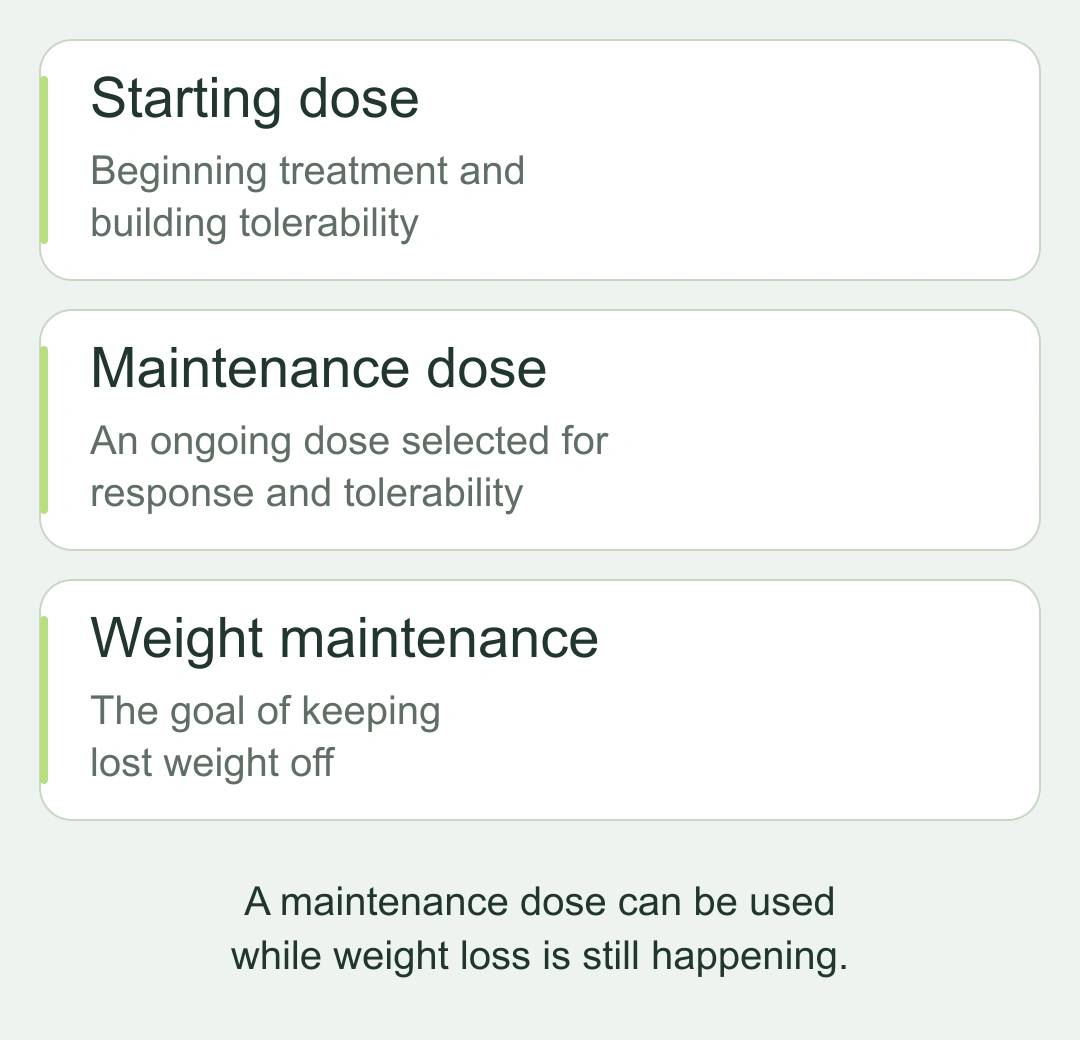
The dose phase and the weight goal can overlap; reaching goal does not create an automatic step-down schedule.
What counts as a maintenance dose?
Start with the product and the condition being treated. Zepbound and Mounjaro contain the same active ingredient, tirzepatide, but their U.S. labels describe different uses. An answer about weight maintenance alone can miss another reason the medicine was prescribed.
| Product and treatment purpose | What the current U.S. label says | What that means after weight loss |
|---|---|---|
| Zepbound for weight reduction and long-term maintenance | Recommended maintenance doses: 5, 10, or 15 mg once weekly, alongside a reduced-calorie diet and increased physical activity. | Maintenance does not require a lower dose than the one used during weight loss. Selection considers response and tolerability. |
| Zepbound for moderate to severe obstructive sleep apnea in adults with obesity | Recommended maintenance doses: 10 or 15 mg once weekly, alongside a reduced-calorie diet and increased physical activity. | A weight-management dose list cannot substitute for the dose recommendations for sleep apnea. |
| Mounjaro | Approved to improve blood sugar control in people with type 2 diabetes, and to reduce major cardiovascular event risk in adults with type 2 diabetes at high risk. Adult dosing has a maximum of 15 mg once weekly; the label ties escalation to additional glycemic control needs. | There is no separate Mounjaro label schedule for “maintenance after goal weight.” Blood sugar and the other treatment goals still matter. |
Sources: current Zepbound and Mounjaro prescribing information, sections 1–2. Mounjaro's glycemic-control indication also includes children aged 10 and older; this article addresses adult treatment.
For Zepbound, 2.5 mg once weekly is the starting dose for four weeks, not an approved maintenance dose. The label then directs an increase to 5 mg once weekly. Any further increases are in 2.5 mg steps after at least four weeks on the current dose. The 7.5 mg and 12.5 mg strengths exist, but they are not among the label's recommended maintenance doses for weight management. A strength being available does not make it a recommended long-term endpoint.
This is also why you do not have to climb to 15 mg simply because it is the maximum. The label offers more than one maintenance dose and bases selection on response and tolerability. These are label distinctions, not instructions to change your own prescription.
Does reaching your goal mean you should step down?
Not by itself. A goal weight tells you something about the outcome you wanted. It does not tell you how much ongoing treatment is needed to support that outcome, whether you are still losing, or how well you can tolerate the current dose.
Consider two different situations. One person has reached an agreed weight range, can eat adequately, feels well, and has a stable trend. Another has reached the same weight but is continuing to lose and struggling to finish meals. The scale reading may match; the treatment review should not. The second situation raises a question about tolerability and adequate intake, rather than being evidence that everyone should reduce at a particular weight.
The Zepbound label specifically says that if someone does not tolerate a maintenance dosage, a lower maintenance dosage should be considered. That makes dose reduction a legitimate topic—not an automatic reward for reaching goal, and not a decision the scale can make alone.
There is no label rule that you must reach a certain percentage of your personal target or hold a steady weight for a fixed number of weeks before “qualifying” for maintenance. A plateau, a target weight, and a dose review describe different things.
What trials actually tell us about continuing or reducing the dose
Two tirzepatide studies help answer different parts of the question. Both excluded diabetes, so neither provides a complete dosing answer for someone whose treatment also needs to control type 2 diabetes.
SURMOUNT-4 tested continuation versus withdrawal
After a 36-week initial tirzepatide period, 670 adults with obesity or overweight and a weight-related complication were randomized to continue their maximum tolerated dose of 10 or 15 mg once weekly, or switch to placebo for another 52 weeks. Both groups continued lifestyle counseling.
From the randomization point, the continued-treatment group lost another 5.5% of body weight on average, while the placebo group gained 14.0%. These percentages describe change from week 36—not the fraction of the original weight loss regained. SURMOUNT-4, JAMA.
The study supports continuing treatment to help preserve weight loss. It also shows that continued treatment can produce further loss. It did not test stepping down to 5 mg, so it cannot tell you that a higher dose is always necessary or identify the lowest dose that would work for you.
SURMOUNT-MAINTAIN directly tested reduction to 5 mg
Published in 2026, SURMOUNT-MAINTAIN used a longer initial period: 60 weeks of tirzepatide treatment, followed by 52 weeks in which 378 adults were randomized to continue their maximum tolerated 10 or 15 mg weekly, reduce to 5 mg weekly, or switch to placebo. Participants had obesity, or overweight with a weight-related condition. Diabetes was excluded. Published trial and trial registration.
At week 112, the published abstract reports model-based average body-weight reductions from the original starting weight of:
- 21.9% with continued maximum tolerated treatment.
- 16.6% after reduction to 5 mg.
- 9.9% after switching to placebo.
Those are total reductions across the study, not additional losses during the maintenance year and not percentages of prior weight loss retained. The study also allowed rescue tirzepatide from week 84 for substantial regain; its primary analysis accounted for rescue rather than simply counting its subsequent benefit as success of the assigned strategy.
The practical finding is narrower than “everyone should drop to 5 mg”: reducing to 5 mg preserved more of the overall reduction than switching to placebo, while the continued higher-dose group had a larger average reduction. Individual responses varied. The study was funded by Eli Lilly.
This was a structured comparison after a lengthy treatment period. It did not establish 2.5 mg maintenance, alternate-week dosing, or a self-directed taper. Its weekly 5 mg arm is evidence about one specific reduction strategy—not a formula for converting any current prescription into a maintenance plan.
A lower weekly dose is different from spacing injections
“Take less each week” and “take the same dose less often” change different parts of treatment. They should not be treated as interchangeable ways to reach the same maintenance dose.
The U.S. labels specify once-weekly administration. The two maintenance studies above also used weekly treatment. Neither establishes that injecting every 10 or 14 days gives the same results as a lower weekly dose. A discussion of a different schedule needs to acknowledge that evidence gap instead of presenting it as routine labeled maintenance.
Stopping is a third decision. Evidence about weight regain after stopping GLP-1 treatment helps explain why follow-up matters, but it does not supply a tapering schedule. If your larger question is how long treatment might continue, our Mounjaro duration guide addresses that separately.
What a useful maintenance review should resolve
The useful outcome is a plan with a clear purpose, not simply the smallest number on a prescription. Bring your current product, prescribed weekly dose, weight trend, appetite and ability to eat, side effects, and any changes to other medicines. If you have diabetes, include the glucose information your care team has asked you to collect.
If you also have type 2 diabetes, a weight-maintenance study cannot decide the dose needed for your diabetes care. Review blood sugar and the other purposes of your prescription alongside weight, rather than treating a weight-loss result as the whole treatment goal.
Then work toward three concrete answers:
- What are we trying to maintain? An agreed weight range, blood sugar control, sleep apnea treatment, or more than one goal may be involved. Clarify whether further loss is still wanted.
- What is the reason to keep or reconsider this dose? Separate good response from problems such as ongoing unwanted loss, difficulty eating, or persistent side effects. A single weight reading should not become a dose instruction.
- How will we judge the plan? Agree on what to monitor, when to review it, and what change should prompt earlier contact. The studies' visit schedules and rescue thresholds are research procedures, not personal targets to copy.
Persistent symptoms belong in that review. The Zepbound Medication Guide says to tell your healthcare provider right away about nausea, vomiting, or diarrhea that does not go away; dehydration can lead to kidney problems. If you use insulin or a sulfonylurea, low-blood-sugar risk also needs attention, and those medicines may require adjustment by your prescriber.
Severe abdominal pain that will not go away, with or without nausea or vomiting, is different from a routine maintenance question. It may extend to the back. Stop using Zepbound and call your healthcare provider right away, as its Medication Guide directs for possible pancreatitis. Zepbound Medication Guide.
Reaching goal changes the question from “How do I lose more?” to “What supports the result I want to keep?” A maintenance dose can stay the same or be reconsidered. The label sets the approved options; the research explains what particular strategies achieved; your ongoing response determines what needs reviewing.

About the author
Maya Lee
Glowise Senior GLP-1 Content Editor
Maya Lee is a Glowise Health Content Editor. Her guides turn product records, authoritative sources, and everyday organization questions into clear, practical GLP-1 information.
She helps readers ask better questions and keep the details relevant to a care conversation together.
See more Glowise on Google
Add Glowise as a preferred source to find our GLP-1 guides more easily in Google Search.