
Yes, Mounjaro's active ingredient, tirzepatide, can improve blood lipids. Studies generally show larger reductions in triglycerides than in LDL cholesterol, alongside increases in HDL cholesterol in some trials. That does not mean every cholesterol number will fall, or that the medicine replaces a statin or another prescribed lipid-lowering treatment.
The useful question is which part of your lipid panel changed, how much it changed from your own starting value, and whether the result meets the goals of your care plan. A lower total cholesterol number alone cannot answer all three.
Start with the numbers a lipid panel separates
A lipid panel is a blood test that reports several related measures. They are worth reading separately:
| Measure | What it tells you | What to keep in view |
|---|---|---|
| LDL cholesterol, or LDL-C | Cholesterol carried in LDL particles, which can contribute to plaque buildup in arteries | A central focus of treatment; the appropriate goal depends on cardiovascular risk |
| HDL cholesterol, or HDL-C | Cholesterol carried in HDL particles | A higher result does not cancel a high LDL result |
| Triglycerides | A different type of fat circulating in the blood | May change substantially even when LDL changes little |
| Total cholesterol | An overall cholesterol measure that includes HDL and other cholesterol fractions | A summary, not a substitute for the individual results |
| Non-HDL cholesterol | Total cholesterol minus HDL cholesterol | Helps capture cholesterol in particles associated with atherosclerosis beyond LDL alone |
The American Heart Association's explanation of cholesterol results emphasizes that HDL is not itself a treatment target for lowering heart attack or stroke risk. Your clinician considers the whole pattern and your health history. An HDL increase can be part of a favorable pattern without becoming a reason to ignore LDL.
What tirzepatide studies actually show
Mounjaro and Zepbound both contain tirzepatide, but their US labels and treatment populations differ. To interpret a percentage, keep the study population, comparison group, and time point attached to it.
A 72-week comparison: triglycerides changed more than LDL
The Zepbound prescribing information, Table 3, reports two placebo-controlled trials in adults with obesity or overweight: Study 1 without diabetes, and Study 2 with type 2 diabetes. Both included lifestyle intervention. These selected results are for 15 mg once weekly at week 72, not a starter-dose forecast.
| Population and measure | Tirzepatide: change from baseline | Placebo: change from baseline | Relative difference versus placebo, with 95% confidence interval |
|---|---|---|---|
| Without diabetes: LDL-C | −7.1% | −1.7% | −5.5% (−8.9 to −2.0) |
| Without diabetes: HDL-C | +8.0% | −0.7% | +8.7% (+5.7 to +11.8) |
| Without diabetes: triglycerides | −29.1% | −5.6% | −24.9% (−29.1 to −20.4) |
| With type 2 diabetes: LDL-C | +4.1% | +7.4% | −3.0% (−8.4 to +2.6) |
| With type 2 diabetes: HDL-C | +9.7% | +0.2% | +9.5% (+5.6 to +13.5) |
| With type 2 diabetes: triglycerides | −27.3% | −3.3% | −24.8% (−30.3 to −18.9) |
These are adjusted estimates. The lipid comparisons were not controlled for multiple testing. The relative differences use log-transformed analyses; they are not simple percentage-point subtractions.
Notice the LDL row for participants with diabetes. LDL rose from baseline in both groups, even though the comparison favored tirzepatide numerically. Its confidence interval crosses zero, so that comparison does not establish a clear LDL benefit. “Lower than placebo” and “lower than where I started” are different statements.
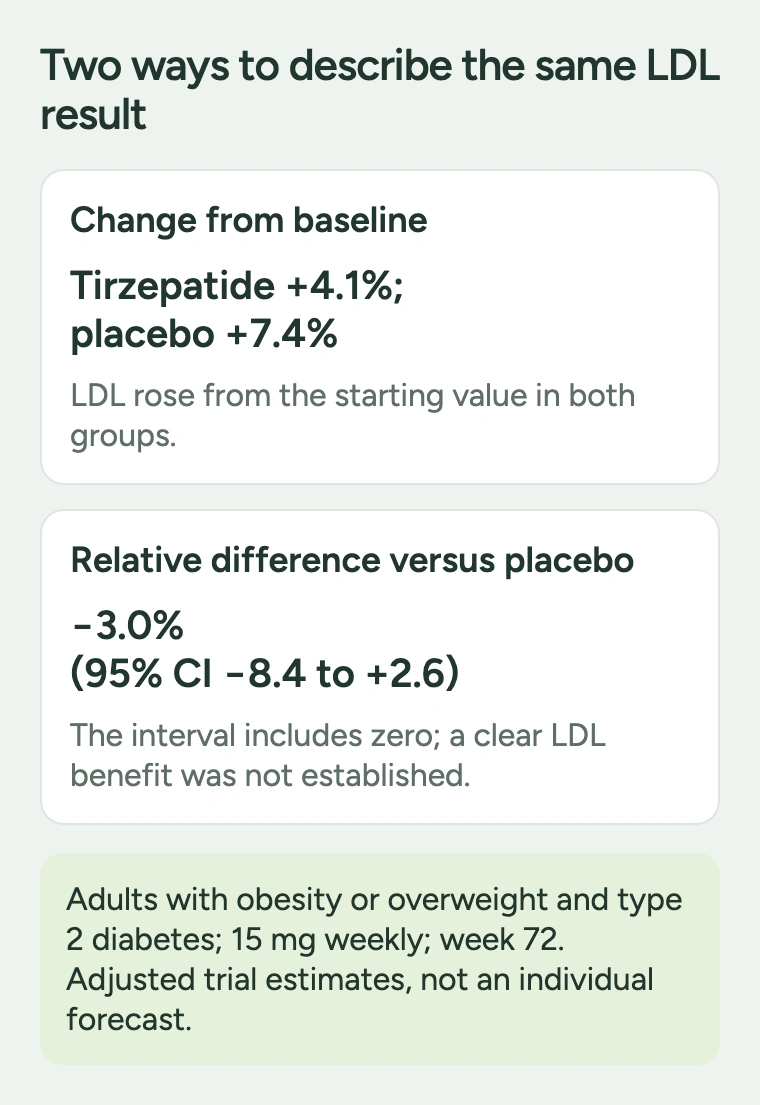
In this trial, “lower than placebo” did not mean “lower than baseline.” The confidence interval also leaves the LDL comparison uncertain.
This is why a headline saying tirzepatide “lowers cholesterol” needs detail. The triglyceride findings are more pronounced here; the LDL findings are smaller and less consistent. None of these group averages predicts your next blood test or justifies choosing a dose to chase a lipid result.
Earlier diabetes research helps explain the pattern
An exploratory analysis of a 26-week randomized trial in type 2 diabetes examined stored samples as well as routine lipids. At 15 mg, the estimated triglyceride reduction relative to placebo was 41.4% (95% confidence interval, 30.7% to 50.5% lower). The LDL-C difference was 19.0% lower (1.9% to 36.0% lower), with a much wider interval. LDL-C lowering was not significantly different from the active comparator, dulaglutide.
Those percentages cannot be pasted onto the 72-week results. This was a different, smaller trial, with a different analysis population and timeframe. It does support looking beyond total cholesterol when discussing tirzepatide.
The analysis also found changes in apoC-III, a protein involved in triglyceride metabolism, and in lipoprotein particles. These findings suggest that lipid changes may involve more than weight change alone. They do not establish exactly how much of an individual's improvement comes from weight loss, glucose control, eating changes, or a direct drug effect. A routine lipid panel cannot separate those causes.
Does a better lipid panel mean fewer heart attacks?
A lipid result is a biomarker. A trial counting heart attacks, strokes, and cardiovascular deaths answers a different question.
Tirzepatide now has its own cardiovascular outcome evidence. In SURPASS-CVOT, adults with type 2 diabetes and established cardiovascular disease received tirzepatide or dulaglutide, which already has cardiovascular benefit evidence. The current Mounjaro label reports a median follow-up of 210.1 weeks and a hazard ratio of 0.92 (95.3% confidence interval, 0.83 to 1.01) for cardiovascular death, nonfatal heart attack, or nonfatal stroke. Tirzepatide met the trial's noninferiority criterion; superiority over dulaglutide was not established.
As of November 2026, the US Mounjaro label includes reducing major adverse cardiovascular events in adults with type 2 diabetes at high risk for those events, alongside its blood-glucose indication. It does not list treatment of high cholesterol as an indication.
That distinction matters. Cardiovascular outcome evidence does not show that the benefit came specifically from lowering cholesterol, or that LDL management is no longer needed. It also does not extend that indication to everyone using tirzepatide for weight management. Findings from semaglutide studies should not be substituted for tirzepatide evidence.
How to compare your own before-and-after results
Bring both reports to follow-up, including their dates and units. Compare LDL, HDL, triglycerides, and non-HDL individually rather than remembering only that “cholesterol improved.”
For example, imagine triglycerides fall from 200 to 150 mg/dL while LDL stays at 150 mg/dL. The triglyceride reduction is 25%: the change of 50 divided by the starting value of 200. That is a useful change, but the unchanged LDL still needs interpretation. This is an arithmetic example, not a treatment goal or an expected response to Mounjaro.
Record whether each test was fasting if that information is available, and follow the laboratory's preparation instructions for the next test. Note any changes in cholesterol medication, missed doses, glucose control, eating patterns, or alcohol intake. That context helps your clinician interpret the comparison; it does not prove which change caused the result.
A lipid panel cannot tell you whether existing artery plaque has disappeared. Nor can improved appetite, weight, or energy tell you that LDL is controlled. The blood test and the risk assessment do separate jobs.
What to discuss at the next visit
Four questions can turn a confusing report into a concrete plan:
- Which result still needs attention? Ask about the actual LDL, non-HDL, and triglyceride values, alongside the change from baseline.
- What goal fits my risk? Previous cardiovascular disease, diabetes, blood pressure, smoking, family history, and other factors affect the plan. A laboratory reference range alone does not set your personal goal.
- Does my lipid-lowering treatment need review? Bring the medication list and explain any difficulty taking it. Do not stop or reduce a statin because tirzepatide improved another number. The AHA's cholesterol treatment discussion guide treats risk assessment, lifestyle, and medication as connected parts of care.
- When should I repeat the test? The 2026 US dyslipidemia guideline recommends checking a lipid profile 4–12 weeks after starting or intensifying lipid-lowering therapy, then generally every 6–12 months. That is a lipid-treatment monitoring recommendation, not a promise that Mounjaro will lower cholesterol within that window. Agree on timing for your circumstances.
Tirzepatide can make a meaningful difference to a lipid profile, particularly triglycerides. The next decision still rests on the numbers you have, the risk they sit within, and the treatment needed to address what remains elevated.

About the author
Maya Lee
Glowise Senior GLP-1 Content Editor
Maya Lee is a Glowise Health Content Editor. Her guides turn product records, authoritative sources, and everyday organization questions into clear, practical GLP-1 information.
She helps readers ask better questions and keep the details relevant to a care conversation together.
See more Glowise on Google
Add Glowise as a preferred source to find our GLP-1 guides more easily in Google Search.