Yes. GLP-1 medicines can cause low blood sugar, called hypoglycemia, although the risk is generally lower when they are used without insulin or medicines that stimulate insulin release. Taking insulin or a sulfonylurea changes that risk substantially. So can eating less than usual while using those medicines.
Two questions matter more than whether you feel vaguely “low”: What other medicines are you taking, and what does your glucose reading show? Dizziness and tiredness can happen during a low, but neither proves that your glucose has fallen too far.
If someone is unconscious, having a seizure, or too confused to treat themselves safely, call 911. Give their prescribed glucagon if available and someone knows how to use it. Do not give food or drink to someone who cannot swallow safely. This is an emergency, even without a glucose reading. ADA emergency guidance
What to do with a low reading
For many adults with diabetes, below 70 mg/dL is the usual action threshold. Your diabetes team may set an individual threshold and treatment plan; follow that plan. You do not need to wait until glucose drops below 54 mg/dL to act. ADA guidance
If you are awake and able to swallow safely, the CDC’s adult 15-15 rule is:
- Take 15 grams of fast-acting carbohydrate. Examples include 4 ounces of juice or regular soda, or glucose tablets or gel in the amount specified on the package for 15 grams.
- Wait 15 minutes, then check glucose again.
- If it remains below 70 mg/dL, repeat. Continue until it is back in your target range.
- After treating the low, eat a snack or meal containing carbohydrate and protein.
Chocolate and high-fiber foods work more slowly and are poor first choices for rescue. Protein alone is not a replacement for fast-acting carbohydrate. These are general adult instructions, not a substitute for a personal diabetes plan. CDC treatment guidance
If you cannot manage the low safely, it keeps falling, or it does not respond to treatment, get emergency medical help. Glucagon is emergency treatment for a person unable to treat themselves; it can be prescribed as a nasal spray or injection. Call 911 right away after giving it, or if it is needed but unavailable. NIDDK emergency guidance
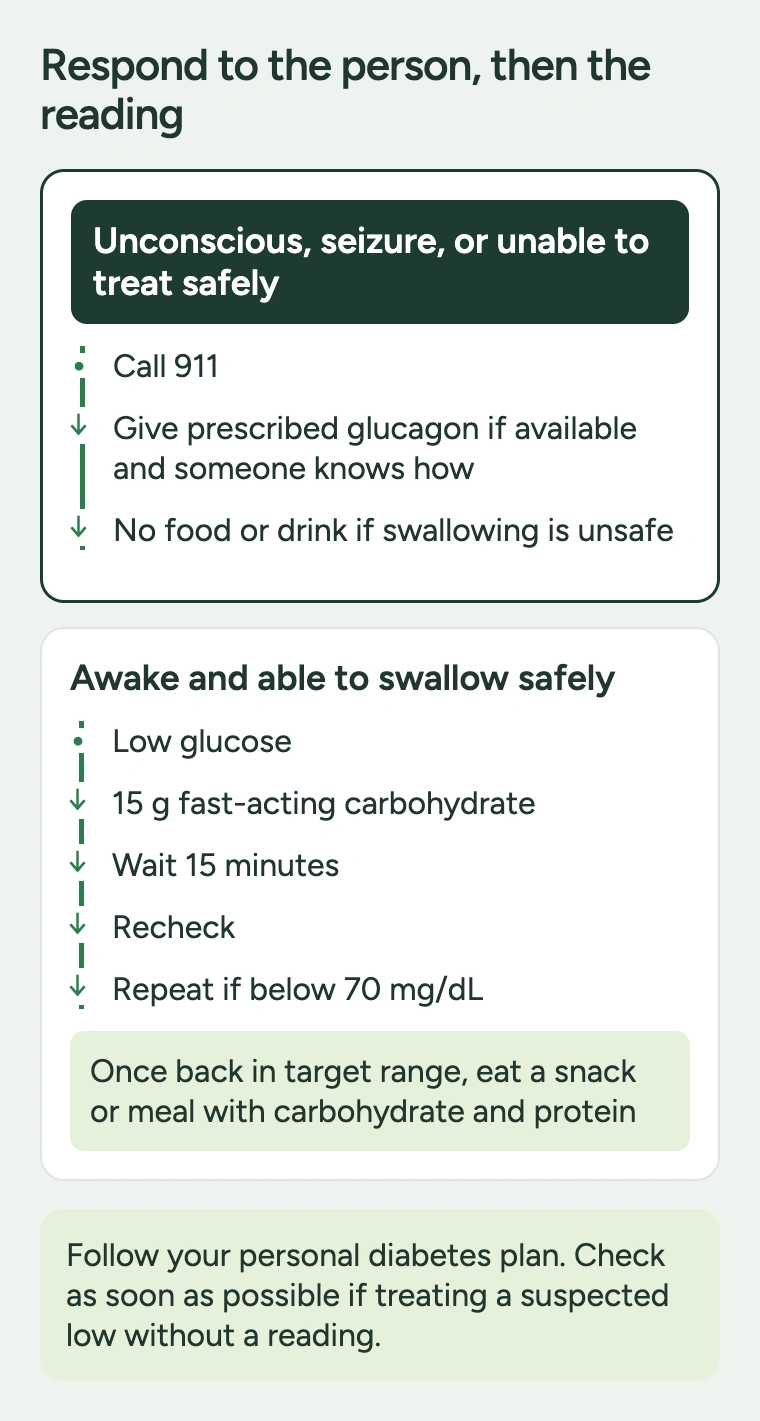
Oral treatment is for someone who can swallow safely. A person who cannot treat themselves needs emergency help; do not wait for a glucose reading.
Why GLP-1 treatment has a different risk from insulin
Semaglutide, the ingredient in Ozempic and Wegovy, increases insulin release and reduces glucagon release in a glucose-dependent way. In plain language, its effect responds to the glucose level rather than pushing insulin release equally at every level. Tirzepatide, the GIP/GLP-1 medicine in Mounjaro and Zepbound, also has glucose-dependent effects on insulin and glucagon. This helps explain the lower risk when these medicines are used without other drugs that can cause lows. It does not make hypoglycemia impossible. Ozempic prescribing information, Mounjaro prescribing information
Injected insulin adds insulin directly. Sulfonylureas stimulate its release and can cause lows even when more insulin is not needed. The Ozempic and Mounjaro labels warn that combining treatment with insulin or an insulin secretagogue, such as a sulfonylurea, increases hypoglycemia risk, including severe events. A prescriber may need to reduce the other medicine’s dose. That is a reason for a planned medication review, not a formula for changing your own doses.
The context that changes your next step
| Your situation | What it means | Useful next step |
|---|---|---|
| GLP-1 treatment without insulin or an insulin-releasing medicine | Risk is usually lower, but a measured low still matters | Ask whether glucose checks are appropriate for you; do not dismiss a low because you do not have diabetes |
| Also using insulin or a sulfonylurea | The combination increases risk | Have a monitoring and low-treatment plan, including when to contact your prescriber |
| Eating much less, delaying meals, vomiting, or fasting while on glucose-lowering treatment | Less available carbohydrate can contribute to a low | Check as directed and contact your diabetes team for an eating/illness plan and medication review |
| Dizziness or fatigue with no glucose reading | A symptom alone cannot identify hypoglycemia | Check promptly if possible; use the suspected-low guidance below if you cannot check |
| A low reading even though you feel fine | Some people do not notice warning symptoms | Treat according to your plan rather than waiting to feel worse |
NIDDK identifies missed meals, insufficient carbohydrate, illness, extra activity, and alcohol without enough food as contributors to lows in people with diabetes. Reduced appetite therefore deserves attention, especially alongside insulin or insulin-releasing medicines. “You are just eating less” is not enough to rule out a real low. NIDDK: causes and prevention
The Wegovy label directs glucose monitoring before starting and during treatment in people with diabetes. Ask your care team how often to check with your exact prescription and other medicines. A routine designed for someone taking insulin may differ from one for a person using a weight-management medicine without diabetes. Wegovy prescribing information
What the trial numbers actually describe
The Zepbound label offers a useful example. In its 72-week Study 2, which enrolled 938 adults with type 2 diabetes and BMI of at least 27, glucose below 54 mg/dL was reported in 4.2% of Zepbound-treated participants versus 1.3% with placebo. Insulin users were excluded from this trial.
Among Zepbound-treated participants, the reported proportion was 10.3% in those taking a sulfonylurea versus 2.1% in those not taking one. These are percentages of the respective treatment subgroups, not percentages of all GLP-1 users or the risk after each injection.
In the separate Zepbound trial without type 2 diabetes, glucose below 54 mg/dL was reported in 0.3% with Zepbound and none with placebo—but hypoglycemia was not systematically captured. That limits what the number can tell us. It cannot establish a universal rate for people without diabetes. Zepbound prescribing information, sections 5.7, 6.1, and 14.1
These figures use a lower threshold than the usual below-70 action point. They are not a count of every reading that would call for treatment at home, and they should not be transferred to another medicine or population.
Feeling low is a reason to check, not a diagnosis
Shaking, sweating, hunger, a fast heartbeat, dizziness, and weakness can accompany hypoglycemia. Some people have few or no warning symptoms. Others feel low-glucose symptoms while their reading is still above 70 mg/dL, particularly when previously high glucose falls quickly. The sensation and the measurement answer different questions. ADA symptoms guidance
If you have symptoms of a suspected low and cannot check, ADA advises treating the suspected hypoglycemia, then checking as soon as possible. Use fast-acting carbohydrate only if you are alert and can swallow safely; use the emergency route above if you cannot. This matters especially when insulin or a sulfonylurea makes a low plausible. Do not delay treatment to assemble a perfect record.
If glucose is in your target range but dizziness or fatigue continues, do not keep assuming that sugar is the answer. Contact your care team to assess the symptoms. For the broader symptom questions, see Mounjaro dizziness and tirzepatide fatigue.
After a low, review what needs to change
Once you are safe, tell the clinician managing your treatment about the episode—particularly if it was below 54 mg/dL, required assistance, or has happened repeatedly. Bring the actual readings and times, what you took to treat it, your medication list, and whether meals, activity, alcohol, or illness had changed. Do not change medicines on your own to prevent the next event. CDC follow-up guidance
Before the next episode, settle three practical questions with your care team: when to check, what to carry for a low, and whether you need prescribed glucagon with someone nearby trained to give it. A lower-risk medicine can still be part of a higher-risk combination. Knowing your own combination is what makes the general advice usable.

About the author
Maya Lee
Glowise Senior GLP-1 Content Editor
Maya Lee is a Glowise Health Content Editor. Her guides turn product records, authoritative sources, and everyday organization questions into clear, practical GLP-1 information.
She helps readers ask better questions and keep the details relevant to a care conversation together.
See more Glowise on Google
Add Glowise as a preferred source to find our GLP-1 guides more easily in Google Search.