
Qualifying for a GLP-1-based weight-management medicine has three different parts: a product's approved use may fit your situation, a prescriber must decide whether that medicine is appropriate for you, and your insurance plan must separately decide whether and how it will pay. A “yes” at one step is not a promise at the next.
For U.S. adults considering medication specifically for weight management, a BMI of 30 or higher—or 27 or higher with a weight-related health problem—is a starting point for discussing prescription weight-management medication. Those numbers do not by themselves establish a diagnosis, make a particular drug safe for you, or secure insurance coverage. Here is how to check each question without mistaking a coverage rule for a medical one.
First, name the treatment goal and the exact product
“GLP-1” is a convenient shorthand, not one prescription. Wegovy contains semaglutide. Zepbound contains tirzepatide, which acts at both GIP and GLP-1 receptors. Their U.S. labels describe weight reduction and long-term maintenance in adults with obesity, or adults with overweight and at least one weight-related condition, alongside a reduced-calorie diet and increased physical activity. The current Wegovy prescribing information also distinguishes its injection from its tablet and lists additional indications with their own populations. Zepbound's prescribing information likewise includes a separate indication for moderate to severe obstructive sleep apnea in adults with obesity. These U.S. labels were accessed October 7, 2026; Wegovy was revised June 2026 and Zepbound August 2026. The BMI discussion below concerns adults seeking weight-management treatment, not every indication or Wegovy's pediatric injection indication.
The brand and reason for treatment matter. Ozempic and Mounjaro are different branded products with diabetes indications; sharing an ingredient with a weight-management product does not make their labels interchangeable. Ask which exact product and indication a clinician is considering before trying to interpret a generic “GLP-1 eligibility” checklist.
What does the BMI threshold tell you?
The National Institute of Diabetes and Digestive and Kidney Diseases says a health professional may prescribe a weight-management medicine to an adult with a BMI of 30 or greater, or a BMI of 27 or greater and a weight-related health problem such as high blood pressure or type 2 diabetes. BMI uses height and weight; it is a screening measure, not a full account of someone's health. The professional assesses individual risk and whether medication belongs in the treatment plan.
Consider two adults who both have a BMI of 28. One has documented high blood pressure; the other does not have a known weight-related condition. The first fits the usual BMI-plus-condition screening pattern for a weight-management discussion. That still does not settle which medicine, if any, is appropriate. For the second, the next useful step is an honest assessment of health history and treatment options, not searching for a condition to “qualify.”
A BMI below the common adult threshold does not mean you should conceal a concern or avoid care. It means the familiar weight-management criteria cannot simply be assumed to fit. Other diagnoses and product indications answer different clinical questions. The clinician should identify the goal before deciding what evaluation is appropriate.
The medical evaluation is more than a number
A prescriber needs to weigh the proposed benefit against risks and practical fit. Bring your medical history, current conditions, medication and supplement list, and any previous experiences with weight-management care. A clinician may confirm measurements, discuss weight-related conditions, review relevant records, and decide whether tests would change care. There is no universal lab panel that automatically “qualifies” everyone for a GLP-1 prescription.
Some information is particularly important before discussing Wegovy or Zepbound. Both labels contraindicate use with a personal or family history of medullary thyroid carcinoma or multiple endocrine neoplasia syndrome type 2 (MEN 2). Wegovy also contraindicates use with known hypersensitivity to semaglutide or any ingredient in its injection or tablets; Zepbound contraindicates use with known serious hypersensitivity to tirzepatide or any ingredient in Zepbound. Tell the prescriber about past reactions and your full medical history rather than trying to make a yes-or-no decision from BMI alone. Each product has further warnings and precautions; read the Wegovy or Zepbound information for the product actually under consideration.
If pregnancy is possible or planned, raise that before treatment begins. For weight reduction, the Wegovy label says to discontinue when pregnancy is recognized and at least two months before a planned pregnancy. The Zepbound label says weight loss is not recommended during pregnancy and to discontinue Zepbound when pregnancy is recognized. Do not wait for a routine follow-up to clarify an unexpected pregnancy or a pregnancy plan with the prescribing team. Also mention diabetes medicines such as insulin or a sulfonylurea, because combining treatments can change low-blood-sugar risk. These details matter even when BMI seems to fit.
Insurance approval is a separate question
An insurer does not make the clinical decision to prescribe. It applies the rules of a particular health plan. A drug might be on a plan's formulary—its list of covered prescription drugs—yet still require prior authorization, which HealthCare.gov defines as plan approval that may be needed before a prescription is covered. A plan may also exclude weight-management drugs or apply other criteria. Rules can differ by product, indication, plan, and benefit year. A prescription alone does not establish the final out-of-pocket cost.
| Question | Who can answer it | What to verify |
|---|---|---|
| Does the product's approved use fit the proposed goal? | Prescriber, using the exact U.S. label | Product, form, indication, age group, weight-related conditions |
| Is it appropriate for me? | Prescriber with your full history | Contraindications, warnings, other medicines, alternatives, follow-up |
| Will my plan pay? | Insurer or pharmacy-benefit manager, with the prescribing office | Formulary status, indication-specific criteria, prior authorization, pharmacy, cost |
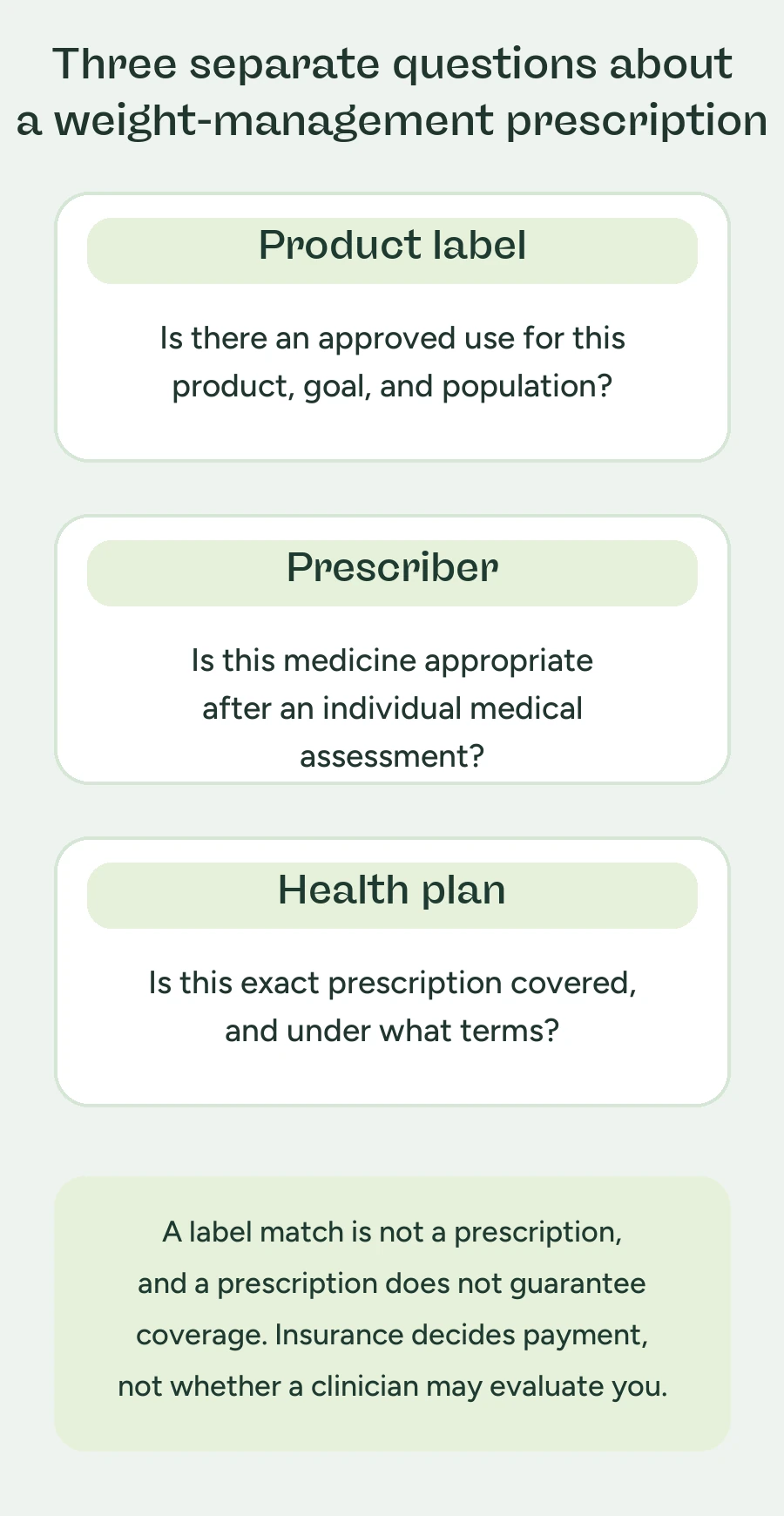
For coverage, ask the number on your insurance card about the exact brand and form, not just “GLP-1s.” Ask whether your current plan covers it for the proposed diagnosis, whether prior authorization or another requirement applies, what records the prescriber must submit, and what your estimated cost would be at an in-network pharmacy. Keep the answer, date, and reference number. Then share the plan's requirements with the prescribing office; do not assume the office can see every detail of your benefit.
A plan rule asking for documented prior treatment attempts is not automatically a condition in the FDA label. Conversely, meeting a label's weight-management population does not force a plan to cover the drug. If a request is denied, ask for the reason in writing and whether missing information, a different covered option, or an appeal is relevant. HealthCare.gov's appeals guide describes internal appeals and external review for covered health-plan decisions; the process and deadlines depend on the plan and decision. A denial is a coverage outcome, not a medical diagnosis.
A short preparation list for the first conversation
You do not need a polished “application.” Bring accurate information that helps the clinician and, if a prescription is written, helps the office address a plan's actual requirements:
- Your treatment goal and what you hope would change. Include the specific product if you have one in mind, while staying open to the clinician's assessment.
- Recent height and weight measurements, plus any documented weight-related conditions and the professionals treating them. Do not guess at diagnoses from a home reading.
- Your medical history, pregnancy plans where relevant, and a current list of prescription medicines, over-the-counter medicines, and supplements.
- What approaches you have tried, for how long, and what made them workable or difficult. This is context for care; it is not proof of a universal “failed lifestyle” prerequisite.
- Your plan's current formulary and prior-authorization answer for the exact product, if you have insurance. Bring the plan's wording rather than relying on an online generalization.
A useful opening is: “I would like an evaluation for weight-management treatment. Does my health history fit any approved option, and what would we need to check before deciding?” If insurance is the barrier, make that a second question: “What does my plan require for the product you recommend?” The distinction can spare you from preparing for the wrong gate.
If treatment is prescribed, our guide to starting GLP-1 covers the narrower task of checking the actual prescription and preparing for the first weeks. For the evidence behind treatment effects and limits, see Does GLP-1 Work?. Neither article nor a tracking app can determine medical eligibility or coverage for you.
Frequently asked questions
Is a BMI of 30 an automatic prescription?
No. It is a common adult screening threshold for considering weight-management medication. A prescriber still evaluates the treatment goal, full history, safety, and options; an insurer makes a separate coverage decision.
Do I have to prove that diet and exercise “failed” first?
There is no single proof requirement that applies to every person and product. Weight-management labels describe treatment alongside diet and physical activity. Some health plans may ask for records of earlier care as part of prior authorization. Ask the plan for its current written criteria rather than treating a coverage condition as a universal medical rule.
Can I qualify medically and still be denied coverage?
Yes. A plan may exclude a product or deny a prior-authorization request under its rules. Request the exact reason and review the plan's correction or appeal route with the prescribing office. Do not change the diagnosis or leave out health information to meet a coverage criterion.
Is Ozempic the same eligibility question as Wegovy?
No. They contain semaglutide but are different branded products with different labeled uses. Ask about the exact product and the reason it would be prescribed; do the same with Mounjaro and Zepbound, which contain tirzepatide.
Sources

About the author
Maya Lee
Glowise Senior GLP-1 Content Editor
Maya Lee is a Glowise Health Content Editor. Her guides turn product records, authoritative sources, and everyday organization questions into clear, practical GLP-1 information.
She helps readers ask better questions and keep the details relevant to a care conversation together.
See more Glowise on Google
Add Glowise as a preferred source to find our GLP-1 guides more easily in Google Search.