
Food noise is a name for food thoughts that keep returning, feel unwanted, and take more of your attention than you want to give them. GLP-1 treatment can reduce some food-related thoughts and cravings, but complete mental silence is not a requirement for treatment to be helping. Thinking about lunch, wanting a favorite dessert, and feeling physically hungry can still be part of your day.
The useful distinction is how the thoughts behave: can you make a food decision and move on, or does the same conversation keep pulling you back? That difference helps you respond to the experience without treating every thought about eating as a problem.
What people mean by food noise
You might finish a meal, return to work, and repeatedly find yourself considering what else to eat. Or you might spend a large part of an afternoon negotiating whether you are allowed a snack, then replay the decision afterward. These are examples of the attention burden people are trying to describe.
Researchers are working to define and measure that burden. A 2025 expert-panel paper distinguishes persistent, unwanted or distressing food thoughts from ordinary food planning. It is a developing research concept, not a diagnosis you can establish by counting how many times you opened the refrigerator.
Enjoying food is not itself food noise. Neither is planning dinner because you need groceries. The concern is the repetition, distress, or interference with the rest of your life.
Hunger, cravings, and emotional triggers can overlap
These words describe different parts of an experience. An emotional trigger describes what happened around an urge; hunger and craving describe what you feel; food noise describes the repeated mental attention. You can experience several together.
| Experience | An everyday example | A useful question |
|---|---|---|
| Physical hunger | Several hours after lunch, you notice an empty feeling and want something to eat. | Have I eaten enough, and is it time for a meal or snack? |
| A craving | After seeing a bakery display, you want a particular pastry. | Is there a specific food or sensory experience I want? |
| An emotional trigger | After a tense call, you start looking for something comforting to eat. | What feeling needs attention, alongside any hunger? |
| Food noise | You keep reopening the snack debate while trying to read, even after making a decision. | How much attention is this taking, and how distressing is it? |
These are clues, not a diagnostic test. Hunger does not always arrive as a growling stomach, and wanting one particular food does not rule it out. Feeling stressed also does not cancel a need to eat. You do not have to classify an urge perfectly before you are allowed to respond to it.
Consider an afternoon when lunch was rushed and a difficult meeting ended just as someone brought in cookies. You could be hungry, want a cookie, and want relief from the meeting. Labeling the whole experience “food noise” can hide those separate needs. Eating something and taking a break may both make sense.
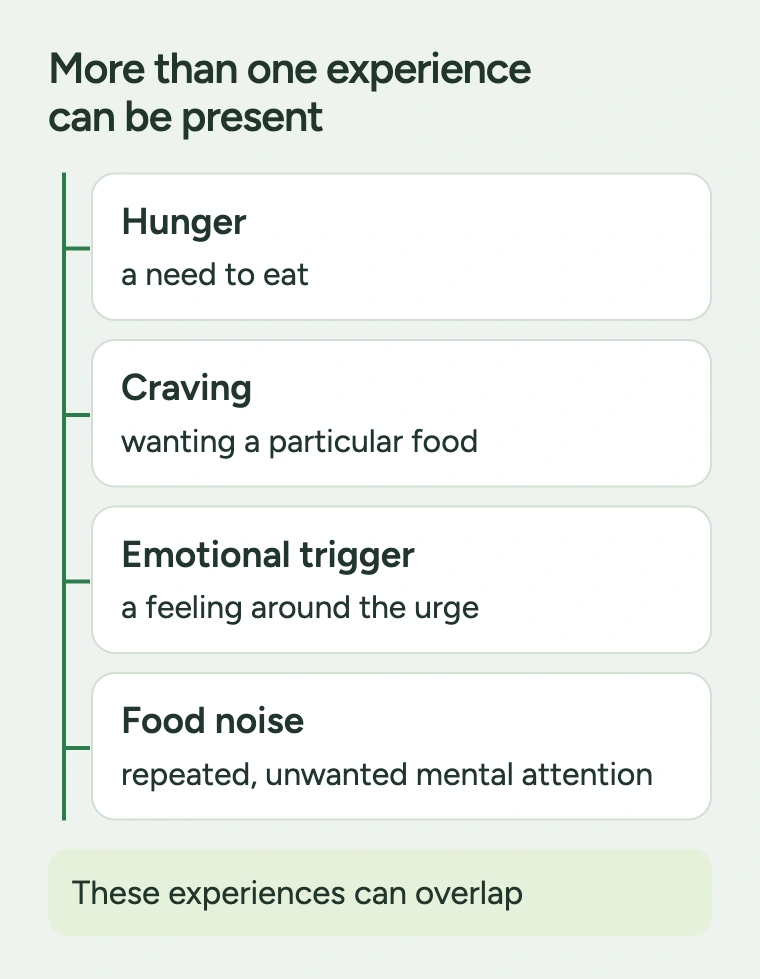
You can be hungry, want a particular food, and need emotional support in the same moment.
What GLP-1 studies actually show
Semaglutide acts on GLP-1 receptors involved in appetite regulation. Its US prescribing information describes reduced calorie intake, likely through effects on appetite. That mechanism helps explain why eating and food thoughts may feel different during treatment, but it does not promise to remove every craving or emotional association with food.
The research is more useful when you separate what each study measured.
Controlled trials support changes in appetite and eating control
In a 20-week randomized trial involving 72 adults with obesity, injectable semaglutide reduced hunger and food cravings and improved control of eating compared with placebo. These are related to food noise, but they are not all the same outcome as persistent, unwanted food thoughts.
A 2026 randomized trial of 120 adults with overweight or obesity followed injectable semaglutide or placebo for 60 weeks. Food preoccupation improved more with semaglutide at week 20. By weeks 40 and 60, the between-group differences in that measure were smaller and no longer statistically significant, while lower energy intake at a measured lunch remained evident. This does not prove everyone’s thoughts return; it shows that subjective food thoughts and measured eating can follow different courses.
A food-noise survey captures reported relief, with important limits
The 2026 INFORM survey asked 550 US adults using injectable semaglutide for weight management about their current experience and their recollection of life before treatment. Constant thoughts about food were recalled by 62% before treatment and reported by 16% at the survey.
That is a substantial reported change, but the study had no randomized comparison group and depended on memory for the earlier experience. Novo Nordisk funded it. The results describe perceived relief among respondents; they cannot establish the size of a causal treatment effect or predict your experience.
Together, these findings support taking reports of quieter food thoughts seriously. They do not establish a deadline for relief, a requirement that thoughts disappear, or an identical effect across every GLP-1 medicine. In particular, these semaglutide findings should not be presented as tirzepatide results.
How to respond when the thoughts keep coming
Start with the need you can identify, rather than an effort to suppress the thought itself.
Make room for eating. If you missed lunch or ate very little, arrange food rather than using distraction as a test of willpower. An easy meal or snack that fits your care plan is more useful than proving you can ignore hunger. A quieter appetite also does not remove your need for nourishment.
Give a specific craving a specific decision. “I want something sweet” does not have to become a debate about the entire day. You might choose to have the food and enjoy it, or decide when you would like it. The point is to make a workable decision, without assigning a moral score to the craving.
Respond to the emotion as well. After a difficult conversation, ask whether you need a pause, support, or a change of scene. Calling someone or stepping away from your desk can address that part of the experience. These options can sit alongside eating; they do not require you to prove that your hunger is only emotional.
Reduce an obvious interruption. If food videos repeatedly pull you away from another task, close the feed or mute the account for a while. Treat this as an experiment in protecting your attention, not a proven cure for food noise or a rule that food must disappear from your surroundings.
These are practical ways to respond to a moment. They have not been established as a guaranteed treatment for food noise, and ongoing thoughts do not mean you failed to use them correctly.
When the experience deserves more support
Bring up food thoughts if they regularly interrupt work, sleep, relationships, or enjoyment of meals. Be concrete: “I spend much of the evening debating food, and I cannot concentrate on what I want to do” communicates more than “my food noise is bad.” One example may be enough; you do not need to document every urge.
Tell a healthcare professional about episodes of losing control over eating, severe restriction, or vomiting or laxative use to compensate for eating. These can be signs of an eating disorder and deserve assessment, at any body size, rather than being folded into the label “food noise.” The National Institute of Mental Health explains these patterns and why treatment matters. A registered dietitian or mental health professional with eating-disorder expertise may be part of that support.
If reduced appetite or nausea makes it difficult to eat adequately, raise that with your treatment team too. The aim is enough nourishment and a more manageable relationship with food. Do not change your medication dose or schedule in pursuit of a completely thought-free day.
You can value the relief treatment brings while still wanting help with the thoughts that remain. A useful goal is being able to eat, make decisions, and return your attention to your life.

About the author
Maya Lee
Glowise Senior GLP-1 Content Editor
Maya Lee is a Glowise Health Content Editor. Her guides turn product records, authoritative sources, and everyday organization questions into clear, practical GLP-1 information.
She helps readers ask better questions and keep the details relevant to a care conversation together.
See more Glowise on Google
Add Glowise as a preferred source to find our GLP-1 guides more easily in Google Search.